
Multi-account copy trading lets one leader account mirror trades to many follower accounts in real time. For prop-firm-safe scaling, the right technical approach is a fail-closed, WebSocket or direct-API copier with per-account sizing and independent risk enforcement, tested in paper accounts before any live capital moves.
TL;DR:
- Reliable multi-account copy trading requires direct-API or WebSocket connections with documented low latency and fail-closed defaults to prevent duplicate trades if connectivity is lost.
- Each follower account must have independent risk controls, including daily loss limits and auto-flatten triggers, to prevent a single breach from affecting the entire portfolio.
- Proper setup involves verifying broker compatibility, configuring per-follower parameters, testing in paper mode, and monitoring for at least a week before scaling up live capital.
- Comparing platforms demands checking technical reliability, risk enforcement, operational flexibility, compliance support, and pricing, not just marketing claims.
- Sonic AI offers a managed, verified gold-trading auto-copy service with proven performance and minimal setup, suitable for those seeking exposure without managing technical details.
Table of Contents
- What Makes a Multi-Account Copy Trading Setup Reliable?
- How Do You Set Up Copy Trading Across Multiple Accounts?
- Why Per-Account Risk Enforcement Protects Your Funded Accounts
- How Should You Compare Multi-Account Copy Trading Platforms?
- Sonic AI: A Verified Gold-Focused Managed Alternative
- What Experienced Multi-Account Operators Get Right
- Try Sonic AI's Gold Auto-Copy Strategy
- Where to Verify Copy Trading Rules and Compliance
- Sources
- FAQ
What Makes a Multi-Account Copy Trading Setup Reliable?
A copier that works for ten funded accounts but breaks on the eleventh isn't a tool worth trusting. The gap between a hobbyist copier and one built for prop-firm operators comes down to five features, and most vendor pages gloss over at least two of them.
Cross-broker copying with per-follower multipliers matters most once you're running accounts across different firms. A leader trading full-size contracts needs to convert automatically for followers on micro or mini contracts, so an ES position becomes MES, and NQ becomes MNQ, without you doing math mid-trade.
Architecture is the next filter. Systems built on direct-API or WebSocket connections route orders in roughly 5 to 10 milliseconds, compared to polling-based tools that check for new trades every few seconds and can lag behind fast gold or index moves. That gap sounds trivial until slippage eats your edge on a scalping strategy.
Per-account risk controls need to run independently of each other:
- Daily loss limits that halt only the account that hit them, not the whole group
- Max-drawdown enforcement tied to each firm's specific rules
- Auto-flatten and account lock when a threshold breaches
- Duplicate protection and a reject quarantine for orders that fail validation
- Automated journaling that timestamps every fill for later audit
Fail-closed defaults deserve special attention. If the connection drops, the system should stop copying rather than guess, and alerting should tell you immediately, not after your account manager emails you.
Pro Tip: Ask any platform directly how it handles a dropped WebSocket connection mid-trade. If the answer involves "it retries automatically," push for detail. Retries without idempotent order logic are how duplicate fills happen.
How Do You Set Up Copy Trading Across Multiple Accounts?
Connecting a leader account to several followers is mechanical work, but the order matters. Skip a step and you'll find out the hard way, usually on a losing trade.
- Confirm broker and platform compatibility first. Direct-API integrations are worth the extra setup time over polling or screen-scraping tools, which introduce delay and occasional missed fills.
- Build your copy group. Add each follower account individually rather than in bulk, so you can verify the connection status one at a time.
- Set per-follower multipliers and symbol mappings. This is where contract conversion lives. A 1.0 multiplier on a full-size account might need to be 0.1 on a micro account, and the mapping should be explicit, not assumed.
- Configure risk profiles before you flip copying on. Daily loss caps, max drawdown, and a maximum trade count all need to be set per account, matching each firm's own copy trading parameters, not a generic default.
- Test in paper mode first. Run the leader's strategy against paper followers for at least a few sessions and confirm mapping accuracy and latency before committing real money.
- Scale with small real size, then monitor daily. Watch fills, execution latency, error logs, and the audit trail every day for the first week. Problems that show up under real market stress rarely show up in testing.
Pro Tip: Run your daily loss limit test on a Friday afternoon session with light volume. If your auto-flatten logic works cleanly when nothing's happening, you'll trust it more when everything is.
Why Per-Account Risk Enforcement Protects Your Funded Accounts
The single biggest mistake in multi-account copying is treating risk as a group-level setting instead of an account-level one. When one account breaches a daily loss limit and the system halts every account tied to the leader, you've turned a single-account problem into a portfolio-wide one.
Independent enforcement isolates that failure. Each account carries its own daily loss cap, its own max-drawdown threshold, and its own auto-flatten trigger, so a breach on Account 4 has zero effect on Account 9.
This matters even more for prop-firm evaluations, where consistency rules are often stricter than raw drawdown limits. A well-built copier applies firm-specific presets and runs a consistency calculator behind the scenes, so a trade that's fine for one firm's rules doesn't accidentally violate another's.
Key mechanics to look for:
- Distance-to-drawdown monitoring that updates in real time, not on a delay
- Auto-lock behavior that fires the instant a threshold is crossed, not after manual review
- Symbol mapping validated against each firm's contract specifications
- A real-time profit-and-loss feed tied to an audit trail, useful if you ever need to appeal a flagged trade
Independent risk controls including daily loss limits, profit caps, and drawdown monitoring are the baseline that separates a copier built for serious multi-account operators from one built for casual use.
How Should You Compare Multi-Account Copy Trading Platforms?
Vendor marketing pages tend to sound identical. The differences show up in five practical categories, and most of them require a demo account or a direct conversation to verify, not a features page.
- Technical reliability: direct-API or WebSocket connectivity, documented latency figures, and confirmed duplicate-order protection
- Risk enforcement: per-account daily loss and drawdown limits, auto-flatten behavior, and a reject quarantine with a visible journal
- Operational flexibility: per-follower sizing, symbol mapping across contract types, and whether follower counts are capped by pricing tier
- Compliance support: prop-firm rule presets and exportable documentation for audits or evaluation appeals
- Commercial terms: pricing structure, trial availability, support responsiveness, and how much work migration takes if you switch later
| Criteria | What to check |
|---|---|
| Technical | API/WebSocket architecture, published latency data |
| Risk | Per-account enforcement, fail-closed defaults |
| Operational | Symbol mapping accuracy, follower limits |
| Compliance | Firm-specific rule presets available |
| Commercial | Trial period, pricing model, support quality |
Sonic AI: A Verified Gold-Focused Managed Alternative
Not every trader wants to build and monitor a multi-account copy setup themselves. Sonic AI runs a managed auto-trading strategy focused exclusively on gold, XAUUSD(https://sonicaigold.com/xauusd-copy-trading), with trade copying handled automatically through the COPYX execution system.
The strategy reports a high win rate and many consecutive winning months, with independently verified performance tracking.
That combination suits a specific reader: someone who wants gold-market exposure without watching charts all day, and who values a track record they can check themselves rather than take on faith.
- Managed, algorithm-driven strategy exclusive to XAUUSD
- Automatic copying through COPYX with no manual execution required
- Independently verified results spanning 18+ months
- Setup guides available for beginner gold auto-copy investors
Before connecting a funded account, review the performance record and confirm your broker supports the connection method Sonic AI uses.
What Experienced Multi-Account Operators Get Right
Most losses in multi-account copying trace back to shortcuts, not bad strategies. Operators who scale successfully avoid polling-based tools entirely and insist on direct-API or WebSocket connections, because the latency difference compounds across dozens of trades a week.
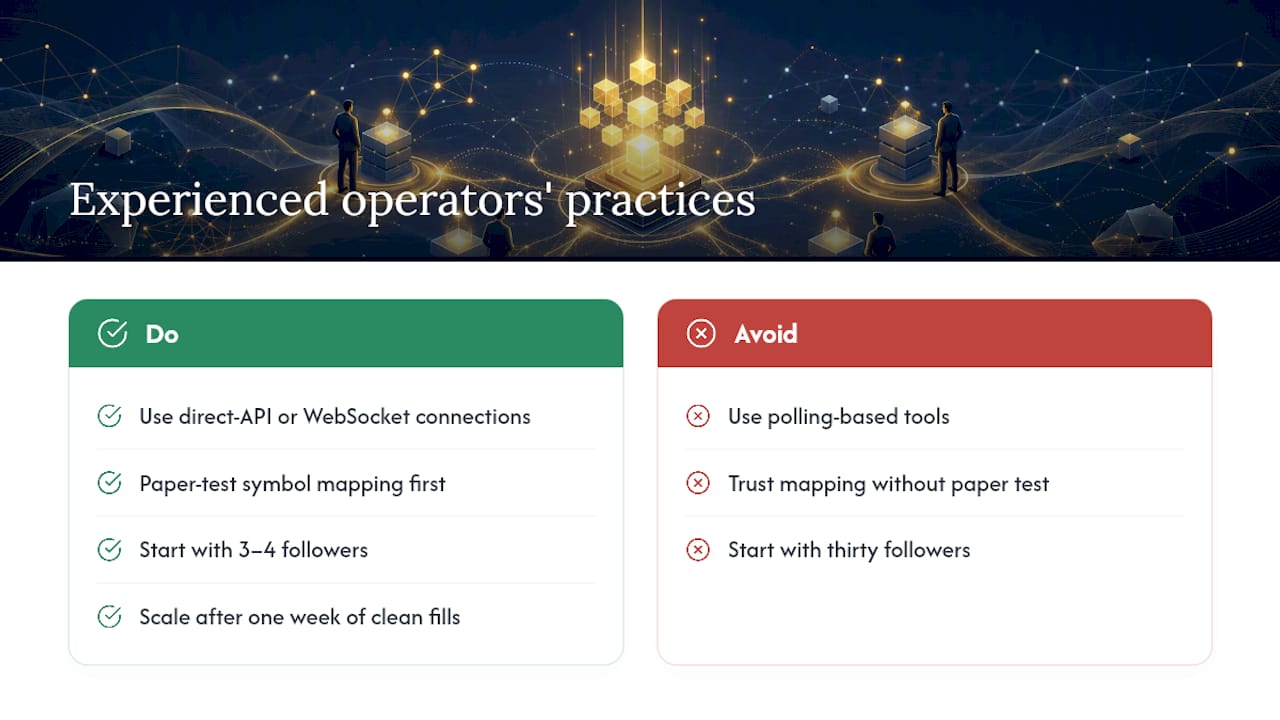
They also never trust a symbol mapping until they've watched it execute correctly in a paper account first. ES to MES conversions look simple on paper and still produce rounding errors that breach a firm's rules in practice.
The pattern that separates careful operators from reckless ones: start with three or four followers, not thirty, and add more only after a week of clean fills and matching audit logs.
— Paulo
Try Sonic AI's Gold Auto-Copy Strategy
Sonic AI gives you a different route to gold exposure than building your own multi-account copier from scratch. Instead of managing symbol mappings, risk profiles, and monitoring dashboards yourself. You connect to an already-managed strategy with a documented, independently verified track record spanning 18 months.

Start by reviewing the Myfxbook performance results to see the verified win rate and drawdown history for yourself. From there, confirm your broker supports the COPYX connection method, and consider testing with a smaller allocation before scaling up. If you operate a prop-firm account, check that firm's automation and copy trading rules before connecting live capital. The gold copy trading product page walks through setup requirements and current allocation options.
Where to Verify Copy Trading Rules and Compliance
U.S. traders should confirm platform registration through CFTC guidance and review NFA investor advisories before connecting funded accounts. For a deeper look at U.S. legality specifics, see Is Copy Trading Legal in the U.S.?
This article is general information, not a substitute for advice from a qualified financial advisor. Consult a qualified financial professional about your own circumstances before acting on anything here.
Sources
- CFTC digital assets and guidance
- NFA investor advisory
- CMC Markets — What is copy trading?
- TradingView — What is copy trading? (beginner guide)
FAQ
Is Copy Trading Illegal in the US?
Copy trading itself is legal in the U.S. when conducted through properly registered brokers and platforms. Always verify registration status before connecting a funded account.
Is Copy Trading Really Profitable?
Copy trading can be profitable, but it's not guaranteed. It depends entirely on the leader strategy's track record, your risk settings, and diversification across providers rather than relying on a single source.
Can You Make $1,000 a Day With Day Trading?
Daily results vary enormously by account size, strategy, and market conditions, and no legitimate platform can guarantee a fixed daily dollar amount. Verified track records, like Sonic AI's 18-month independently confirmed performance history, give you a more honest reference point than a hypothetical daily target.
How Much Do Day Traders With $10,000 Accounts Make Per Day?
There's no reliable average figure, because outcomes depend heavily on strategy, leverage, and market volatility. A beginner-focused explainer on copy trading is a better starting point than chasing an average that doesn't reflect your actual risk settings.
What's the Difference Between Copy Trading and Social Trading?
Copy trading automates mirroring another trader's positions directly, while social trading typically involves following signals or discussions without automatic execution. The distinction matters for anyone deciding how hands-on they want their trading to be.