
A risk multiplier scales a signal provider's trade before it lands in your account, using a lot, notional, or balance-based formula, and the chief danger is a jump in effective leverage that can trigger liquidation faster than the trade you copied. The single control that fixes most of that danger before it happens: set your allocation, cap your maximum copy lot, and run one minimum-size test trade before you scale up.
TL;DR:
- Using a flat ratio or lot multiplier can significantly increase effective leverage, risking rapid liquidation on smaller accounts during volatile moves.
- Effective leverage doubles roughly with each doubling of the multiplier, making small mistakes in sizing potentially catastrophic for account safety.
- Automated safeguards like maximum copy lot, allocation limits, and copy stop-loss are essential to prevent a single bad signal from wiping out your capital.
- Testing your trade size, verifying fills, and monitoring margin ratios before scaling up are critical steps to avoid unexpected losses.
- Applying proportional to equity or balance modes with predefined risk thresholds helps maintain consistent risk exposure despite market volatility.
Table of Contents
- What Is a Risk Multiplier in Copy Trading?
- How Multipliers Change Effective Leverage and Liquidation Risk
- Formulas for Calculating Follower Size and Expected Loss
- Platform Safety Controls Every Follower Should Configure
- How to Pick the Right Multiplier for Your Risk Profile
- Testing and Verification Before You Scale Allocation
- Sonic AI's Approach to Safe Multiplier Defaults
- Does a Risk Multiplier Hurt Portfolio Diversification?
- How Multipliers Behave in Calm Versus Volatile Markets
- Comparing Multiplier Effects Across Forex, Stocks, and Crypto
- Why Followers Struggle to Stick With a Multiplier Setting
- What Historical Multiplier Settings Reveal About Risk and Reward
- Why I'd Rather Under-Size Than Chase a Bigger Multiplier
- Start With a Verified Track Record and a Small Test Allocation
- Sources
What Is a Risk Multiplier in Copy Trading?
A risk multiplier is the setting that tells a copy-trading platform how to convert a master trader's position into your position. It is not a single number with one meaning. Depending on the platform, "multiplier" might scale lots directly, scale notional value, or scale a percentage of your balance or equity. Each mode produces a different follower order size from the exact same master trade, which is why two people copying the same signal provider at the "same" multiplier can end up with wildly different risk.
Platforms typically offer five sizing modes, and the position sizing formula runs the instant the trade is copied, locking in that size for the life of the trade.
- Proportional to Equity × Ratio. Your order size scales with your live account equity, multiplied by a ratio you set. This is the most common default because it self-adjusts as your balance moves.
- Proportional to Balance × Ratio. Similar to equity mode, but it uses your account balance (deposits and realized profit) instead of live equity, so open floating losses don't shrink your next trade size.
- Ratio multiplier. A straight multiplier applied to the master's lot or notional size, with no reference to your account size at all.
- Fixed lot. Every copied trade opens at the same lot size regardless of what the master trader did, useful for testing but blind to the master's own sizing logic.
- Fixed risk %. The platform calculates lot size from your stop-loss distance so every trade risks the same percentage of your account, regardless of the master's position size.
The failure mode shows up fastest with a plain ratio or lot multiplier. If a signal provider trades a $100,000 account and you're copying with $5,000, a "1x" lot multiplier can put a full-size position into an account 20 times smaller than the one it was designed for. Balance% and fixed-risk% modes exist specifically to prevent that mismatch, because they resize automatically to your own account rather than copying the master's absolute lot count.
One statistic worth internalizing: a copier support article documents that Multiplier (Notional) and Multiplier (Lot) diverge whenever contract sizes differ between master and follower instruments — meaning the same multiplier value can produce two different real-world exposures depending on which formula the platform applies underneath it.
How Multipliers Change Effective Leverage and Liquidation Risk
Effective leverage is position notional divided by account equity, and a multiplier changes the numerator without you touching the denominator. Double your multiplier and you roughly double your effective leverage on that trade, even though your account balance hasn't moved a cent. That's the mechanical core of risk multiplier copy trading: you're not changing how the market moves, you're changing how much of your account is exposed to that movement.
This is why identical entries can liquidate a follower before they touch the master account. A master trader running a well-capitalized account at low effective leverage can absorb a 3% adverse move without stress. A follower copying that same trade at 2x or 3x multiplier, on a smaller account with tighter margin, can hit maintenance margin on the exact same price move. Same entry, same exit, wildly different survival odds.
Three platform-specific edge cases widen that gap further:
| Edge case | Why it increases follower risk |
|---|---|
| Mark price vs. last price | Some platforms calculate margin and liquidation off a mark price that can diverge from the traded last price during volatile moves, triggering earlier liquidation than the raw chart suggests |
| Margin-mode mismatch | A master running cross margin and a follower running isolated margin (or vice versa) experience completely different drawdown tolerance on the same trade |
| Auto-deleveraging (ADL) | On leveraged futures, an exchange's ADL system can force-close a profitable opposing position during extreme volatility, distorting expected payout independent of your own stop-loss |
Futures-based copy trading embeds leverage into the position itself, which is a different risk profile than spot copying, and that distinction matters more with a multiplier attached, because the multiplier compounds whatever leverage the instrument already carries.
Pro Tip: Watch your margin ratio, not just your account balance. A balance that looks healthy can sit dangerously close to maintenance margin if your multiplier has pushed effective leverage higher than you realize. Check margin ratio and unrealized PnL against maintenance margin daily, not just after a losing trade.
Formulas for Calculating Follower Size and Expected Loss
The math behind risk multiplier copy trading isn't complicated, but skipping it is how accounts blow up. Two formulas cover almost every platform you'll encounter, and the exact structure comes from copier documentation on notional versus lot multipliers.
Lot Multiplier: Follower Lot Size = Master Lot Size × Multiplier
Notional Multiplier (adjusts for contract-size differences): Follower Notional = Master Notional × Multiplier × (Follower Contract Size ÷ Master Contract Size)
Balance% or Equity% mode: Follower Lot Size = (Follower Balance or Equity × Ratio) ÷ (Master Balance or Equity)
Two worked examples show how differently these formulas behave.
Example 1: mismatched account sizes. A master trades 1.0 lot on gold from a $100,000 account. A follower has $10,000.
- Under a straight 1x lot multiplier, the follower also opens 1.0 lot, a position sized for an account ten times larger than theirs.
- Under balance% mode at a 1:1 ratio, the follower's order size becomes 1.0 lot × ($10,000 ÷ $100,000) = 0.10 lot, proportionally matched to their own capital.
That single formula choice is the difference between a manageable trade and an account-ending one.
Example 2: multiplier with a contract-size adjustment. A master opens a position worth $50,000 notional using a contract size of 100 units.
Follower Notional = $50,000 × 2 × (10 ÷ 100) = $10,000
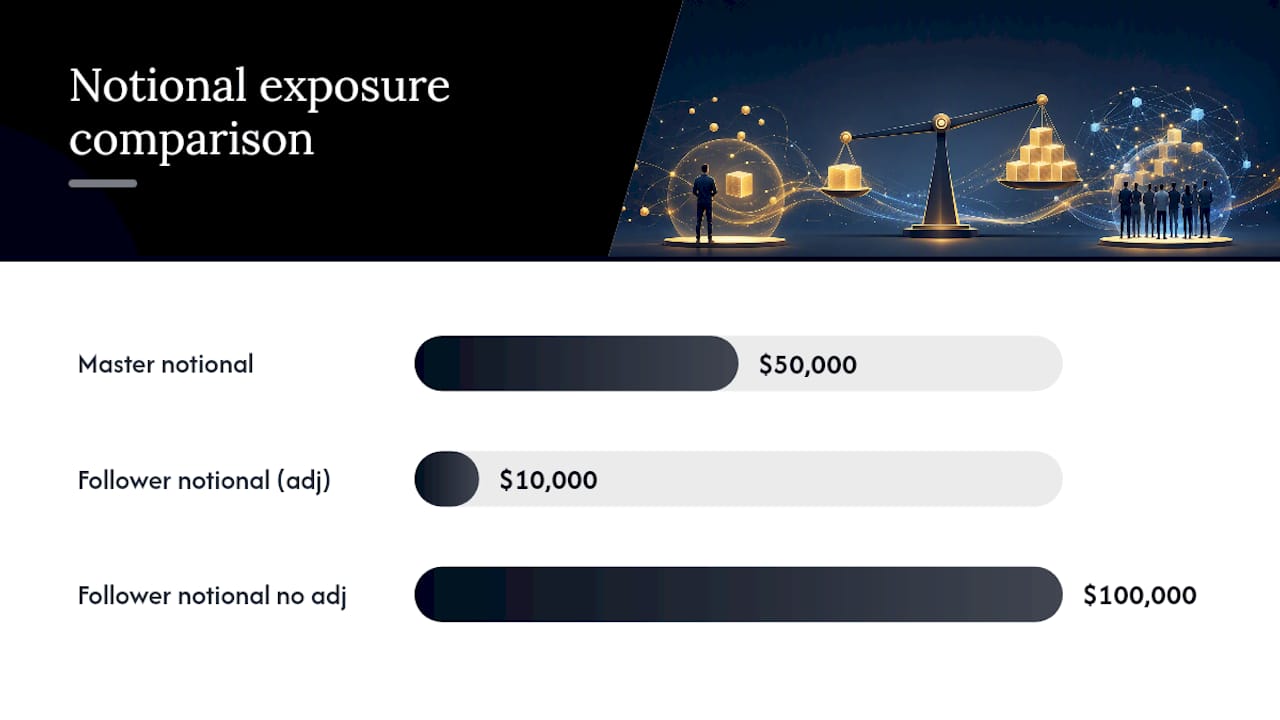
Without the contract-size adjustment baked into the notional formula, that same 2x multiplier could have produced $100,000 of exposure instead, a tenfold error hiding inside a setting that looked simple.
To translate any of this into expected dollar risk, use the stop-loss distance:
- Calculate the price distance between entry and stop-loss in the instrument's smallest unit (pips, points, or ticks).
- Multiply that distance by your contract's value per unit and by your lot size to get expected dollar loss if the stop is hit.
- Divide that dollar figure by your account equity to get percent risk per trade, the number that actually tells you whether a multiplier is safe for your account.
Platform Safety Controls Every Follower Should Configure
Sizing mode is half the risk equation. The other half is the platform's guardrails, and the controls that actually stop a single bad trader from wrecking an account are allocation limits, copy stop-loss, maximum copy lot, symbol filters, and a kill switch.
- Allocation amount. A widely cited guideline caps exposure to any single signal provider at 5% of total investable capital, so one underperforming trader can't sink the whole portfolio.
- Maximum copy lot. A hard ceiling on lot size per trade prevents a multiplier miscalculation, or a signal provider's sudden change in position sizing, from scaling into an oversized order.
- Daily loss limit. Pausing copying after a set daily drawdown percentage stops a bad session from compounding into a bad week.
- Copy stop-loss (CSL). Set your CSL near the signal provider's historical maximum drawdown plus a buffer, commonly an extra 20 to 30% beyond their worst documented pullback, since past performance doesn't cap future drawdown.
- Symbol filters and spot-vs-futures selection. Restricting which instruments get copied, and confirming whether you're copying spot or leveraged futures positions, closes one of the biggest unexamined risk gaps in copy trading.
- Slippage checks. Reviewing fill prices against the master's reported entry regularly catches execution drift before it erodes your edge.
Pro Tip: Set your copy stop-loss before your first trade copies, not after. Adjusting CSL retroactively does nothing for a position that's already open, since changes to sizing settings don't resize existing trades, only future ones.
How to Pick the Right Multiplier for Your Risk Profile
Choosing a multiplier is a sequence, not a guess. Work through it in this order:
- Define your copy budget. Decide the dollar amount you're willing to allocate to this specific signal provider, ideally no more than the 5% single-provider guideline referenced above.
- Pick your sizing mode. Balance% or equity% for most followers; fixed lot only for short test periods; fixed risk% when you want identical percentage exposure on every trade regardless of the master's position size.
- Compute implied risk per trade. Use the stop-loss formula from the previous section to see what percentage of your account is actually at stake before you commit real capital.
- Set your multiplier against a conservative, balanced, or aggressive baseline. A conservative follower might run 0.25x to 0.5x equity ratio, targeting under 1% risk per trade. A balanced follower might run 1x, targeting 1 to 2% risk per trade. An aggressive follower pushing 2x or higher should expect proportionally higher percentage risk per trade and drawdown swings.
- Anchor your CSL to the trader's historical max drawdown. If a signal provider's worst historical drawdown was 15%, a CSL slightly above the normal pullback gives you a buffer without cutting off a normal pullback.
- Favor fixed-risk% over ratio multipliers when the signal provider changes position sizing often. Ratio and lot multipliers copy the master's sizing decisions faithfully, which is exactly the problem when those decisions get erratic.
Testing and Verification Before You Scale Allocation
Never fund a multiplier decision with real risk before testing it. Run this sequence:
- Configure your sizing mode, multiplier, max copy lot, and CSL first, before any live capital touches the connection.
- Execute one minimum-lot test trade and confirm the fill matches your calculated expectation.
- Verify contract-size conversion and pip value math against the actual fill, not just the platform's preview number.
- Monitor margin ratio and realized slippage daily for the first two weeks.
- Scale allocation upward only after a defined threshold, for example after 20 to 30 copied trades with fills matching expectations within an acceptable tolerance.
- Check that fill price and reported slippage stay within a tolerance you set in advance.
- Confirm your maximum copy lot actually caps orders as configured, not just as documented.
- Set a stop condition (a drawdown percentage or a losing streak length) that pauses copying automatically.
Sonic AI's Approach to Safe Multiplier Defaults
Sonic AI's gold copy-trading strategy runs on a Proportional to Equity × Ratio default, the same sizing logic that adjusts your position size automatically as your account equity moves, executed through the COPYX system for automatic trade replication.
Typical onboarding safeguards for a managed service like this include:
- Allocation limits that cap exposure per client account
- Maximum copy lot settings tied to account size, not a flat number
- Kill-switch mechanisms that halt copying if drawdown crosses a preset threshold
Even with a verified, professionally managed strategy, start with a small allocation and one test cycle before scaling up. Multiplier math doesn't stop applying just because the signal provider is experienced.
Does a Risk Multiplier Hurt Portfolio Diversification?
A risk multiplier controls how large one signal provider's trades become in your account, but it says nothing about how many uncorrelated signal providers you're running. That distinction gets lost constantly. Followers often treat "lowering the multiplier" as risk management when the real gap is running a single gold strategy, a single forex scalper, and a single crypto signal provider, all of which might spike drawdown at the same time during a broad risk-off market move.
Correlation risk compounds with multiplier size. If your other copied strategies react to the same factor, your portfolio isn't diversified just because it has multiple signal providers. It has multiple sources of the same bet.
The practical fix isn't lowering every multiplier uniformly. It's sizing each signal provider's multiplier against how correlated its instrument and strategy style is with everything else you're already copying. A gold strategy and a EUR/USD carry trade might justify a higher combined multiplier than two gold strategies run by different providers, because the latter pair moves together far more often than the former. Before raising any single multiplier, check what percentage of your total copied exposure already sits in that instrument's asset class.
How Multipliers Behave in Calm Versus Volatile Markets
A multiplier is a fixed ratio, but the risk it produces is not fixed at all, because volatility changes what that ratio actually costs you.
This matters most for balance% and equity% modes, which recalculate against your account value but not against market conditions. Fixed risk% mode behaves differently here, because it derives lot size from your stop-loss distance, and stop-loss distances typically widen during volatile periods to avoid premature exits. That built-in adjustment is one reason fixed risk% often performs more predictably across changing volatility regimes than a static ratio multiplier.
Liquidity conditions compound the volatility effect. During fast-moving sessions, spreads widen and slippage increases, meaning your actual fill can land further from your intended entry than your sizing formula assumed. A multiplier calculated cleanly on paper can produce a real-world position that's riskier than the math suggested, simply because the market moved between signal generation and your fill.

The practical response isn't abandoning your multiplier every time volatility spikes. It's building a volatility check into your monitoring routine, reducing multiplier size temporarily around known high-volatility events (major economic releases, central bank decisions), and reviewing whether your CSL buffer still makes sense when average daily ranges expand well beyond their recent baseline.
Comparing Multiplier Effects Across Forex, Stocks, and Crypto
The same multiplier value produces different real-world risk depending on the asset class underneath it, because leverage norms, margin mechanics, and volatility profiles diverge sharply across markets.
Gold (XAUUSD) trading, while technically a commodity, typically runs through forex-style margin accounts and inherits similar leverage dynamics, which is why sizing mode matters as much as the multiplier number itself in metals copying.
Stock copy trading generally carries lower native leverage than forex or crypto, so a given multiplier tends to translate into a more modest swing in effective exposure. The tradeoff is that individual equities can gap significantly on earnings or news in ways broad currency pairs rarely do, so the volatility risk shows up in position concentration rather than leverage amplification.
Crypto copy trading spans the widest range, because spot copying and futures copying on the same asset carry entirely different risk profiles, with futures embedding leverage directly into the position. Confirming market type before setting a multiplier matters more in crypto than in any other asset class covered here.
Why Followers Struggle to Stick With a Multiplier Setting
The math of risk multiplier copy trading is fixed and calculable. Human behavior around it is not, and that gap causes more account damage than any formula error.
The most common pattern: a follower sets a conservative multiplier, watches a winning streak, and raises it mid-streak to capture more of the upside. That decision typically happens right before a drawdown, not because of bad luck, but because winning streaks are exactly when overconfidence peaks and risk awareness drops. The multiplier that felt appropriately conservative during a calm month suddenly feels "too small" once a few big wins land, and the increase happens without recalculating percent risk per trade.
The reverse pattern shows up during drawdowns. A follower cuts their multiplier after a losing streak, right when the signal provider's strategy may be about to mean-revert, locking in reduced position sizing right before the recovery trades that would have offset the earlier losses. Neither adjustment is irrational in isolation. Both are driven by recent results rather than the underlying formula, which is precisely the trap a fixed multiplier is supposed to prevent.
The behavioral fix isn't willpower, it's structure. Predetermined thresholds for when a multiplier can change, written down before results start coming in, remove the emotional decision point. A follower who commits in advance to "increase multiplier only after 30 trades with drawdown under X%" makes a very different decision than one reacting to yesterday's profit-and-loss statement.
What Historical Multiplier Settings Reveal About Risk and Reward
Looking at how different multiplier choices play out over time makes the tradeoff concrete in a way formulas alone don't.
The tradeoff is proportionally smaller gains during winning periods too. Conservative multipliers compress both tails of the outcome distribution, not just the downside.
That's the kind of swing that breaches most personal risk tolerance even when the underlying strategy hasn't changed at all.
The lesson isn't that low multipliers are always correct. It's that multiplier selection should be reverse-engineered from a specific, documented historical drawdown figure for that signal provider, not chosen as a round number that feels aggressive or conservative in the abstract. A provider with a shallow historical drawdown can reasonably support a higher multiplier than one with deep historical swings, even if both providers show similar average returns. Reward without a matching drawdown analysis is only half the picture.
Why I'd Rather Under-Size Than Chase a Bigger Multiplier
If there's one bias I'll defend without apology, it's a preference for equity-proportional sizing over flat ratio or lot multipliers, paired with a maximum copy lot set lower than most platforms suggest by default. The math above shows why: proportional modes self-correct as your account changes, and flat multipliers don't.
The behavioral trap I see most often isn't a bad formula choice. It's compounding multipliers across several signal providers at once, each one individually reasonable, that together push total account leverage far past what anyone would choose deliberately. They arrive there one "small" multiplier bump at a time.
Copying a trade doesn't hand off the job of risk manager. That job stays with you, every time you touch a multiplier setting.
— Paulo
Start With a Verified Track Record and a Small Test Allocation
A gold strategy can run on Proportional to Equity × Ratio sizing by default, executed through systems like COPYX, which means your position size adjusts with your account rather than copying a flat lot count that could overwhelm a smaller balance. That's the concrete difference from setting up a raw ratio multiplier yourself on an unmanaged signal provider: the sizing logic this article just walked through is already applied as the default, not something you have to configure and test from scratch.

The published 18-month track record and reported 80% win rate are available for independent verification through Sonic AI's Myfxbook results, and checking that data yourself before funding an account is exactly the kind of diligence this article has been arguing for throughout. Start with a small allocation, confirm fills match expectations on a minimum-size trade, and only then consider scaling up. Review the full strategy details and setup steps on the gold copy trading page when you're ready to move forward.
Sources
- Position Sizing & Allocation Methods | B2COPY
- What is the risk factor and available options
- Lot Multiplier vs Fixed Lot: Copier Risk by Account Size
This article is general information, not a substitute for advice from a qualified financial advisor. Consult a qualified financial professional about your own circumstances before acting on anything here.