
The number that decides whether you can copy trade with $100 to $500 isn't the account minimum advertised on a homepage. It's the minimum per copy — the smallest amount a platform lets you allocate to a single trader or lead. That figure controls how many traders you can realistically follow, and following just one trader with your entire balance is a concentration risk most new copiers don't see coming.
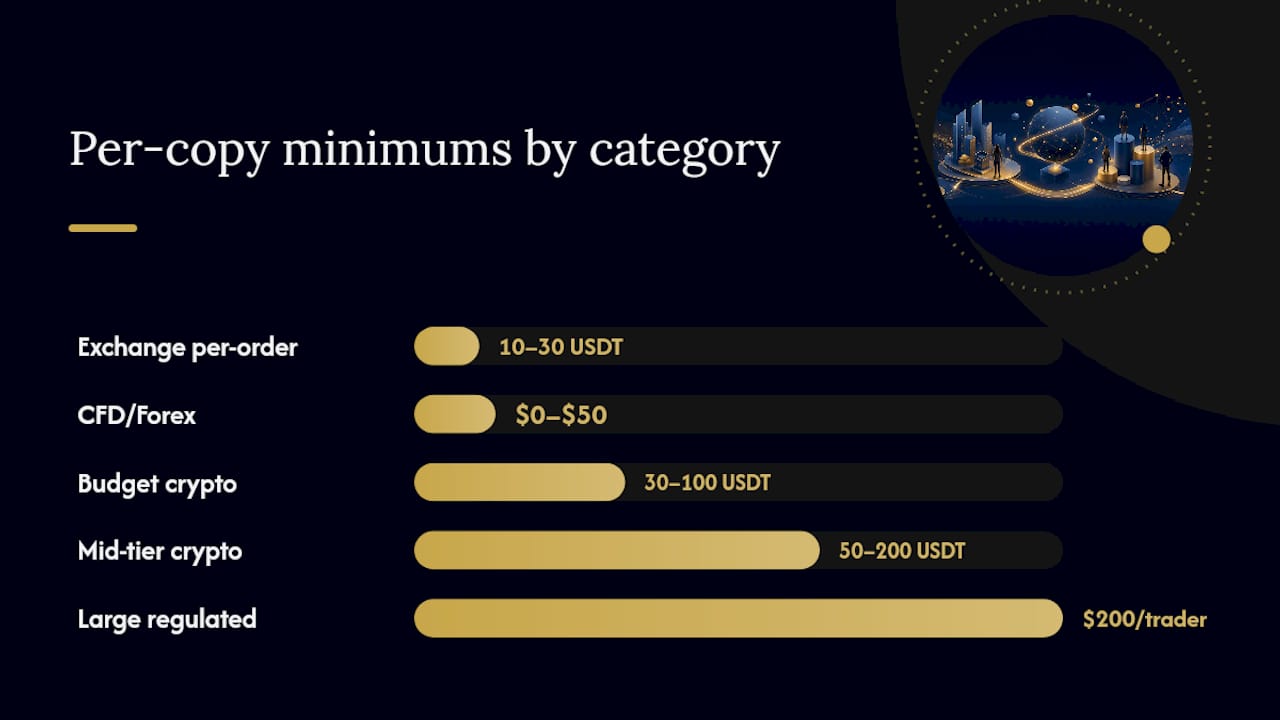
The lowest-entry categories break down into three tiers. Crypto-native exchanges often set per-order floors as low as 10 USDT, letting a $100 account split across multiple positions. Budget crypto copy products typically land in the 30 to 100 USDT per-copy range. Large social trading brokers, by contrast, often price per-copy minimums closer to $200 per trader, which eats a big chunk of a $300 account in one allocation.
- Crypto-native per-order floors: as low as 10 USDT per position, best for splitting a small balance across several trades
- Budget crypto copy products: 30 to 100 USDT per copy, workable for two or three diversified slots on a $300 balance
- Large social trading brokers: often around $200 per copied trader, which limits a $500 account to two or three leads at most
Statistic to remember: independent roundups list per-copy floors ranging from 10 USDT to $200 depending on the venue and product type, a spread wide enough to change your entire diversification strategy.
For readers who'd rather skip the multi-trader juggling act entirely, Sonic AI offers a gold-focused (XAUUSD) auto-trading strategy managed by one team, executed through the COPYX system, with 18 consecutive months of independently verified performance. It's a fit for anyone who wants a single, professionally managed strategy instead of spreading a starter balance thin across unfamiliar traders.
Key Takeaways
Minimum per copy, not the headline account deposit, determines how many traders a $100–$500 account can realistically follow, and fee drag from execution frequency erodes small balances faster than headline fee percentages suggest.
| Point | Details |
|---|---|
| Per-copy floor decides diversification | Check the Minimum Copy Amount before the account minimum; it ranges from 10 USDT to $200 depending on category. |
| Run the slot math first | Use allocation = capital / (slots + fee buffer) before choosing a platform, not after funding it. |
| Fee frequency matters more than fee rate | High-frequency leads multiply transaction costs; a lower percentage rate doesn't offset frequent execution. |
| Verify custody and regulation | Confirm segregated funds and jurisdictional oversight before trusting a low advertised floor. |
| Sonic AI offers a single managed path | For readers who prefer one vetted gold strategy over multi-trader diversification, Sonic AI runs a verified, COPYX-executed XAUUSD strategy with 18 consecutive winning months reported. |
Where to Verify These Numbers Yourself
Platform help centers remain the final authority on region-specific minimums, since figures in any guide, including this one, can shift after publication.
- The ESMA supervisory briefing verifies regulatory expectations and disclosure standards for copy trading products across the EU.
- Independent roundups like the low-minimum platform comparison verify representative per-copy floors across crypto-native venues.
- Broker comparison guides such as Forexbrokers verify headline account minimum ranges and highlight where they diverge from per-copy requirements.
- Investing verifies the existence of ultra-low minimum copy products and their regional caveats.
Always cross-check the specific figure against the platform's own current documentation before transferring any funds, since terms change more often than roundups get updated.
This article is general information, not a substitute for advice from a qualified financial advisor. Consult a qualified financial professional about your own circumstances before acting on anything here.
Table of Contents
- Copy Trading Minimum Deposit by Platform Category
- Minimum Per Copy vs. Minimum Account Deposit: Why the Distinction Decides Your Strategy
- How Fees and Profit Share Turn a Low Floor Into a Higher Real Cost
- How to Calculate How Many Traders You Can Actually Copy
- Choosing a Copy Trading Platform on a $100–$500 Budget
- Regulatory and Custodial Checks That Affect Whether a Low Minimum Is Actually Safe
- Sources
Copy Trading Minimum Deposit by Platform Category
Once you understand that per-copy floors vary more than account minimums do, the next step is comparing categories side by side. The table below groups platforms by type rather than naming individual brands, because the meaningful differences are structural: how the product prices its floor, how it charges fees, and how much room it leaves a $100–$500 account to diversify.
| Category | Min. per copy | Typical account minimum | Fee range | Profit share | Copy modes | Best for |
|---|---|---|---|---|---|---|
| Crypto exchange per-order copy | 10–30 USDT | $0–$50 | 0.05% to 0.20% maker/taker | 0%–10% | Fixed amount, per-order | Tiny exploratory accounts wanting maximum spread |
| Budget crypto copy products | 30–100 USDT | $50–$100 | 0.05% to 0.20% + network fees | 5%–20% | Fixed amount, smart ratio | $100–$300 accounts testing 2–3 leads |
| Mid-tier crypto social platforms | 50–200 USDT | $100–$200 | Spread + maker/taker fees | 10%–30% | Ratio, per-order | Accounts wanting broader lead selection |
| Large regulated social brokers | $200 per trader | $0–$200 headline | Spread-based, no commission on some products | Built into spread | Fixed amount only | Regulated jurisdictions, CFD exposure |
| CFD/forex brokers with copy add-ons | Often $0–$50 stated, but margin rules apply | $0–$200 | Spread + swap | None to leader, broker spread only | Fixed lot, percentage allocation | Traders wanting regulated custody over rock-bottom floors |
| Single-strategy managed auto-trading (e.g., Sonic AI) | Set by broker connection, not per-trader shopping | Broker-dependent | Broker spread; performance-based structure | Performance-based | Automatic copy via COPYX | Readers who want one vetted strategy instead of picking traders |
A few things jump out once you line these up. The crypto exchange per-order tier is the cheapest way to spread a $100 balance across multiple positions, but that low floor comes with the least regulatory oversight of the group. Mid-tier crypto social platforms sit in an awkward middle: fees creep up, but so does the selection of traders worth following. Large regulated social brokers front-load higher per-copy floors, which is the tradeoff for stronger custodial protections and, often, negative-balance protection.
- Crypto per-order floor: the lowest absolute ticket size, useful for testing strategies with money you can afford to lose, but weakest on regulatory backing.
- Budget crypto copy products: a middle ground that lets a $300 account run two or three leads without maxing out its buffer.
- Mid-tier crypto social platforms: wider lead selection, moderate fees, reasonable for $300–$500 accounts willing to research individual traders.
- Large regulated social brokers: fewer diversification slots per dollar, but generally stronger consumer protections and clearer dispute resolution.
- Single-strategy managed auto-trading: removes the trader-selection step entirely by copying one algorithm-driven approach, which suits readers who find picking among dozens of leads overwhelming rather than empowering.
Headline account minimums are often misleading on their own. Comparison tables commonly list minimum deposits ranging from $0 to $200 or more across brokers, but that number tells you almost nothing about what you'll pay to open your first copy position. A broker advertising a $0 minimum deposit can still require $200 per copied trader, which means your $300 balance funds exactly one and a half slots before fees even enter the picture.
The lowest-entry band matters more than it looks. A 10 to 30 USDT per-copy floor on crypto exchanges means a $100 account can theoretically open three to five small positions at once. That's the difference between testing a genuine diversification strategy and betting your entire starter balance on a single trader's next drawdown. Some venues list even lower thresholds. Roundups on platforms serving U.S. traders note that certain copy products advertise minimums as low as $1 to $10, though those figures usually apply to specific app-based CFD products with their own conditions attached, not the account as a whole.
Minimum Per Copy vs. Minimum Account Deposit: Why the Distinction Decides Your Strategy
These are two different numbers doing two different jobs, and conflating them is the single most common mistake new copiers make. The minimum account deposit is what funds your account and lets you log in with a positive balance. The minimum per copy (sometimes labeled "Minimum Copy Amount" in platform documentation) is the smallest amount you can allocate to any one trader or lead. You can clear the first hurdle with $50 and still get blocked from copying anyone if the per-copy floor sits at $200.
That distinction cascades into three practical consequences for anyone starting with $100 to $500:
- Diversification gets capped fast. A $200 per-copy floor on a $300 account leaves room for exactly one lead, no backup, no hedge against one trader having a bad month.
- Order sizing gets awkward at low balances. Some venues size your copied trades proportionally to the lead's own position, meaning a tiny account can end up with fractional lots too small to execute cleanly.
- Fee buffers shrink your usable capital. Every dollar allocated to a per-copy minimum is a dollar that can't absorb spread costs or a string of early losing trades.
Here's what that looks like with real numbers. Platform documentation for subscription management systems confirms that if your account balance drops below the Minimum Copy Amount, your subscription to a lead can pause or fail to open new trades entirely, even if you never withdrew a cent.
- $100 account, 10 USDT per-copy floor: roughly 3 to 4 slots after setting aside a small fee buffer, enough for meaningful diversification.
- $300 account, 30 USDT per-copy floor: typically 2 to 3 slots once you reserve margin for fees, according to independent analysis of low-minimum platforms.
- $300 account, 100 USDT per-copy floor: effectively one slot, with almost no room to diversify or recover from a single bad trader.
- $500 account, $200 per-copy floor: two slots at most, which barely qualifies as diversification.
The math breaks down fast once fees enter the picture. A $100 account split across four 10 USDT slots looks diversified on paper, but after spread costs and any profit share on winning trades, each slot might have $2 to $3 of real buffer against volatility. That's not a flaw in the math. It's a warning that ultra-low per-copy floors solve the diversification problem but not the undercapitalization problem.
How Fees and Profit Share Turn a Low Floor Into a Higher Real Cost
A platform's advertised per-copy minimum is only half the cost equation. The other half lives in fees you won't see until you read the fine print: maker and taker charges, spreads, crypto network fees, profit share paid to the trader you're copying, and sometimes a fixed fee per copied trade.
- Maker/taker fees: crypto exchanges commonly charge 0.05% to 0.20% per side, which compounds fast on high-frequency leads.
- Spread costs: forex and CFD brokers often build their margin into the spread rather than charging a visible commission.
- Crypto transaction fees: network fees apply on top of exchange fees for on-chain settlement, an easy cost to overlook.
- Profit share to the lead trader: ranges widely, commonly 5% to 30% of realized gains, depending on the platform and the trader's own settings.
- Fixed copy fees: some platforms charge a flat fee per copied position regardless of size, which disproportionately hurts small accounts.
Here's where frequency does more damage than percentage rates. Research into algorithmic trading systems shows that execution frequency multiplies costs far more than small differences in fee percentages do. A lead trader who opens and closes 40 positions a month will generate roughly four times the fee drag of one who trades 10 times a month, even if both charge identical maker/taker rates. On a $100 allocation, that difference can mean the gap between a strategy that's profitable after costs and one that quietly bleeds out through transaction fees alone.
Currency mismatches add a second layer of friction. If a platform prices its floor in USDT but you're funding from a different fiat currency, foreign exchange conversion can eat into your effective minimum before you place a single trade.
Before funding any account, pull up the platform's official fee schedule directly from its help center rather than relying on third-party summaries, since maker/taker tiers and profit-share defaults change without much announcement.
How to Calculate How Many Traders You Can Actually Copy
Turning a starting balance into a sensible allocation plan takes five steps, and you can run through all of them in about ten minutes with a calculator and a platform's fee schedule open in another tab.
- Decide your total copy capital. This is the portion of your deposit you're willing to allocate to copying, not your entire account balance. Most experienced copiers hold back 10% to 20% as an untouched buffer.
- Pick your target per-copy floor. Check the specific platform's Minimum Copy Amount, which can vary by product type (spot versus futures) and sometimes by individual lead trader settings.
- Reserve a fee buffer per slot. Set aside roughly 5% to 10% of each allocation to absorb spread costs and early drawdown without triggering a maintenance issue.
- Compute your maximum slots. Divide your copy capital by (per-copy floor plus fee buffer) to get a realistic slot count, not an optimistic one.
- Cap your diversification at a sensible number. More slots sound safer, but each one needs enough capital behind it to survive normal volatility, not just clear the minimum.
A $300 account with a 30 USDT floor and the same buffer supports 2 to 3 slots at $100 to $130 each, matching the independent findings on low-minimum platforms. A $500 account facing a $200 per-copy floor is capped at 2 slots, since a third would leave almost nothing in reserve.
The quick formula: allocation = capital / (number of slots + fee buffer). Plug in your own numbers before committing to a platform, since the output often surprises people who assumed more slots were automatically available.
Pro Tip: Set a per-copy loss cap or automatic stop-loss default on every slot before you fund it. A single lead trader having one bad week can otherwise consume an entire slot's allocation and force you to rebuild that position from scratch.
Choosing a Copy Trading Platform on a $100–$500 Budget
Run through this checklist before you deposit a dollar. The details that matter most rarely show up on a homepage; you'll find them in help-center articles and fee schedules instead.
- Confirm the exact minimum per copy, not just the account minimum, and check whether it changes by product (spot, futures, CFD).
- Read the profit-share structure to see whether it's charged on gross gains, net gains after fees, or only above a high-water mark.
- Check the full fee schedule, including maker/taker rates, spreads, and any fixed per-trade charges.
- Verify which copy modes are supported: fixed amount, proportional ratio, or per-order copying each behave differently on a small balance.
- Ask about per-copy caps and stop-loss defaults, since not every platform lets you set a hard ceiling on losses per slot.
- Understand margin maintenance rules, since falling below the Minimum Copy Amount can pause or cancel your subscription without warning.
- Check withdrawal and deposit limits, along with any processing delays, before assuming your capital is fully liquid.
Reach out to support with specific questions if the help center is vague: what exactly counts as the Minimum Copy Amount, can allocations be adjusted after a subscription starts, and are there inactivity or withdrawal fees that apply to small balances specifically?
Red flags worth walking away from: a high per-copy floor bundled with a basic, low-fee marketing pitch (the fine print rarely matches the headline); profit-share mechanics that aren't disclosed until after signup; no available per-copy loss cap; and deposit methods that carry hidden conversion or processing fees that only appear on your statement.
Pro Tip: Screenshot the fee schedule and Minimum Copy Amount the day you fund your account. Platforms update these terms periodically, and having your own record makes it easy to spot changes before they cost you.
Regulatory and Custodial Checks That Affect Whether a Low Minimum Is Actually Safe
A low per-copy floor means little if the platform behind it offers weak custodial protection or operates outside any recognizable regulatory framework. Before chasing the cheapest entry point, confirm a few structural facts about where your money actually sits.
- Is the platform regulated in a jurisdiction that covers you? Registration with a recognized financial regulator generally means segregated client funds and a formal complaints process; unregulated crypto exchanges typically offer neither.
- What custodian holds your deposit? Some copy trading products route funds through a regulated broker's segregated accounts, while others hold client assets directly on an exchange's own balance sheet.
- Is the copy product itself a regulated managed-account construct, or a bolt-on feature? These carry very different legal protections if something goes wrong with the underlying strategy.
Margin maintenance rules add an operational risk layer on top of the regulatory picture. If your balance dips below the platform's Minimum Copy Amount, even briefly, your subscription to a lead trader can pause or be suspended automatically, sometimes without an alert until you check your dashboard.
Supervisory guidance on copy trading from European regulators specifically flags product design and disclosure as areas needing scrutiny, noting that retail investors face amplified risk when a copy product's mechanics aren't clearly explained before signup.
That guidance comes from ESMA's supervisory briefing on copy trading, which remains one of the clearest regulatory statements on the category to date. If you're outside the EU, check your own jurisdiction's equivalent guidance rather than assuming U.S. or Asian frameworks mirror it. For readers specifically weighing gold-focused copy strategies, a deeper look at safety considerations walks through the questions worth asking before funding any account.
How These Minimums Were Verified
The per-copy and account-minimum figures in this guide came from a cross-check of platform help centers, official fee schedules, and independent roundups rather than a single source.
- Consulted platform help-center documentation and fee-schedule pages directly for representative maker/taker ranges and Minimum Copy Amount rules.
- Cross-referenced those figures against independent roundups and the ESMA supervisory briefing for regulatory context.
- Confirmed representative fee ranges (0.05% to 0.20% maker/taker) appear consistently across multiple crypto exchange fee schedules rather than relying on one outlier.
These figures reflect verification as of early 2026. Per-copy floors change by region, by product type (spot trading behaves differently from futures), and sometimes by individual lead trader settings within the same platform. Treat every number here as a representative category floor, not a guaranteed figure, and confirm current terms on the platform's own documentation before funding an account.
When a Small Balance Is Worth Starting, and When It Isn't
Starting with $100 to $500 makes sense if you treat it as exploration, not income. The goal in month one isn't returns. It's understanding how a platform actually behaves: how fast fees accumulate, how often a lead trader executes, and whether the Minimum Copy Amount rules trip you up before you've learned anything useful.
Start with one conservative lead and a modest allocation rather than spreading a small balance across five untested traders on day one. Track your realized fee drag for 30 to 60 days before adding a second or third slot. That window tells you more about a platform's real cost structure than any advertised fee percentage.

A useful rule of thumb: aim for 3 to 5 diversified slots for genuinely useful learning, but recognize that's only achievable on categories with low per-copy floors. On a platform where per-copy minimums run to $200, a $500 account simply can't get there yet, and pretending otherwise just spreads undercapitalized bets that all fail the same stress test at once.
Sonic AI: A Single, Managed Path to Gold Exposure
Every category above asks you to shop across multiple traders, weigh their track records, and manage several allocations at once. That's a reasonable approach if you enjoy the research. If you'd rather put your capital behind one vetted, professionally managed strategy instead, Sonic AI takes a different route.

Sonic AI runs a single auto-trading strategy focused exclusively on gold (XAUUSD), managed by an experienced team and executed automatically through the COPYX system. You don't need to compare per-trader profit-share percentages or juggle five subscriptions. You connect your account, the system copies trades automatically, and the strategy has posted 18 consecutive winning months with independently verified performance reporting, alongside a documented win rate around 80%. That track record is publicly viewable, not a claim you have to take on faith.
Setup follows the same basic pattern as any copy trading connection: fund your broker account, link it to Sonic AI, and let COPYX handle execution from there. Before you fund anything, confirm your specific broker's account minimum on its own gold copy trading product page, since broker-side requirements can vary independently of Sonic AI's own setup. If you want the full performance breakdown before deciding, Sonic AI's results page is the place to start.
Sources
- Best Copy Trading Platforms with a Low Minimum Deposit (2026) — MetaTrader
- Supervisory Briefing on Copy Trading — ESMA
- Forexbrokers
- Investing
- Research on algorithmic trading and information systems — INFORMS