
Copy trading is not categorically illegal in the United States, but it becomes a regulated activity the moment it meets statutory definitions of investment advice, portfolio management, or commodity trading. Copy trading legality depends less on what a platform calls itself and more on what it actually does with client funds and decisions.
Before depositing funds, run three checks immediately:
- Is the platform registered? Look for SEC-registered Registered Investment Adviser (RIA), FINRA-licensed broker-dealer, or CFTC/NFA-registered Commodity Trading Adviser (CTA) status.
- Are trades executed automatically into your account? Automatic execution without your per-trade approval raises the probability of triggering investment management rules.
- Are there clear disclosures, custody arrangements, and stop-copy controls? Absence of any one of these is a material risk flag.
Pro Tip: Search the SEC's Investment Adviser Public Disclosure (IAPD) database and FINRA BrokerCheck before funding any account. Both are free, take under two minutes, and confirm registration status directly from the regulator.
Key Takeaways
Copy trading is legal in the U.S. but triggers registration requirements the moment a platform exercises discretion, handles custody, or executes trades automatically without per-trade client approval.
| Point | Details |
|---|---|
| Legal status in the U.S. | Copy trading is permitted but becomes regulated when it meets definitions of investment advice, portfolio management, or commodity trading. |
| Registration triggers | Automatic execution, discretion over client assets, performance fees, and custody each independently trigger SEC, FINRA, or CFTC registration requirements. |
| Investor controls | Set allocation caps, stop-copy thresholds, and fixed-lot modes before copying; document your rules in writing. |
| Tax documentation | Collect 1099-B or consolidated statements; instrument type (securities, futures, CFDs) determines tax treatment, not the copy trading method. |
| Sonicaigold | Publishes independently verified Myfxbook results, uses COPYX execution, and provides explicit custody and fee disclosures as a compliance-oriented example. |
Table of Contents
- What copy trading is and the models you'll encounter
- Which U.S. regulators govern copy trading activity
- When copy trading triggers a registration requirement
- What compliant platforms must disclose and how they should handle funds
- What you must do as an individual copier to limit risk and exposure
- How copy trading gains and losses are taxed in the U.S.
- How prop firms and brokers detect copy trading activity
- A compliance checklist to run before you copy-trade
- How a compliant U.S.-facing copy trading service can be structured
- What compliance teams actually prioritize day to day
- Sonicaigold offers a transparent example worth reviewing
- Sources
What copy trading is and the models you'll encounter
Copy trading lets one investor automatically replicate the trades of another. The three main models differ in how much discretion the platform or signal provider exercises, and that difference drives regulatory treatment.
- Automated copy trading: Orders execute in your account automatically when the lead trader opens or closes a position. No per-trade approval from you is required. This model most closely resembles discretionary portfolio management.
- Mirror trading: Your account exactly duplicates another account's full position set, including sizing ratios. It is functionally identical to automated copy but typically applied at the strategy level rather than the individual trade level.
- Signal-based copy: The platform delivers a trade signal, but you must manually confirm each order. Because you retain per-trade discretion, this model is less likely to trigger investment management rules, though marketing language that crosses into "advice" can still attract regulatory attention.
Platforms implement these models differently. Some use fixed-lot modes, where your position size is set independently of the lead trader's size. Others use proportional modes, where your size scales with the lead trader's. Automated copy execution and fixed-lot controls are distinct features with different risk and compliance implications.
Which U.S. regulators govern copy trading activity
Regulators focus on what the activity does, not what it is called. Three agencies can assert jurisdiction, and their triggers overlap.
- SEC: Covers investment advisers and portfolio managers under the Investment Advisers Act of 1940. A platform that exercises discretion over client securities accounts or provides advice for compensation may need to register as an RIA.
- FINRA: Oversees broker-dealer conduct, sales practices, and order execution. A platform routing securities orders on behalf of clients may need a broker-dealer license.
- CFTC/NFA: Covers commodity trading, including leveraged derivatives, CFDs on commodities, and futures. A platform advising on or executing these instruments for clients may need CTA or commodity pool operator (CPO) registration.
The core triggers across all three agencies are: discretionary trading on client accounts, custody or handling of client funds, offering advice for compensation on securities or commodity derivatives, and operating pooled or managed account structures.
| Regulator | Primary statute | Key copy trading trigger |
|---|---|---|
| SEC | Investment Advisers Act 1940 | Discretion over client securities accounts |
| FINRA | Securities Exchange Act | Broker-dealer order routing for clients |
| CFTC/NFA | Commodity Exchange Act | Advising on or executing commodity derivatives |
ESMA's supervisory guidance on copy trading under MiFID II is a useful comparator. ESMA expects suitability assessments, product governance, and disclosure obligations from any firm offering copy trading. U.S. law differs in structure, but the underlying logic, that automation and discretion increase regulatory obligations, applies equally here.
The FCA's position is similarly instructive: where automatic execution removes manual client input, the FCA treats the activity as portfolio management, triggering authorization and conduct obligations. U.S. regulators apply analogous reasoning.
When copy trading triggers a registration requirement
Not every copy trading arrangement requires registration. The fact patterns below are the ones that typically force it.
- Automatic execution into copier accounts without per-trade approval. This is the clearest trigger for investment management classification.
- The platform or lead trader exercises discretion over client assets. Discretion, not just automation, is the operative word for SEC and CFTC analysis.
- Advisory fees or performance-based compensation. Charging a fee tied to advice or results is a strong indicator of investment adviser status.
- Pooled or managed account structures. Aggregating client funds into a single trading pool typically requires CPO registration with the CFTC.
- The platform recommends specific traders and manages allocations. Curating a trader roster and directing client capital toward it looks like portfolio management.
- The platform holds client custody. Custody of client funds triggers additional SEC obligations under the Custody Rule.
Situations that often avoid registration: purely signal-based services where clients execute trades themselves and the provider does not exercise discretion. Even then, marketing language matters. A signal service that describes its output as "advice" or "recommendations" can attract regulatory scrutiny regardless of execution mechanics.
What compliant platforms must disclose and how they should handle funds
A compliant platform publishes clear, verifiable information before you fund an account. The minimum standard includes:
- A complete fee schedule covering copy trading commission, spread markups, and any performance fees
- Standardized performance reporting with methodology notes (time period, account size basis, drawdown figures)
- Explicit risk warnings tied to the specific instruments offered
- Trader qualification criteria and how the platform vets lead traders
- A clear statement of who holds custody of client funds and under what regulatory framework
- Independent performance verification or third-party audit of reported results
- Segregation of client funds from operating capital
- Independent stop-copy mechanics that let you exit a copy relationship without platform intervention
- KYC/AML procedures that meet applicable standards
SafeFly's risk disclosure framework illustrates how a platform can present investor obligations and risk disclosures in a structured, accessible format.
Pro Tip: To validate a platform's registration claims, cross-reference the registration number on SEC IAPD, FINRA BrokerCheck, or the NFA's BASIC database. A legitimate firm will have a verifiable record. If the number returns no result or the firm name does not match, stop.
What you must do as an individual copier to limit risk and exposure
Copy trading shifts risk management from the trade level to the allocation level. You no longer decide each trade, so your controls must operate at a higher level. Allocation caps, copy ratios, and stop-copy thresholds are the primary tools.
Before copying any trader, set these defaults:
- Maximum allocation per trader as a fixed percentage of your total account
- Total copy-trading budget across all traders combined
- Independent per-trade stop-loss where the platform allows it
- Copy stop-loss or kill switch that automatically stops copying if drawdown reaches a set threshold
- Diversification across multiple traders with non-correlated strategies
CFD copy trading adds leverage and liquidation risk on top of strategy risk. Platforms that offer independent stop-loss, take-profit, and fixed-lot modes give you materially better control than those that do not.
Additional steps: verify platform registration, read the terms and custodian agreements in full, enable two-factor authentication, and confirm the platform's dispute resolution procedure before funding.
A recommended risk-management checklist covers allocation limits, 2FA, stop-copy settings, diversification, and verifying trade history. Run through it for every platform you evaluate.
Pro Tip: Document your pre-copy rules in writing and maintain a copy-trading journal noting when you started copying, what controls you set, and any changes you made. If a regulator or broker questions your activity, written records demonstrate informed, deliberate decision-making.
How copy trading gains and losses are taxed in the U.S.
Tax treatment follows the instrument, not the trading method. Copied trades executed in your account are your trades for tax purposes.
- Securities (stocks, ETFs): Gains are capital gains. Short-term (held under one year) are taxed as ordinary income. Long-term rates apply after one year.
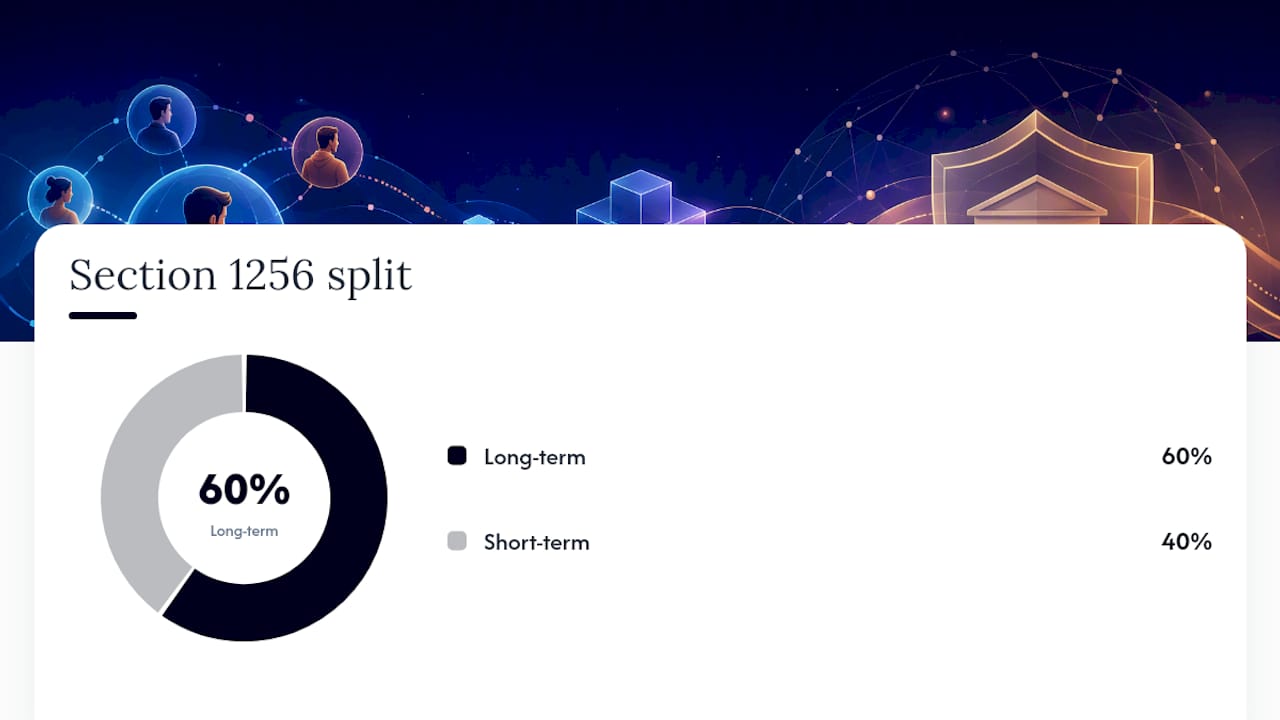
- Futures contracts: Section 1256 of the Internal Revenue Code applies a 60/40 blended rate (60% long-term, 40% short-term) regardless of actual holding period.
- CFDs: Treatment is less settled. Most practitioners treat CFD gains as ordinary income, but the instrument's structure and the broker's domicile can affect the analysis.
- Gold (XAUUSD) spot or derivatives: Collectibles rules, Section 1256, or ordinary income treatment may apply depending on the instrument structure.
Practical filing steps: collect your 1099-B or consolidated tax statement from the broker, track realized profit and loss by account and instrument type, and confirm whether the platform issues tax documents for copied trades executed in your account. Tax treatment varies materially by instrument, and leveraged or derivative products can produce unexpected outcomes.
Pro Tip: Consult a tax professional before copying CFD or leveraged products. The difference between ordinary income treatment and Section 1256 blended rates can be significant, and the wrong classification creates filing risk.
How prop firms and brokers detect copy trading activity
Firms monitor for coordinated trading patterns using automated surveillance tools. The signals they look for include:
- High correlation of trade timing and position size across multiple accounts
- Repeated identical order chains appearing simultaneously
- Identical position sizing patterns across accounts with no apparent independent basis
- Duplicate risk profiles appearing suddenly across accounts opened around the same time
- Unusually low variance in entry and exit prices across a group of accounts
Firms care about this for three reasons: risk concentration (many accounts taking the same position amplifies market impact), potential market abuse concerns, and contractual breaches where account terms prohibit copy trading without disclosure.
If flagged, expect a request for documentation. A written copy relationship agreement, evidence of consent, and clear disclosure of the arrangement to the broker are the standard responses. Platforms that operate transparently and with proper registration are far less likely to generate these flags in the first place. A compliance-friendly execution setup documents the arrangement from the start.
A compliance checklist to run before you copy-trade
Use this list when vetting any platform. Each item should have a clear, verifiable answer.
- Does the platform have a verifiable registration number (RIA, broker-dealer, CTA)?
- Are client funds held in segregated accounts, separate from the platform's operating capital?
- Is performance reporting independently verified or audited by a third party?
- Does the platform offer independent stop-copy mechanics and fixed-lot or allocation cap settings?
- Is the full fee schedule published, including copy trading commission, spreads, and performance fees?
- Does the platform conduct suitability assessments before allowing you to copy?
- Is the lead trader's track record audited, and for how long?
- Who is legally responsible for trade execution errors?
- How are trader qualifications verified and updated?
- What is the dispute resolution procedure, and is it in writing?
- How does the platform report copied trades for tax purposes, and does it issue 1099-B or equivalent documentation?
- Does the platform publish its custodian's identity and the regulatory framework governing custody?
Questions to ask customer support directly: who holds legal responsibility for execution, how are trader qualifications reviewed on an ongoing basis, and what happens to open copied positions if the platform suspends a lead trader.
How a compliant U.S.-facing copy trading service can be structured
Sonicaigold's Gold copy trading service provides a working example of how a copy trading product can be structured with transparency in mind. The key elements:
- COPYX execution system: Trades are copied automatically into client accounts via COPYX, with documented execution mechanics and clear allocation controls.
- Independently verified performance: Sonicaigold publishes Myfxbook-verified results covering 18+ consecutive months, giving investors an auditable track record rather than marketing claims.
- Explicit custodial model: Client funds are held with the connected broker, not by Sonicaigold directly, with clear documentation of the custody arrangement.
- Disclosed fees and risk controls: Allocation limits, stop-copy options, and risk disclosures are published before account funding.
What makes this model compliance-friendly is the combination of independent verification, a clear custody model, and documented controls. No copy trading service eliminates regulatory risk entirely, but published proofs reduce the information asymmetry that regulators and investors both flag.
Pro Tip: Ask any platform to share its registration certificate, most recent audit or verification report, and a sample client agreement before you fund. A compliant provider will produce these without hesitation. Delay or redirection is itself a signal.
What compliance teams actually prioritize day to day
Compliance in copy trading is not a one-time registration exercise. It is an ongoing operational function. The core claim: compliance is risk control, not a checkbox.
The three daily priorities for any copy trading compliance team are monitoring trader behavior for strategy drift, verifying that performance reporting remains accurate and current, and confirming that client-side controls (stop-copy, allocation caps, kill switches) are functioning as designed. A trader whose strategy shifts materially after clients start copying them is a compliance problem, not just a performance problem.
The real tradeoff is between product usability and strict execution limits. Automatic execution is what makes copy trading attractive to retail investors. But automatic execution is also what triggers the most significant regulatory obligations. Balancing those two realities requires clear written policies, not just technical controls.
Documentation culture matters as much as the controls themselves. Audit trails, client consents, and written agreements are what protect both the platform and the investor when a dispute arises. Retain them.
Sonicaigold offers a transparent example worth reviewing
Investors who want a concrete, U.S.-facing example of how copy trading can be structured with published verification and clear controls can review Sonicaigold's XAUUSD copy trading product documentation. The platform publishes independently verified performance data, documents its COPYX execution model, and provides explicit disclosures on fees, allocation, and custody.

This is not a substitute for your own due diligence. Verify Sonicaigold's registration status independently, confirm tax treatment with a qualified tax professional for your specific instruments, and review the full client agreement before funding. For U.S.-specific considerations, the Sonicaigold U.S. members page outlines the compliance and procedural steps relevant to U.S. investors.
Sources
These primary sources are the starting point for any serious compliance review.
- Is Copy Trading Legal? Here's What the Law Says
- Copy trading | FCA
- ESMA provides guidance for supervision of copy trading services
- Copy Trading Risk Management Checklist | Crypto Blog
- Copy Trading Risk Management Stops Costly Account Blowups
- Taxes on Day Trading: A Complete Guide for Traders - DNS Accountants