
The most effective approach combines disciplined trader selection, diversified core-satellite allocations, and mechanical unfollow rules applied before you fund a single live dollar. Start with a strategy that has at least 12 months of verified history, a maximum drawdown under 20%, and a profit factor above 1.5. Allocate across four to eight traders using a core-satellite split, then set hard unfollow triggers so emotion never drives the decision to exit.
Three immediate actions:
- Filter every candidate trader by strategy age (12+ months), max drawdown, and monthly consistency before copying.
- Allocate capital using a template: 60–70% to a low-drawdown core, 20–30% to a balanced mid-tier, and 5–10% to a higher-risk satellite.
- Set mechanical unfollow rules now: unfollow automatically if drawdown breaches your pre-set threshold, regardless of recent wins.
Do this now: Demo test for six to twelve weeks → fund a micro-live account ($100–$1,000) → scale quarterly only after the live results align well with the demo performance.
Pro Tip: Never skip the demo phase. A strategy that looks strong on a provider's public stats page can behave differently under your account's position sizing and broker execution conditions. Six weeks of demo data is the minimum to trust.
Table of Contents
- What copy trading strategy types are and when to use each
- How to evaluate a trader or signal provider
- How to build a copy trading portfolio with allocation templates
- Risk management: platform controls and personal limits you must set
- What to check on a platform before you start copying
- How Sonic AI fits into a gold-focused copy portfolio
- Copy trading versus other forms of trading and investing
- Legal and tax implications of copy trading
- Psychological aspects and behavioral pitfalls in copy trading
- Key Takeaways
- What copy trading actually feels like to manage over time
- Sonic AI: a tested gold strategy you can verify and trial
- Useful sources and further reading
What copy trading strategy types are and when to use each
Copy trading is a method where your account automatically replicates the trades of a selected provider in real time. The provider executes a trade; your account mirrors it proportionally. No manual order entry is required on your side.
The strategy types break down along two axes: risk profile and execution method.
Risk profile styles:
- Conservative/core: Low drawdown, steady equity curve, typically forex majors or gold. Suited to capital preservation and long time horizons.
- Balanced: Moderate drawdown tolerance, mixed assets, some discretionary judgment from the provider. Fits investors who want growth without extreme volatility.
- Aggressive/satellite: Higher drawdown potential, often crypto or leveraged instruments, shorter holding periods. Appropriate only as a small allocation within a larger portfolio.
Execution method:
- Algorithmic (EA/automated): A rules-based system executes trades without human discretion. Behavior is consistent and back-testable. Gold-focused algorithms like Sonic AI fall here.
- Discretionary/social leaders: A human trader makes judgment calls. Results can be excellent but are harder to predict across market regimes.
The table below maps trader profiles to recommended styles:
| Trader profile | Risk tolerance | Time horizon | Recommended style | Typical assets |
|---|---|---|---|---|
| Capital-preservation focus | Low | 12+ months | Conservative/core | Gold, forex majors |
| Growth-oriented beginner | Medium | 6–18 months | Balanced | Forex, indices, gold |
| Experienced, higher risk | High | 3–12 months | Aggressive/satellite | Crypto, leveraged forex |
| Passive income seeker | Low–medium | 12+ months | Algorithmic core | Gold, stable forex pairs |
Pros and cons by style:
- Conservative: lower returns but predictable drawdown; easiest to monitor; least emotional friction.
- Balanced: moderate upside; requires monthly review; provider quality varies widely.
- Aggressive: highest return potential; drawdown can exceed 40%; unsuitable as a primary allocation.
- Algorithmic: consistent behavior; no emotional drift; dependent on the algorithm's design quality.
- Discretionary: can adapt to news events; harder to verify consistency; strategy drift is a real risk.
Strategy age matters more than recent performance. A provider with 18 months of consistent, verified results tells you far more than one with three months of exceptional returns. ForexBrokers.com's copy trading guide recommends prioritizing a 12-month minimum track record and verified drawdown data before copying any provider.
How to evaluate a trader or signal provider
Long-term, risk-adjusted metrics outperform short-term return figures as selection criteria. A provider showing 200% returns over six weeks is a red flag, not an invitation.
The core evaluation checklist:
- Strategy age: Minimum 12 months of live trading history. Longer is better.
- Max drawdown: The largest peak-to-trough decline in account equity. Under 20% is a reasonable threshold for a core allocation; under 30% for a balanced one.
- Profit factor: Gross profit divided by gross loss. A value above 1.5 indicates the strategy earns more than it loses over time.
- Sharpe ratio: Risk-adjusted return per unit of volatility. A Sharpe above 1.5 places a provider in the top decile of risk-adjusted performers.
- Monthly consistency: Look for positive months in at least 70–80% of the track record period, not just a high average return.
- Trade frequency: Very high frequency (hundreds of trades per week) can indicate scalping or grid strategies that are difficult to copy reliably.
- Asset concentration: A provider trading only one instrument in one direction carries hidden correlation risk.
- Copier base: A rapidly growing copier count can degrade execution quality as the provider's orders move markets.
- Verified/audited track record: Third-party verification (Myfxbook, FX Blue, or broker-native audit) is the minimum standard. Self-reported stats are not sufficient.
| Metric | What "good" looks like | Red flag |
|---|---|---|
| Strategy age | 12+ months live | Under 6 months |
| Max drawdown | Under 20% (core) | — |
| Profit factor | Above 1.5 | Below 1.0 |
| Sharpe ratio | Above 1.5 | — |
| Monthly win rate | 70–80% positive months | Clustered wins, long losing streaks |
| Copier count trend | Stable or gradual growth | Sudden surge (execution risk) |
LedgerMind's copy trading guide identifies max drawdown, Sharpe ratio, win rate, trade frequency, and track record length as the seven metrics that matter most when filtering providers. The CopyTradeInsider deep guide adds a six-metric filter that includes holding period and copier base size as practical execution-quality signals.
Red flags to watch:
- Explosive short-term returns with no prior history.
- Grid or martingale trading styles, which can produce smooth equity curves until a single catastrophic drawdown.
- A sudden surge in follower count, which worsens fill quality for all copiers.
- Strategy drift: a provider who shifts from their stated approach (e.g., switching from gold to crypto mid-year).
- Uncapped copier counts with no position-sizing controls.
How to build a copy trading portfolio with allocation templates
Diversify across traders, not just assets. Four to eight qualified providers is a manageable number for most investors; below four concentrates risk, above eight makes monitoring impractical.
Three allocation templates:
1. Conservative core-satellite (recommended for beginners)
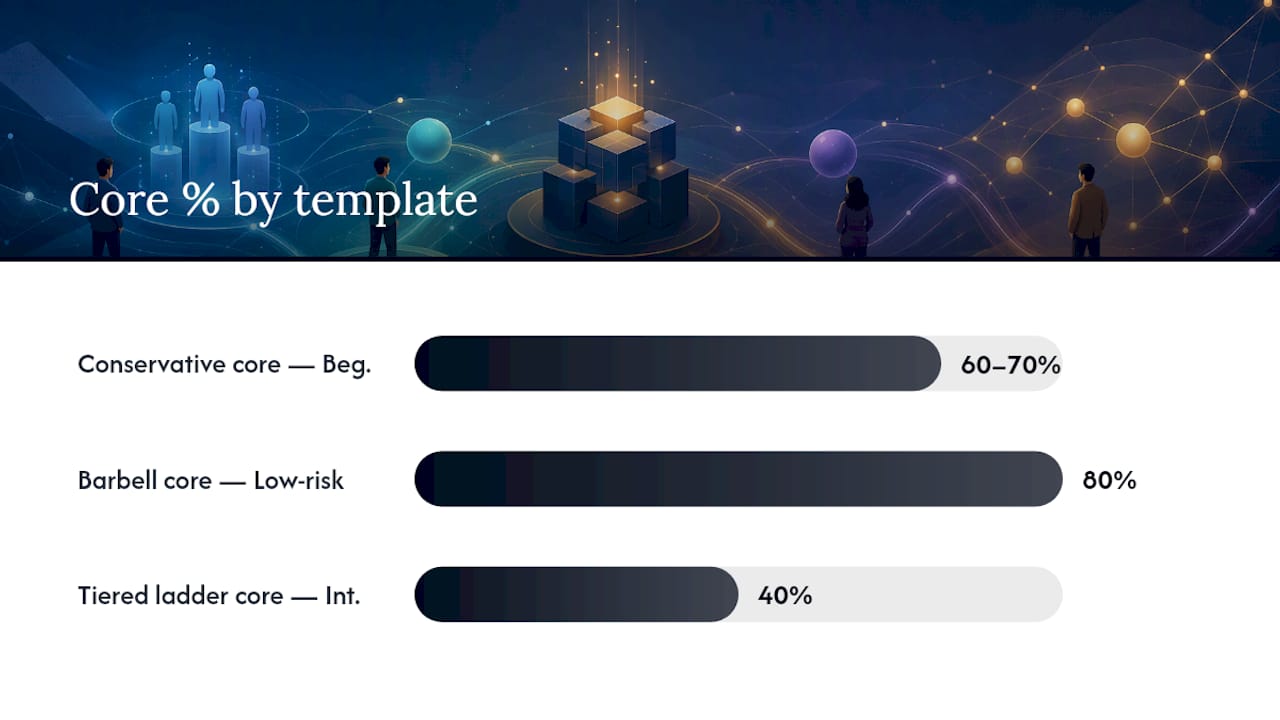
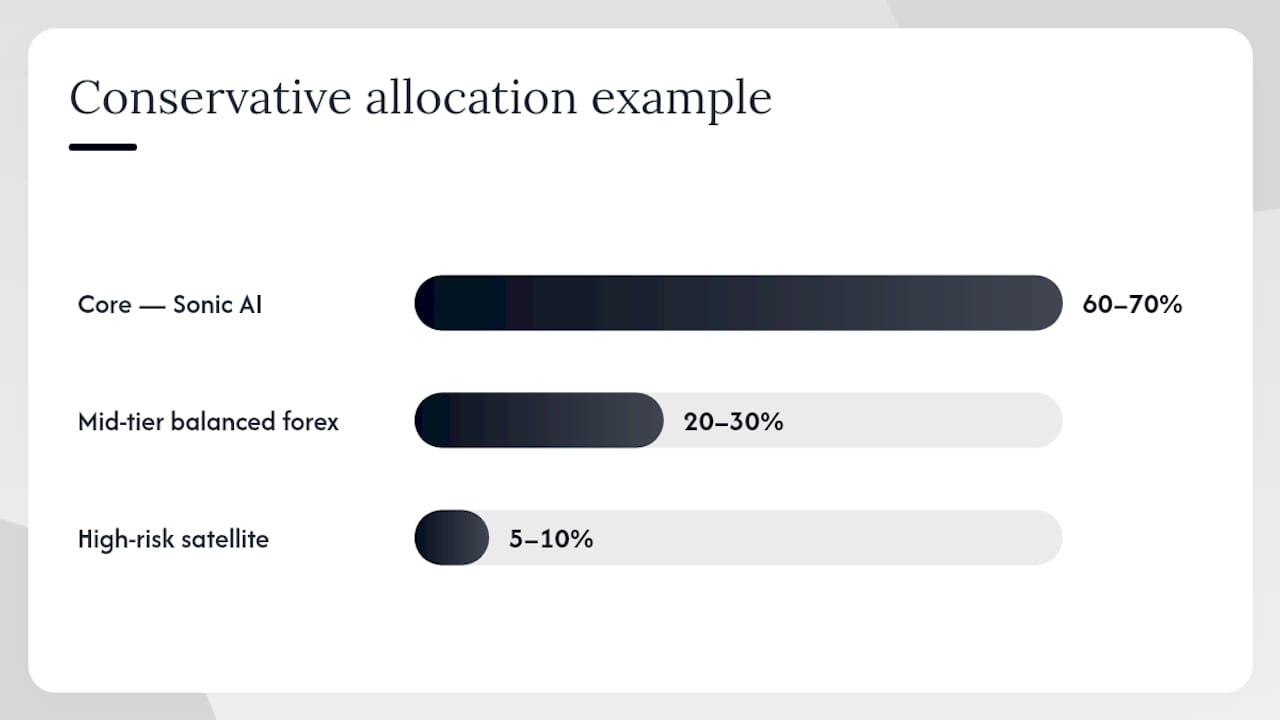
Place 60–70% of copy capital with one or two low-drawdown, verified core providers (algorithmic gold or stable forex). Allocate 20–30% to a balanced mid-tier provider. Reserve 5–10% for a higher-risk satellite with a shorter track record. The core stabilizes the portfolio; the satellite provides upside exposure without threatening the whole account.
2. Barbell
Split capital roughly 80/20 between a very conservative core and a single aggressive satellite. Nothing in the middle. This works when you want capital preservation as the primary goal but are willing to accept occasional volatility from the satellite position.
3. Tiered ladder
Allocate across three to four providers ranked by drawdown tolerance: 40% to the lowest-drawdown provider, 30% to a mid-tier, 20% to a higher-risk provider, and 10% to a speculative satellite. Rebalance quarterly.
| Template | Core % | Mid-tier % | Satellite % | Best for |
|---|---|---|---|---|
| Conservative core-satellite | 60–70% | 20–30% | 5–10% | Beginners, capital preservation |
| Barbell | 80% | 0% | 20% | Low-risk investors with one high-conviction bet |
| Tiered ladder | 40% | 30% | 20–30% | Intermediate investors, active monitoring |
CopyPipe's strategy guide frames this as a four-pillar approach: selection, allocation, risk overlays, and ongoing optimization. The allocation step is where most beginners underinvest their attention.
Position sizing guidance:
Never allocate more than 25–30% of total copy capital to a single provider. A moderate allocation is recommended based on the provider's historical win rate and average win/loss ratio.
Mechanical unfollow rules:
Set these before you copy, not after a drawdown surprises you.
- Unfollow if the provider's drawdown from peak exceeds your pre-set threshold (e.g., 15% for a core provider, 25% for a satellite).
- Unfollow if the provider's monthly win rate drops below 50% for two consecutive months.
- Unfollow if copier count grows more than 300% in 30 days without a corresponding increase in liquidity.
- Unfollow if the provider's asset focus or trade frequency changes materially from the original profile.
Rebalancing cadence: Review allocations monthly. Rebalance quarterly. Scale a provider's allocation up only after three consecutive months of live performance matching the historical track record.
Risk management: platform controls and personal limits you must set
Configure platform stop-loss copying, a per-trader hard stop, and an account-level daily loss limit before funding live capital. These three settings are the minimum floor.
Platform-level settings to configure:
- Copy stop-loss and take-profit: Enable this setting so your account exits trades at the same levels as the provider. Without it, your position may stay open after the provider closes, exposing you to additional risk. The MQL5 signal documentation specifically flags "Copy Stop Loss and Take Profit levels" as a required setting for reliable signal copying.
- Per-trader max drawdown override: Set a hard cap at the account level so copying pauses automatically if a provider's drawdown hits your threshold.
- Position-sizing multiplier: Adjust the copy ratio to match your account size and risk tolerance. Copying at 1:1 from a much larger account can result in oversized positions.
- Per-trade limits: Cap the maximum lot size per copied trade to prevent outsized exposure from a single provider signal.
- Profit-sharing opt-outs: Some platforms allow you to exclude certain trade types from profit-sharing calculations. Review these settings carefully.
Personal limits to set:
- Maximum 25–30% of total copy capital per provider.
- Total portfolio drawdown limit: if the whole copy account drops 20% from peak, stop all copying and review.
- Daily loss limit: set at 3–5% of total account equity per day.
- Review cadence: weekly check of open positions, monthly full metric review.
Pro Tip: Double-check whether your platform copies the provider's stop-loss and take-profit levels by default or requires manual activation. Many platforms default to "off." A provider who closes a trade at a tight stop-loss will leave your position open if this setting is inactive.
U.S. tax and reporting note: Copy trading generates taxable events in the United States. Each copied trade that closes at a profit or loss is a reportable transaction. Profit-sharing fees paid to a provider or platform may be deductible as investment expenses, but tax treatment depends on your specific situation. Track every closed trade and retain records of all fees paid. Consult a qualified tax professional for guidance specific to your accounts.
What to check on a platform before you start copying
Regulation, execution quality, supported copy mechanics, and asset coverage are the four checks that materially affect both safety and results.
Regulation and safety:
Verify that the broker or platform is registered with a recognized U.S. regulator. For futures-related products, the NFA's BASIC lookup tool confirms whether an entity holds current NFA registration. For securities-based products, check SEC and FINRA registration. Unregulated platforms carry counterparty risk that no strategy quality can offset. The Investing.com platform comparison recommends verifying regulatory status, fee transparency, and leader track record verification as the first three platform checks.
Execution quality:
Execution affects your actual copied fills. Key factors:
- Copier count effects: When a provider gains thousands of copiers, their orders can move the market slightly, worsening fills for everyone copying them. A provider with a rapidly growing follower base may deliver worse execution than their historical stats suggest.
- Latency: Platforms with faster order routing deliver fills closer to the provider's price. Latency matters most for short-term strategies.
- Spread and commission models: Some platforms charge wider spreads instead of explicit commissions. Calculate the true cost per trade, not just the headline fee.
Copy mechanics to verify:
- Does the platform copy the provider's stop-loss and take-profit levels automatically?
- Is position sizing proportional to your account balance, or fixed lot?
- Can you set a per-provider drawdown cap at the platform level?
- Does the platform offer a demo copy mode for testing before going live?
Asset coverage:
Confirm the platform supports the specific instruments the provider trades. A gold-focused provider requires a platform with reliable XAUUSD execution and tight spreads on that pair. For guidance on gold copy trading platforms, Sonicaigold's platform comparison covers the key features relevant to XAUUSD investors specifically.
Platform categories to consider:
- Exchange copy marketplaces: Built into crypto or multi-asset exchanges; large provider pools but variable regulation.
- Broker-native copy systems: Integrated into a regulated broker's platform; typically better execution oversight.
- MT4/MT5 signal markets: Wide provider selection; execution quality depends on your broker's infrastructure.
How Sonic AI fits into a gold-focused copy portfolio
Sonic AI is an example of a core strategy suited to the conservative anchor position in a gold-focused portfolio. It trades exclusively XAUUSD using an algorithmic approach, which means its behavior is rules-based and consistent across market sessions.
Allocation example:
In a conservative core-satellite split, Sonic AI could occupy the 60–70% core position. A balanced forex provider could fill the 20–30% mid-tier slot. A higher-risk satellite (crypto or leveraged forex) takes the remaining 5–10%. The gold core provides stability; gold's low correlation with equities means the core tends to hold value during equity drawdowns, which is the primary function of a conservative anchor.
Verification checklist:
- Locate the independent performance report on Myfxbook or the platform's audit page. Verify that the track record covers 18+ consecutive months of live trading.
- Confirm the reported win rate and maximum drawdown figures match the audited data, not just the marketing summary.
- Check the equity curve for consistency: a smooth, upward-trending curve with contained drawdowns is more reliable than a curve with large spikes.
- Review the Sonic AI Myfxbook results page directly to validate the independently verified performance data.
- Cross-reference the strategy's trade frequency and holding periods against the provider's stated methodology.
Sonicaigold reports an 80% win rate and multiple consecutive winning months with an independently verified track record. These figures are stated on the platform's public performance pages and are available for independent verification via Myfxbook.
Pros and cons:
- Pros: Single-asset focus reduces strategy drift risk; algorithmic execution removes discretionary emotion; profit-sharing model aligns provider incentives with copier outcomes; 18+ month verified history meets the minimum track record threshold.
- Cons: Gold-only exposure means the core is not diversified across asset classes; profit-sharing fees reduce net returns; performance is tied to gold market conditions, which can be range-bound for extended periods.
Trial steps:
Start by reviewing the audited performance data. Open a demo account on the connected broker platform and copy the strategy at a small ratio for four to six weeks. If demo results align with the historical metrics, fund a micro-live account. Set a per-provider drawdown cap before going live. For setup details, the XAUUSD copy trading guide covers the COPYX execution settings and recommended configuration steps.
For context on why gold-focused algorithms can serve as a low-volatility core, Sonicaigold's gold trading strategy overview explains the asset-class rationale in detail.
Copy trading versus other forms of trading and investing
Copy trading sits between passive index investing and active manual trading. Each approach has distinct tradeoffs.
Compared to manual trading:
Copy trading removes the need for technical analysis skills and real-time market monitoring. A manual trader controls every decision; a copier delegates execution to a provider. The tradeoff is that copiers accept the provider's judgment, including their mistakes. Manual trading can outperform copy trading when the trader has genuine edge; it underperforms when the trader lacks experience or discipline.
Compared to index fund investing:
Index funds offer broad diversification, low fees, and no active management. Copy trading can potentially deliver higher returns but carries higher risk, higher fees (profit-sharing plus spreads), and requires active monitoring. Index funds are appropriate for long-term wealth building with minimal involvement. Copy trading is appropriate for investors who want market exposure with some active management but without the full burden of manual trading.
Compared to managed accounts or hedge funds:
Professional managed accounts typically require high minimum investments and charge management plus performance fees. Copy trading platforms offer similar delegation at lower minimums and with more transparency: you can see the provider's live track record, drawdown, and trade history. The tradeoff is that copy trading providers are not always regulated as investment advisors, and investor protections vary by jurisdiction.
Summary of tradeoffs:
| Approach | Skill required | Fees | Transparency | Minimum investment | Control |
|---|---|---|---|---|---|
| Copy trading | Low–medium | Medium (profit share + spreads) | High (live stats) | Low ($100+) | Partial |
| Manual trading | High | Low (spreads only) | Full | Low | Full |
| Index funds | Very low | Very low | Medium | Very low | None |
| Managed accounts | None | High (2+20 typical) | Low | High | None |
Copy trading's main structural advantage is transparency. You can verify a provider's track record before copying and monitor it in real time. That level of visibility is not available with most managed funds.
Legal and tax implications of copy trading
Copy trading is legal in the United States for most retail investors, but the regulatory treatment depends on the instruments traded and the platform structure. Forex copy trading falls under CFTC and NFA oversight when conducted through a registered broker. Securities-based copy trading falls under SEC and FINRA jurisdiction. Crypto copy trading occupies a less defined regulatory space, with ongoing rule-making from the SEC and CFTC.
U.S. tax treatment:
Each closed copied trade is a taxable event. Gains and losses are reported on Schedule D (capital gains) or as ordinary income, depending on the holding period and instrument type. Forex trades held under 24 hours are typically treated as ordinary income under Section 988 of the Internal Revenue Code, unless the trader elects Section 1256 treatment. Futures contracts traded on U.S. exchanges fall under Section 1256, which applies a 60/40 blended rate (60% long-term, 40% short-term capital gains). Gold CFDs and spot gold trades have their own treatment depending on the instrument structure.
Profit-sharing fees paid to a copy trading provider may be deductible as investment expenses, but this depends on your tax filing status and the nature of the account. The IRS does not have a specific ruling on copy trading profit-share fees as of the current tax year.
International considerations:
Tax treatment varies significantly by jurisdiction. In the UK, forex trading profits may be subject to Capital Gains Tax or Income Tax depending on trading frequency and intent. In Australia, the ATO treats forex trading gains as assessable income for frequent traders. EU jurisdictions vary by country. Investors outside the U.S. should verify the applicable tax treatment with a local tax professional.
Regulatory note: This is general information, not legal or tax advice. Confirm current rules with the IRS, your broker's compliance team, or a qualified tax professional before filing.
Psychological aspects and behavioral pitfalls in copy trading
Copy trading does not eliminate behavioral risk. It relocates it. Instead of making bad trades yourself, you make bad decisions about which providers to copy, when to stop copying, and how much to allocate.
The most common behavioral mistakes:
Overreacting to short-term drawdowns. A provider experiencing a 10% drawdown within their historical range is behaving normally. Stopping the copy at this point locks in a loss and removes you from the recovery. Academic research published in Information Systems Research identifies this pattern as a primary failure mode in algorithmic replication strategies: investors exit at the worst point in the cycle.
Chasing recent performance. Copying a provider after a strong month is the copy trading equivalent of buying a stock at its peak. The provider's edge, if real, was present before the recent run. Copying after a surge means you absorb the next drawdown without the benefit of the prior gains.
Over-diversifying into correlated providers. Adding five providers who all trade EUR/USD in the same direction is not diversification. True diversification requires different strategy behaviors, not just different account names. Evaluate drawdown recovery time as a secondary metric: two providers with similar drawdown profiles but different recovery speeds offer more genuine diversification than two providers with identical recovery patterns.
Ignoring the monitoring burden. Copy trading requires active oversight. Weekly position checks, monthly metric reviews, and quarterly rebalancing are not optional. Investors who treat copy trading as fully passive tend to miss strategy drift, copier-count surges, and provider behavior changes until the damage is done.
How to avoid these pitfalls:
- Write your unfollow rules down before you copy. Treat them as a contract with yourself.
- Set calendar reminders for weekly and monthly reviews. Use the metrics, not your gut, to make decisions.
- When a provider is in drawdown, check whether the drawdown is within their historical range before acting. If it is, hold. If it exceeds your pre-set threshold, the mechanical rule handles it.
- Separate the decision to copy from the decision to stop copying. Use different criteria for each: copy based on verified historical metrics; stop based on mechanical rules.
The Sharpe ratio is one of the most useful tools for depersonalizing these decisions. A provider whose Sharpe ratio remains above 1.0 during a drawdown period is still delivering acceptable risk-adjusted performance. One whose Sharpe drops below 0.5 is not, regardless of how recent their last winning streak was.
Key Takeaways
The most effective copy trading approach combines verified trader selection, template-based allocation, and mechanical unfollow rules applied before any live capital is committed.
| Point | Details |
|---|---|
| Prioritize verified metrics | Filter providers by 12+ months of history, max drawdown under 20%, and profit factor above 1.5. |
| Use allocation templates | A conservative core-satellite split (60–70% core, 20–30% mid-tier, 5–10% satellite) controls risk across providers. |
| Set mechanical unfollow rules | Define drawdown thresholds and strategy-drift triggers before copying; never override them emotionally. |
| Monitor actively | Weekly position checks and monthly metric reviews are required; copy trading is not a set-and-forget system. |
| Sonicaigold as a core option | Sonicaigold's Sonic AI gold strategy offers 18+ months of independently verified results and fits the conservative core slot in a gold-focused portfolio. |
What copy trading actually feels like to manage over time
Copy trading is active management with a different workload, not passive investing. The common expectation that copying a verified provider means no further involvement is the single most reliable path to a poor outcome.
The behavioral pattern that causes the most damage is not picking the wrong provider. It is picking a good provider and then abandoning the copy during a normal drawdown because it feels uncomfortable. A 12% drawdown on a provider with a 15% historical max drawdown is not a signal to exit. It is a signal to check the metrics and hold. The mechanical unfollow rule exists precisely to handle this: if the drawdown stays within the pre-set threshold, the rule says hold, and the decision is made.
The second most damaging pattern is adding capital after a strong run. Scaling up after three consecutive winning months feels logical. It is the opposite of what the data supports. Scale after three consecutive months of on-track performance relative to the provider's historical metrics, not after a run of wins that may already reflect mean reversion.
Monthly reviews should take two to three hours and follow a fixed checklist: current drawdown versus historical max, monthly win rate versus historical average, profit factor, and any changes in trade frequency or asset focus. When the numbers match the historical profile, no action is needed. When they diverge, the mechanical rules provide the response.
The providers who deliver consistent long-term results are rarely the ones with the highest short-term returns. They are the ones with the flattest equity curves, the most consistent monthly win rates, and the longest verified track records. Those qualities are boring to look at and difficult to abandon during a drawdown. That difficulty is the entire point of writing the rules down before you start.
Sonic AI: a tested gold strategy you can verify and trial
Sonicaigold's Sonic AI strategy is a gold-focused, algorithm-driven copy trading option with 18+ months of independently verified performance and an 80% win rate as publicly verified on the results page. For investors building a conservative core-satellite portfolio, it fits the anchor position: single-asset focus, algorithmic consistency, and a profit-sharing model that aligns the provider's incentives with copier outcomes.

The trial path is straightforward. First, review the audited performance data on the Sonic AI Myfxbook results page and confirm the track record length, max drawdown, and equity curve shape match the stated figures. Second, open a demo account on the connected broker platform and copy the strategy at a small ratio for four to six weeks. Third, if demo results align with the historical metrics, fund a micro-live account and set a per-provider drawdown cap before going live. Fourth, scale quarterly only after live performance matches the demo baseline.
The profit-sharing model means Sonicaigold earns when you earn. Fee details and setup instructions are available on the gold copy trading page. U.S.-based investors can find jurisdiction-specific setup notes and membership resources at the USA members page. Verify the track record, run the demo, set the mechanical limits, and scale only when the numbers support it.
Useful sources and further reading
Verifying a provider's track record, drawdown figures, and regulatory status requires going to primary sources. The links below are the sources cited in this article, organized by what to check on each.
- Copy Trading Guide — ForexBrokers.com
- Best copy trading platforms — Investing.com
- Information Systems Research — academic article
- Bybit copy trading deep guide 2026 — CopyTradeInsider
- Copy trading strategy guide — CopyPipe
- How to copy trade cryptocurrency — LedgerMind
- GoldMine Trader Signal — MQL5
- NFA basic profile