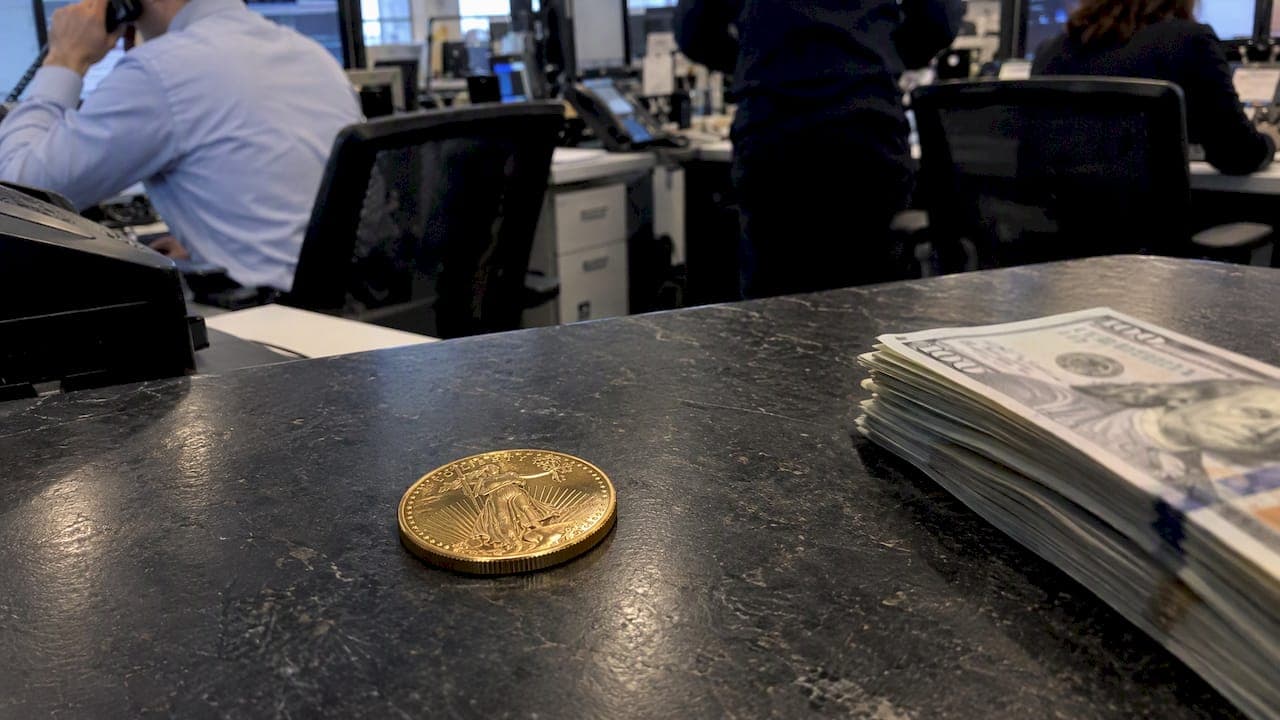
Gold and the U.S. dollar usually move in opposite directions. When the dollar weakens, gold tends to rise. When the dollar strengthens, gold tends to fall. The link is real, but it is a tendency, not a rule. Over a rolling 12-month window the correlation between the U.S. Dollar Index (DXY) and gold typically sits between negative 0.4 and negative 0.6. That is a meaningful relationship, and it leaves a lot of room for exceptions.
This guide explains why the link exists, how strong it has been, when it breaks, and what a XAUUSD trader should do with the information.
TL;DR
- Gold is priced in dollars, so a stronger dollar usually pressures gold and a weaker dollar usually supports it.
- The correlation is moderate, not perfect. Rolling 12-month readings of roughly -0.4 to -0.6 mean the dollar explains only part of gold's moves.
- Real interest rates often matter more than the dollar. Central bank buying and global stress can push gold and the dollar up together.
- Use the DXY as one input next to real yields, news timing and risk limits, never as a stand-alone signal.
- Automated copy trading removes the need to read the correlation yourself, but it does not remove market risk.
Table of Contents
- Why gold and the dollar move in opposite directions
- How strong is the correlation?
- Real yields often matter more than the dollar
- When the inverse link breaks
- Reading the DXY correctly
- Liquidity and trading costs around dollar moves
- A worked example
- Diversifying beyond gold and dollar signals
- Our view: use the correlation as context, not a trigger
- Trade gold without tracking the dollar yourself
- What to watch next
- FAQ
- Sources
Why gold and the dollar move in opposite directions
Two mechanisms explain most of the inverse link.
The currency effect. Gold is priced globally in dollars. When the dollar strengthens, the same dollar price of gold costs more in euros, yen or rupees. Foreign demand falls and pressure builds on the dollar price. When the dollar weakens, gold becomes cheaper for those buyers and demand tends to improve.
The yield effect. Gold pays no interest. It competes with dollar assets that do. According to a Banque de France analysis, when real interest rates (nominal rates minus inflation) rise, the opportunity cost of holding gold rises too. Dollar strength and higher U.S. yields often arrive together, so the two effects reinforce each other.
The CME Group describes the same logic in its overview of gold and the U.S. dollar: the relationship has historically been inverse, and it rests on how gold is priced and held.
How strong is the correlation?
Numbers help here, because "inverse" can mean very different things.
| Measure | Reading | Source |
|---|---|---|
| Rolling 12-month DXY and gold correlation | About -0.4 to -0.6 | Convex |
| Rolling 60-day correlation | Typically near -0.45 | Convex |
| Gold move for a 1% dollar rise (monthly data, 1976 to 2017) | About 3.09% decline in a typical regime | ScienceDirect study |
A correlation of -0.5 is a useful lean, not a guarantee. It means that on many days the two assets move against each other, and on many other days they do not. A trader who shorts gold only because the DXY rose will be wrong often.
The same ScienceDirect paper adds two details. The relationship is non-linear and can be disrupted during extreme market turbulence or financial crises. And a falling dollar tends to have a stronger effect on gold's upside than a rising dollar has on gold's downside. The authors link this to leverage effects in financial markets. In practice, dollar weakness has been the more powerful signal for gold bulls than dollar strength has been for bears.
Real yields often matter more than the dollar
Many traders watch only the DXY. Research points to a stronger driver: real interest rates.
PIMCO argues that changes in real yields explain the majority of changes in gold prices. Its research links a 100-basis-point rise in 10-year U.S. real yields to a decline of roughly 18% in the inflation-adjusted gold price. The Banque de France reaches a similar conclusion: real rates create a stronger and more reliable pressure on gold than the exchange rate alone.
This matters for the dollar question. The dollar often strengthens because the market expects higher U.S. rates. In that case gold falls for two reasons at once, and the DXY looks like the cause when it is partly a symptom. When the dollar moves for other reasons, such as a shift in trade flows or a change in risk appetite, the gold reaction is weaker and less predictable.
A practical habit: before you act on a DXY move, check what moved it. A dollar rally driven by rising real yields is bad news for gold. A dollar rally driven by a flight to safety may not be.

When the inverse link breaks
The correlation is variable. It has run from strongly negative to near zero, and occasionally positive. Three situations stand out.
Global stress
In acute risk-off episodes, investors may buy both the dollar, as a safe haven, and gold, as a hedge against systemic risk. IMF research describes how heightened uncertainty can produce a temporary positive correlation. An academic study on macroeconomic uncertainty and the gold-dollar link examines this same question: whether the relationship is always negative.
Central bank buying
Sustained gold purchases by emerging market central banks have, in recent years, weakened the usual drivers. The IMF's External Sector Report notes that interest rates and dollar strength have at times decoupled from gold, as central banks diversified away from dollar assets. Gold became the second largest global reserve asset at market value in 2024. When official buyers are price-insensitive, a strong dollar does not cap gold the way it used to.
Large swings at record levels
Gold's recent path shows how far price can run on its own logic. Trading Economics data shows an all-time high of 5,608.35 in January 2026, and a price of 4,140.74 on October 19, 2026, down 4.66% over the past month. A fall of that size in a month is large even for gold. Dollar moves alone rarely explain it.
Reading the DXY correctly
The DXY measures the dollar against a basket of major currencies. It is not the whole dollar story, and it is weighted heavily toward the euro. A few points help when you chart it next to XAUUSD.
- Use more than one timeframe. Short windows swing widely. A 60-day reading near -0.45 can sit inside a 12-month reading of -0.6 or -0.4. Check both.
- Compare moves, not levels. Gold at $4,000 and a DXY near 100 tell you nothing on their own. Direction and speed matter.
- Look for divergence. When both rise together for several sessions, the usual driver has changed. Find out why before trading the old pattern.
- Mind the clock. The dollar and gold react most at data releases and during the overlap of the London and New York sessions. Our guide to gold trading hours for U.S. traders lays out the schedule, and our analysis of XAUUSD volatility from 23 years of intraday data shows when moves cluster.
- Respect news. U.S. inflation and jobs reports move the dollar and gold within seconds, often in the same direction for a moment before the usual pattern returns. See how news moves gold.
Liquidity and trading costs around dollar moves
Traders who ask about XAUUSD liquidity are usually asking when it is safe to trade. Gold against the dollar is one of the most actively traded instruments, but liquidity is not constant through the day. Spreads widen when major dollar news lands and in thin overnight hours. Slippage rises with them.
This is where a correct view on the dollar can still lose money. If you enter during a spike, the spread and slippage can consume the edge you expected from the correlation. Two of our guides cover the cost side: how spreads affect XAUUSD trading and how slippage adds up per lot.
Leverage adds another layer. A 1% dollar move that costs gold 3% on average can be much larger on a leveraged position. Read XAUUSD leverage risks and the guide on using 2x exposure safely before sizing a trade on a dollar view.
A worked example
Suppose the DXY rises 1% in a month and nothing else changes. Using the 3.09% average from the 1976 to 2017 study, gold would be expected to fall about 3.09%. On a gold price of $4,140.74, that is roughly $128. This is an illustration of a historical average, not a forecast, and the study itself says the relationship is non-linear.
Now add a second factor: real yields rise 25 basis points in the same month. Applying PIMCO's historical relationship of about 18% per 100 basis points gives roughly 4.5% of additional pressure on the inflation-adjusted price. The two effects overlap, because yields and the dollar move together, so you cannot simply add them. The point is that the yield channel can dwarf the currency channel.

Now reverse it. The dollar rises 1%, but a geopolitical shock sends investors into gold and central banks keep buying. Gold can rise despite the stronger dollar. A trader who held a rigid short rule would have lost money.
Diversifying beyond gold and dollar signals
Because gold's link to the dollar is partial, some investors hold other real assets alongside it. One example is direct investment in U.S. energy projects, which is open to accredited investors and responds to a different mix of drivers. Any such allocation carries its own risks, so check eligibility, fees and liquidity before committing capital.
Our view: use the correlation as context, not a trigger
We trade only gold, so we watch the dollar every day. Here is how we think about it.
The DXY relationship is one of several inputs, and it is the weakest to trade alone. A moderate correlation means a rule based only on the dollar fails often. Sonic AI is built on a systematic strategy for XAUUSD rather than a single macro signal. We report an 80% win rate and 18 consecutive winning months, with results shown on MyFXBook. Those are our reported figures and past performance does not guarantee future results. You can review the details on our MyFXBook results page and the live performance page.
We also think traders should look at risk before they look at returns. A strategy can have a high win rate and still carry meaningful risk, especially with leverage. Our page on Sonic AI risks sets those out, and our guide to Martingale risk in gold explains one method to question in any gold strategy, ours included.
The dollar tells you about the environment. It does not replace position sizing, stop rules or a verified track record.
— Paulo
Trade gold without tracking the dollar yourself
Watching the DXY, real yields, central bank headlines and session times is a full-time job. Sonic AI is an auto-trading strategy focused only on gold (XAUUSD). Trades are copied automatically to your account through COPYX, so you do not need to read correlations or place orders. The strategy fee is a performance fee, and you can read how it works on the fees page. To see how it works end to end, start at Sonic AI or read the XAUUSD copy trading overview. Trading gold carries risk of loss, and you should only fund an account with money you can afford to lose.
What to watch next
Three things decide whether the inverse link holds in the coming months.
- U.S. real yields. If they fall, gold gains support even when the dollar is firm.
- Central bank demand. Continued official buying keeps gold less sensitive to dollar swings.
- Risk sentiment. In a global shock, expect gold and the dollar to rise together for a time.
The safe-haven question is also under debate among institutions. Our summary of the IMF and BIS views on gold as a safe haven covers it.
FAQ
Is the gold price linked to the U.S. dollar?
Yes. Gold is priced in dollars worldwide, so changes in the dollar's value affect what foreign buyers pay. The link is inverse more often than not, but it is not fixed. It can weaken or turn positive during stress or heavy central bank buying.
How much does gold fall when the dollar rises?
In a study of monthly data from 1976 to 2017, a 1% rise in the dollar was associated with a 3.09% decline in gold in a typical regime. That is a historical average. Individual months differ widely, and the effect is stronger when the dollar falls than when it rises.
Why do gold and the dollar sometimes rise together?
In periods of acute global distress, investors may buy the dollar as a safe haven and gold as a hedge at the same time. Strong gold purchases by central banks can also override the usual currency effect. Both produce a temporary positive correlation.
Is the DXY or real yields a better guide for XAUUSD?
Research from PIMCO and the Banque de France points to real interest rates as the stronger driver. The DXY still helps as context, particularly around U.S. data releases. Most traders use both, along with session timing and risk limits.
Sources
- Convex: Dollar Index vs Gold
- ScienceDirect: Nonlinear dynamics of gold and the dollar
- Banque de France: How can we account for the increase in the price of gold?
- CME Group: Gold and the U.S. Dollar, an Evolving Relationship
- PIMCO: Understanding Gold Prices
- IMF External Sector Report 2025, Chapter 2
- Applied Economics: Is the relationship between gold and the U.S. dollar always negative?
- Trading Economics: Gold price and historical data