
You can trade gold (XAUUSD) during most hours of the trading week, from Sunday evening through Friday afternoon, but the best execution window is the London–New York overlap, where spreads are tightest and directional moves are most reliable.
TLDR:
- Weekly schedule: Spot XAUUSD opens Sunday evening, closes Friday afternoon. COMEX GC futures follow a similar weekly window with a daily break in the late afternoon.
- Best window: London–New York overlap, 08:00–12:00 ET. Tightest spreads, highest volume, most reliable price moves.
- Avoid: The daily rollover window (around 5:00 PM ET), Asian session if you need tight spreads, and holding open positions into the Friday 5:00 PM ET close without a plan for the weekend gap.
Table of Contents
- Why gold trading hours aren't as simple as "24/5"
- Session-by-session guide to gold trading times
- How trading hours differ by instrument
- What the data says about the most active hours for gold
- The daily maintenance window and what it means for your trades
- Holidays and shortened sessions that affect gold liquidity
- Practical trading rules for U.S. XAUUSD traders
- Key Takeaways
- The hours matter more than most traders admit
- Sonicaigold handles session timing automatically
- Useful sources and calendars to check
Why gold trading hours aren't as simple as "24/5"
Gold appears to trade around the clock on weekdays because pricing responsibility passes continuously between global financial centers: Sydney and Tokyo open the week, London takes over mid-morning UTC, and New York carries the session through the afternoon. Spot XAUUSD and retail CFDs are available nearly 24 hours Monday through Friday, but the exact open, close, and any daily break depend on the broker.
That continuous availability is not the same as consistent execution quality. A market that is "technically open" at 2:00 AM ET is not the same market you trade at 10:00 AM ET. Thinner books during the Asian session mean wider spreads and slower order fills. Institutional participation concentrates during London and New York hours, and price discovery sharpens accordingly. Sessions determine the liquidity environment, but price moves when institutional flow and news force repricing — volume alone isn't the sole cause of large moves.
For U.S. traders, the practical distinction is this: you have access to the market almost all week, but only a few hours each day are worth treating as primary execution windows.
Pro Tip: Set your charting platform to display both ET and UTC. The US and UK do not always switch to daylight saving time on the same date, creating a 1–2 week period each spring and fall when the ET-to-UTC offset shifts by one hour. Confirm your broker's displayed session times during those transition weeks.
Session-by-session guide to gold trading times
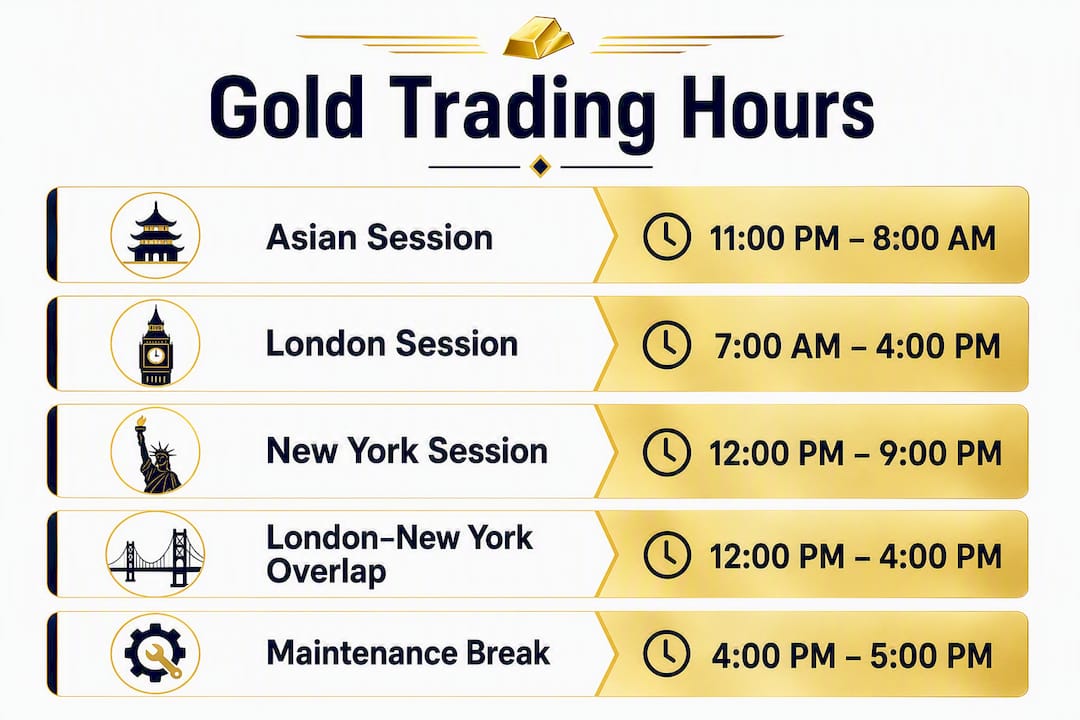
The table below maps each major session to its approximate ET and UTC windows and describes what to expect in terms of liquidity and volatility.

| Session | ET Window | UTC Window | Liquidity / Volatility Note |
|---|---|---|---|
| Asian (Sydney/Tokyo) | Evening to early morning | Late night to morning | Lower volume; range-bound; wider spreads; cleaner trends possible but slippage risk on stops |
| London Open | Early morning | Morning to early afternoon | Volume picks up; breakouts more likely; LBMA benchmark auctions add institutional reference events |
| London–New York Overlap | Morning to noon | Early afternoon to early evening | Highest liquidity; tightest spreads; largest daily moves |
| New York (post-overlap) | Noon to late afternoon | Evening to nighttime | Moderate volume; U.S. macro data impact; volatility can spike on scheduled releases |
| Daily Rollover | Late afternoon | Late evening UTC | Spreads widen; liquidity drops; avoid new entries |
The London–New York overlap is consistently the most active window across broker guides and exchange documentation. Both major financial centers are open simultaneously, institutional order flow is at its peak, and the bid-ask spread on XAUUSD reaches its narrowest point of the day.
DST caveat: ET shifts between UTC-5 (November–March) and UTC-4 (March–November). The UK observes its own DST transition, which does not always align with the U.S. date. During the transition weeks, the London open can appear one hour earlier or later than expected in ET. Always verify session times on your broker's platform during those weeks.
How trading hours differ by instrument
Not every gold instrument follows the same schedule. The table below describes three main instruments U.S. traders use, with their typical weekly open and close times and daily breaks as generally observed by brokers or exchanges.

| Instrument | Weekly Open | Weekly Close | Daily Break | Notes |
|---|---|---|---|---|
| Spot XAUUSD / CFD | Sunday evening | Friday afternoon | Late afternoon (broker-specific) | Broker-dependent; some have no formal break |
| COMEX GC Futures | Sunday evening | Friday afternoon | Late afternoon daily | CME Globex includes a daily break; TAS closes early afternoon |
| Gold ETFs (e.g., GLD) | Morning Monday | Afternoon Friday | None (U.S. exchange hours) | No weekend or overnight access; tracks spot price during U.S. equity hours |
Key points by instrument:
- Spot XAUUSD / CFD: The most flexible instrument for retail traders. Opens Sunday at 22:00 UTC (17:00 ET) and closes Friday at 22:00 UTC (17:00 ET). Spreads are tightest during the London–New York overlap and widest during the Asian session and around the daily rollover.
- COMEX GC Futures: Trades on CME Globex with a formal 60-minute daily break starting at 5:00 PM ET. The TAS (Trade at Settlement) window closes at 1:30 PM ET each day. Futures carry margin requirements and contract specifications that differ from spot CFDs.
- Gold ETFs: Strictly U.S. stock-exchange hours (9:30 AM–4:00 PM ET, Monday–Friday). No overnight or weekend access. Suitable for longer-term positions but not for intraday traders who need to act on Asian or London session moves.
When spreads typically widen: Around the daily rollover (~5:00 PM ET), at the Asian session open (Sunday 6:00 PM ET), and during low-liquidity holiday periods. For intraday trades, the London–New York overlap is the preferred window. For swing positions held overnight, futures or spot CFDs are the practical choices; ETFs cannot fill that role.
What the data says about the most active hours for gold
The London–New York overlap (08:00–12:00 ET) is the primary high-liquidity window, and broker guides and exchange documentation consistently support that ranking. Institutional participation from both centers concentrates during those four hours, producing the tightest bid-ask spreads and the most reliable directional moves of the trading day.
Ranked by execution quality and liquidity depth:
- London–New York overlap (08:00–12:00 ET): Tightest spreads, highest volume, best conditions for limit and market orders.
- London session pre-overlap (03:00–08:00 ET): Volume builds; breakouts are more common; the LBMA benchmark auctions at 10:30 and 15:00 GMT add institutional reference points.
- New York post-overlap (12:00–17:00 ET): Moderate depth; U.S. macro releases (CPI, FOMC, NFP) can spike volatility sharply during this window.
- Asian session (18:00–03:00 ET): Lowest volume; range-bound behavior is typical; thinner books can allow clean trends but also increase slippage if stops are poorly sized.
Some traders organize their day around three intraday "killzones": the London open, the London–New York overlap, and the New York open. Each window historically produces a disproportionate share of the daily range and volatility. Midweek sessions (Wednesday and Thursday) tend to show higher activity tied to scheduled macro events; Monday often runs at lower volume.
Statistic callout: The London–New York overlap (08:00–12:00 ET / 13:00–17:00 UTC) is the most active and liquid period for XAUUSD, producing the tightest spreads and most reliable directional moves of the trading day.
Pro Tip: Automated strategies are especially sensitive to session timing. Build session filters into any algorithm so entries are disabled outside the London–New York overlap and during the daily rollover window. An AI trading bot that ignores session context will fill orders in thin markets and face wider spreads and stop-outs that would not occur during peak hours.
The daily maintenance window and what it means for your trades
Every trading day, gold markets go through a brief settlement and maintenance pause. For spot XAUUSD and COMEX GC futures, this window falls around 5:00 PM ET (22:00 UTC). During this period, liquidity drops sharply, spreads widen, and price quotes can become unreliable.
Spot CFD brokers handle this differently from CME Globex. CME Globex enforces a formal 60-minute break (5:00–6:00 PM ET) each day. Retail CFD brokers may have a shorter or less defined pause, but virtually all of them show spread widening around the same time. Automated strategies should include logic to disable entries during this window to avoid stop-outs caused by temporary quote dislocations.
Pre-maintenance checklist:
- Close or reduce open positions you do not intend to hold overnight, especially short-term intraday trades.
- Widen stop-loss levels on any positions you keep open, to account for temporary spread spikes.
- Pause automated entry logic for at least 30 minutes before and after the rollover window.
- Confirm your broker's exact maintenance time on their platform — it can vary by a few minutes from the standard 5:00 PM ET.
Steps to follow after the maintenance window closes:
- Wait for spreads to normalize before placing new orders. A quick check of the bid-ask on your platform takes under a minute.
- Review any positions that were open during the window for unexpected fills or stop triggers.
- Re-enable automated entry logic only after confirming normal spread levels.
- Check for any broker notifications about extended maintenance or technical issues before resuming full position sizing.
Holidays and shortened sessions that affect gold liquidity
Gold markets do not close for every public holiday, but certain dates reduce liquidity enough to change execution conditions materially. U.S. traders should track both CME Group holidays and their broker's own calendar, since the two do not always align.
Key dates and their typical effect:
- Good Friday: CME closes COMEX gold futures early or for the full day. Spot CFD liquidity also thins significantly.
- Christmas Day and New Year's Day: Full closure or severely reduced hours on both futures and spot markets. Spreads on any available quotes are wide.
- U.S. bank holidays (e.g., Thanksgiving, Independence Day): COMEX may operate on a shortened schedule; spot CFD brokers vary. Volume drops noticeably even when the market is technically open.
- UK bank holidays: London session liquidity drops, which affects the overlap window. The London–New York overlap loses much of its institutional depth on UK public holidays.
Weekend gap risk is a related concern. When gold closes Friday at 5:00 PM ET and reopens Sunday at 6:00 PM ET, the price can open at a materially different level if significant news breaks over the weekend. Experienced traders reduce exposure before the Friday close or hedge positions to control gap risk. Holding a full-size position into the weekend without a plan is one of the more common sources of unexpected losses for retail traders.
Where to check: The CME Group holiday calendar lists official COMEX closure and early-close dates. Your broker's trading-hours page lists their specific maintenance and holiday schedule. Check both before holding positions into any known holiday.
Practical trading rules for U.S. XAUUSD traders
A clear session-aware routine reduces execution errors and keeps risk management consistent. The steps below apply to both intraday and short-term swing traders.
- Choose your session window first. The London–New York overlap (08:00–12:00 ET) is the default for intraday execution. If you trade the London open (03:00–08:00 ET), expect higher volatility and less predictable fills. Avoid the Asian session for tight-spread entries unless you are specifically trading a range-bound strategy.
- Match your order type to available liquidity. During the overlap, market orders fill cleanly. Outside peak hours, use limit orders to control entry price and avoid slippage from thin books.
- Size positions against available depth. Larger positions in thin markets (Asian session, rollover window) move price against you on entry and exit. Scale size down outside the overlap.
- Define stop placement before entering. Place stops outside the session's typical noise range, not inside the spread. During the rollover window, spreads can spike enough to trigger stops that would not have been hit in normal conditions.
- Plan around U.S. macro releases. Midweek sessions (Wednesday and Thursday) carry the highest event risk: FOMC statements, CPI prints, and NFP reports all move gold sharply. Either reduce size before the release or wait for the initial spike to settle before entering.
- Manage weekend gap risk every Friday. Before 5:00 PM ET, decide whether to close, reduce, or hedge any open positions. Do not carry full-size positions into the weekend without a defined plan.
Risk management bullets:
- Never place new entries within 30 minutes of the 5:00 PM ET rollover window.
- Set a calendar alert for scheduled macro releases (FOMC, CPI, NFP) every week.
- Test any automated strategy across multiple sessions before running it live, specifically checking behavior during the Asian session and rollover window.
- Review the CME and broker holiday calendars at the start of each month.
Pro Tip: When running an automated gold strategy, add a session-time filter that restricts entries to the London–New York overlap (08:00–12:00 ET) and disables the system from 4:30 PM to 6:30 PM ET around the rollover. This single adjustment removes the majority of bad fills caused by thin-market conditions.
Key Takeaways
The single most important fact for U.S. gold traders: the London–New York overlap (08:00–12:00 ET) is the only window where liquidity, spreads, and directional reliability consistently align for quality execution.
| Point | Details |
|---|---|
| Weekly schedule | Spot XAUUSD opens Sunday 6:00 PM ET and closes Friday 5:00 PM ET; COMEX GC follows the same window with a 60-minute daily break. |
| Best execution window | London–New York overlap (08:00–12:00 ET / 13:00–17:00 UTC) offers the tightest spreads and most reliable directional moves. |
| Daily rollover risk | Spreads widen and liquidity drops around 5:00 PM ET daily; close intraday positions or pause automated entries during this window. |
| Weekend gap planning | Reduce or hedge open positions before Friday 5:00 PM ET close; prices can re-open Sunday at a materially different level. |
| Sonicaigold auto-trading | Sonicaigold's XAUUSD strategy uses session-aware execution via COPYX, with 18+ months of independently verified results available on the performance page. |
The hours matter more than most traders admit
Most retail traders focus on entry signals and ignore session context entirely. That is a consistent mistake. A valid setup at 2:00 AM ET in a thin Asian market will fill at a worse price, carry a wider spread cost, and face a stop-out risk that the same setup at 10:00 AM ET simply does not have.
The practical routine that follows from this article is straightforward: confirm the weekly open and close for your instrument, identify the London–New York overlap as your primary execution window, build the 5:00 PM ET rollover into your daily checklist, and check the CME and broker holiday calendars before holding positions into any known holiday.
The one adjustment that changes execution quality most for U.S. traders is not a better indicator or a tighter stop. It is trading during the right hours. The London–New York overlap is not a preference; it is where institutional depth, tight spreads, and reliable price discovery actually exist. Everything else is working around the edges of that fact.
For traders using automated strategies, session filtering is not optional. A system that runs entries at any hour will eventually fill in conditions that make the trade unworkable before it has a chance to develop.
Sonicaigold handles session timing automatically
Manual session management takes discipline. Tracking the London–New York overlap, pausing entries around the rollover, and managing weekend gap risk every Friday requires consistent attention that most traders underestimate.
Sonicaigold's automated XAUUSD strategy handles that execution layer directly. The system trades gold exclusively, uses session-aware logic via the COPYX platform, and has produced 18 consecutive months of independently verified results. You do not need to monitor the clock or adjust entries around maintenance windows. The strategy manages those conditions as part of its core execution approach.

Performance data is publicly available on the Myfxbook results page. U.S. traders can review account setup and onboarding details on the USA members page. To get started with automated gold copy trading, visit the gold copy trading page and follow the setup steps.
This article is general information, not financial or investment advice. Confirm current trading hours, instrument specifications, and regulatory requirements with your broker and a qualified professional before trading.
Useful sources and calendars to check
Authoritative pages to verify current hours, holiday schedules, and maintenance windows:
- CME Group — COMEX Gold Futures: Official trading hours, daily break times, TAS window, and the CME holiday calendar. The primary source for COMEX GC specifications.
- StarTrader — XAUUSD Trading Hours Guide: Detailed weekly schedule in ET, PT, and GMT with session tables and rollover notes.
- Your broker's trading-hours page: Every broker publishes its own maintenance schedule and holiday closures. These can differ from CME dates. Check this page monthly and before any known holiday.
- Best copy trading platforms for gold: Analysis of automated and copy-trading approaches for XAUUSD, including how session timing affects copy-trade execution.
- Is copy trading safe for U.S. gold investors?: Covers safety, risk, and regulatory considerations for U.S. traders using automated gold strategies.
- Sonicaigold blog: Ongoing coverage of XAUUSD execution, session analysis, and gold copy-trading strategy updates.