
Fed policy cues, CPI/PCE releases, Nonfarm Payrolls, Treasury yields, and oil or geopolitical shocks are the five fastest, highest-impact news categories for gold. When any of these breaks, the Reuters gold markets desk documents the immediate transmission: dollar strength or weakness, yield moves, and safe-haven demand all shift within minutes. The news impact on gold is not random — it follows a repeatable logic you can learn to read.
Highest-impact headlines to watch:
- Fed policy signals (FOMC decisions, dot plot revisions, Fed speaker language): the single most powerful driver of real yields and dollar direction
- US CPI/PCE (especially core month-on-month): directly reprices rate-hike odds and inflation expectations
- Nonfarm Payrolls (NFP) with wage growth and revisions: the labor half of the Fed's dual mandate
- DXY and 10-year Treasury yield moves: the transmission channels that translate macro news into gold price action
- Oil price shocks and geopolitical escalations: trigger safe-haven demand and inflation-expectation shifts simultaneously
Pro Tip: When a headline breaks, check the 10-year Treasury yield and DXY before you check the gold price. If yields and the dollar move in the same direction as the news implies, the gold reaction is likely durable. If they diverge, treat the first gold move as noise.
Key Takeaways
The news impact on gold follows a consistent logic: Fed policy, CPI/PCE, NFP, Treasury yields, and geopolitical shocks are the primary drivers, and each one transmits through real rates, the dollar, or safe-haven demand.
| Point | Details |
|---|---|
| Top five gold drivers | Fed policy, CPI/PCE, NFP with revisions, DXY/10-year yields, and oil/geopolitical shocks move gold fastest. |
| NFP correlation | NFP is negatively correlated with gold: a miss (like July's –23,000) reduces hike odds and supports gold prices. |
| Confirmation sequence | Wait for DXY and 10-year yield to confirm news direction before entering; a close above/below a key moving average adds conviction. |
| Risk management rule | Cap pre-news exposure, size positions using ATR × 1.5 as stop distance, and apply a time-stop if the trade does not follow through within four hours. |
| Sonicaigold | Sonicaigold's COPYX-based auto-trading strategy applies consistent risk controls and executes on XAU/USD signals across all market conditions, with 18+ months of verified results. |
Table of Contents
- Which news headlines move gold prices the most?
- How fast does gold react? A timing and magnitude guide
- How to read CPI, NFP, and Fed signals beyond the headline
- How geopolitical shocks and oil prices transmit to gold
- Which technical signals confirm a news-driven gold move?
- What tools do you need to monitor gold news in real time?
- Three dated case studies: how CPI, NFP, and geopolitics moved gold
- How to manage risk around news-driven gold moves
- How automated gold strategies handle news events differently
- What this means for gold investors right now
- Sonicaigold: automated gold trading built for news-driven markets
- Sources
Which news headlines move gold prices the most?
Gold responds to news through three transmission channels: real interest rates, the US dollar, and safe-haven demand. Every major headline hits at least one of them. The ranking below reflects typical market impact, from highest to lowest.
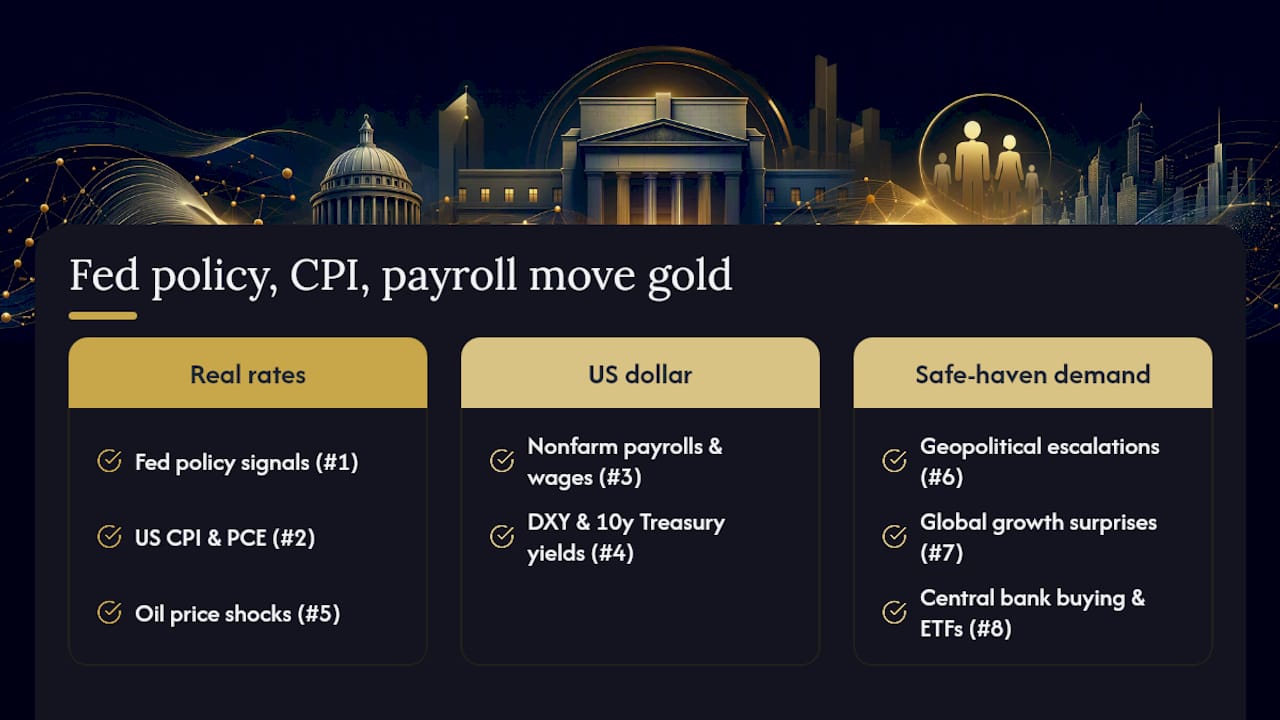
1. Federal Reserve policy signals Fed meetings, dot plot updates, and individual Fed speaker comments move real yields directly. A hawkish surprise (faster hikes, higher terminal rate) lifts real yields and the dollar, pressuring gold. A dovish pivot does the reverse. The CME FedWatch Tool translates each print into live rate-hike probabilities — watch it alongside the gold chart.
2. US CPI and PCE Core CPI (month-on-month) and the Fed's preferred PCE gauge reprice rate expectations within seconds of release. A hotter-than-expected print raises hike odds, lifts yields, and typically caps gold. A softer print does the opposite. FXStreet reported gold trading near $4,400 while markets parsed Fed hike bets and CPI risk simultaneously — a clear illustration of how the two forces interact.
3. Nonfarm Payrolls and wage growth NFP data is generally negatively correlated with gold: a stronger-than-expected payroll print tends to strengthen the USD and push gold lower, while a miss supports gold by reducing rate-hike pressure. Wage growth (average hourly earnings) often matters as much as the headline number because it feeds directly into inflation expectations.
Statistic callout: July NFP came in at –23,000 jobs, with prior months revised down by a combined ~103,000. Markets immediately reduced near-term Fed hike odds, and gold prices moved higher within the session.
4. DXY and 10-year Treasury yields These are not news events themselves, but they are the real-time scoreboard for every macro release. Gold trades in dollars, so a rising DXY makes gold more expensive for foreign buyers and typically suppresses price. The 10-year real yield (nominal yield minus inflation breakeven) is the most direct competitor to gold as a store of value.
5. Oil price shocks Oil spikes raise inflation expectations, which can support gold. They can also strengthen the dollar and push yields higher, which caps gold. The net effect depends on context — more on this in the geopolitics section below.
6. Major geopolitical escalations Conflict, sanctions, and supply disruptions drive safe-haven flows into gold regardless of rate expectations. These moves are often sharp but can reverse quickly once the initial shock fades.
7. Global growth surprises (China PMI, Eurozone data) Weak Chinese manufacturing PMI or a Eurozone recession signal reduces global risk appetite and can lift gold. Strong data does the reverse by supporting the dollar and global yields.
8. Central bank buying and ETF flows Central bank demand is a structural support for gold over time, as documented by the World Gold Council. Large ETF inflows (GLD, IAU) and rising CFTC net-long futures positions amplify news-driven moves. When positioning is already stretched long, even a mildly positive print can trigger a sharp reversal.
How fast does gold react? A timing and magnitude guide
Gold's reaction to news follows a predictable arc. Understanding the timeline helps you set realistic stop and target levels.
Minute-by-minute (0–5 minutes) Algorithmic systems execute within milliseconds of a release. Spreads widen, liquidity thins, and the initial price move is often exaggerated. This is the highest-risk window for manual traders.
First hour (5–60 minutes) The market begins to digest the full report. DXY and 10-year yields settle into a direction. Gold either confirms the initial move or reverses as traders reassess the subcomponents (wage growth, revisions, core vs. headline CPI).
Hours to days (1–72 hours) Technical levels come into play. Moving averages, Fibonacci retracements, and volume profiles determine whether the news-driven move extends or stalls. TradingPedia noted gold reclaiming $4,400 with technical resistance near the 200-day SMA — a typical post-news consolidation pattern.
Weeks to months If the news triggers a genuine repricing of the Fed cycle (e.g., a series of weak NFP prints or persistently high CPI), gold can sustain a directional trend for weeks. The Fed's dual-mandate bind — weak labor data plus sticky inflation — historically establishes a medium-term bullish floor for gold because it limits the Fed's ability to hike aggressively.
Typical magnitude by headline class:
- Fed meeting surprise (hawkish/dovish): $30–$80 intraday move on XAU/USD
- CPI miss or beat: $20–$60 intraday, with follow-through over 24–48 hours if it reprices the dot plot
- NFP miss (like July's –23,000): $20–$50 immediate, with persistence tied to revision depth
- Geopolitical escalation: $30–$100 intraday, often partially reversed within 48 hours
- Oil shock: $15–$40, direction depends on dollar and yield response
Pro Tip: Never trade the first 60 seconds of a major release. The initial print is often revised or misread by algos. Wait for DXY and the 10-year yield to confirm direction before entering a position.
How to read CPI, NFP, and Fed signals beyond the headline
The headline number is the starting point, not the conclusion. Revisions and subcomponents routinely move policy pricing more than the top-line figure.
CPI and PCE checklist
- Core CPI month-on-month — this is what the Fed watches most closely. A 0.3% or higher print is typically hawkish for yields and bearish for gold.
- Core PCE — the Fed's stated preferred measure. Compare it to the prior month and to market-implied breakevens.
- Ex-energy, ex-food components — isolate the sticky services inflation that the Fed cannot easily dismiss.
- Market-implied real yields — check the TIPS market (5-year and 10-year) immediately after the print. Rising real yields are the clearest near-term headwind for gold.
NFP checklist
- Headline payrolls — the first number, but not the only one.
- Prior-month revisions — the July report's combined downward revision of ~103,000 was as significant as the headline miss. Revisions change the cumulative labor picture and shift Fed expectations.
- Unemployment rate and participation rate — a falling unemployment rate driven by people leaving the workforce is less hawkish than one driven by genuine hiring.
- Average hourly earnings — wage growth feeds directly into services inflation. A beat here can offset a weak headline and keep the Fed hawkish.
Fed signal checklist
- Dot plot changes — shifts in the median dot for the current year or next year move markets more than the statement language.
- FOMC statement wording — watch for additions or deletions of phrases like "additional firming" or "data dependent."
- Voting splits — a dissent signals internal division and reduces the certainty of the next move.
- Fed speaker calendar — scheduled speeches between meetings can function as policy signals. Note whether the speaker is a voter and whether their tone diverges from the last statement.
Using CME FedWatch: After each release, open the CME FedWatch Tool and check the probability shift for the next two meetings. A 10-percentage-point or larger swing in hike probability typically produces a durable gold move. Smaller shifts often reverse within hours.
Statistic callout: NFP surprises are negatively correlated with gold — a stronger-than-expected print strengthens the USD and raises rate expectations, which pressures gold. Pair the NFP print with DXY and 10-year yield direction to judge whether the gold reaction will hold.
How geopolitical shocks and oil prices transmit to gold
Geopolitical risk and commodity shocks reach gold through different channels, and they do not always point in the same direction.

Safe-haven demand channel Direct geopolitical escalation — military conflict, sanctions, or supply disruptions — drives investors toward gold as a store of value outside the financial system. This channel operates independently of rate expectations. Demand rises, physical buying increases, and gold typically moves higher within hours of a credible escalation.
Oil inflation channel An oil price spike raises headline inflation expectations. That can support gold through the inflation-hedge channel. But it can also strengthen the dollar (petrodollar flows) and push Treasury yields higher as markets price in a more aggressive Fed response. When the yield and dollar effects dominate, oil-driven inflation can actually cap gold rather than lift it.
The two-way effect in practice Tensions around the Strait of Hormuz illustrate both sides. An initial escalation drives safe-haven gold buying and lifts oil. If the Fed signals it will respond to the resulting inflation with rate hikes, yields rise, the dollar strengthens, and gold gives back some of the initial gain. The net outcome depends on whether the market reads the shock as primarily a risk event (gold positive) or an inflation event (gold mixed).
Cross-currency safe havens Gold does not operate in isolation. The Japanese yen (JPY) and Swiss franc (CHF) are the other primary safe-haven currencies. When stress is broad — a global risk-off event rather than a US-specific shock — capital flows into all three simultaneously. In that environment, gold's move is amplified. When stress is US-specific (a domestic political shock, for example), JPY and CHF may strengthen while gold's move is more modest because the dollar itself is under pressure, which complicates the transmission.
- Watch JPY/USD and CHF/USD alongside gold during geopolitical events
- A simultaneous rally in gold, JPY, and CHF signals broad risk-off; a gold rally without JPY/CHF strength may be more fragile
- Oil-driven gold moves require confirmation from yields and the dollar before treating them as durable
The Business Times documented gold advancing above $4,000 while markets weighed US inflation data, central bank buying, and energy-price risks together — a clear example of these channels operating in parallel.
Which technical signals confirm a news-driven gold move?
A news headline creates the impulse. Technical and sentiment signals tell you whether the move is real or a false breakout.
Key technical indicators for XAU/USD
- 100-day and 200-day moving averages: a close above or below these levels after a news event is a strong confirmation signal. Gold reclaiming $4,400 with resistance near the 200-day SMA is a textbook example of technical context shaping the post-news reaction.
- RSI and momentum: RSI above 70 after a news spike suggests the move may be exhausted; below 30 after a selloff suggests oversold conditions that could reverse.
- ATR-based volatility bands: use the Average True Range to set realistic stop distances. During high-impact news, ATR expands — widen stops accordingly or reduce position size.
- Fibonacci retracement levels: intraday traders use 38.2%, 50%, and 61.8% retracements of the prior swing to identify likely reversal or continuation zones after the initial news move.
- Volume and volume profile: a news-driven move on above-average volume is more likely to persist. A spike on thin volume (common in the first 60 seconds) is more likely to reverse.
Sentiment and positioning signals
- CFTC Commitments of Traders (COT) report: net speculative long positions in COMEX gold futures. When positioning is heavily long before a news event, even a positive surprise can trigger profit-taking.
- ETF flows (GLD, IAU): sustained inflows over multiple sessions confirm that institutional money is adding exposure, not just speculating intraday.
- Futures open interest: rising open interest alongside a price move confirms new money is entering the trend. Falling open interest during a price move suggests short-covering rather than fresh conviction.
Pro Tip: Set a rule before the release: you will only act if both DXY and the 10-year yield confirm the news direction within 15 minutes. This single filter eliminates most false breakouts driven by algo noise in the first seconds.
Use TradingView to overlay XAU/USD, DXY, and the 10-year yield on a single screen. The visual confirmation of all three moving together is faster and more reliable than checking them separately.
What tools do you need to monitor gold news in real time?
A reliable monitoring setup covers live prices, economic calendar alerts, and news feeds simultaneously.
Essential real-time feeds
- XAU/USD spot price: live quotes via TradingView or your broker's platform
- COMEX/CME gold futures (GC): front-month contract for institutional-grade price discovery
- DXY (US Dollar Index): the primary transmission channel for macro news
- 10-year Treasury yield: check the CME or Bloomberg feed, or the CBOE 10-year yield index (TNX)
- WTI/Brent crude: for geopolitical and oil-channel monitoring
- GLD/IAU ETF flows: daily flow data from the fund providers or Bloomberg
Economic calendar setup
- Subscribe to BLS release alerts at Bls for NFP (first Friday of each month) and CPI (mid-month).
- Add FOMC meeting dates and Fed speaker events from the Federal Reserve's official calendar.
- Set calendar alerts 30 minutes before each release so you can check positioning and current levels.
- Mark PCE release dates from the BEA (Bea) — the Fed's preferred inflation gauge.
Dashboard configuration
- TradingView: create a watchlist with XAU/USD, DXY, TNX (10-year yield), WTI, GLD, and the S&P 500 (risk sentiment proxy). Use multi-chart layout to watch all simultaneously.
- CME FedWatch Tool: bookmark the current-meeting probability page. Refresh immediately after CPI, NFP, and Fed speaker events.
- Reuters or Bloomberg news feed: set keyword alerts for "gold," "Fed," "CPI," "NFP," and "geopolitical."
Alert triggers to set
- Price alert: XAU/USD moves more than 1 ATR in either direction within 15 minutes of a scheduled release
- DXY alert: moves more than 0.3% within 10 minutes of a release
- Yield alert: 10-year Treasury yield moves more than 5 basis points within 30 minutes of a release
- News alert: any headline containing "Fed," "rate hike," "CPI," or named conflict regions
Understanding gold trading hours and session liquidity matters here: NFP releases at 8:30 AM ET hit during the most liquid overlap of London and New York sessions, which amplifies moves. A geopolitical headline at 2:00 AM ET hits thinner Asian-session liquidity, which can produce exaggerated initial moves that partially reverse at the London open.
Three dated case studies: how CPI, NFP, and geopolitics moved gold
Case study 1: July NFP miss
Date: August 2026 (July payroll data released) Event: US nonfarm payrolls fell by 23,000 in July, with prior months revised down by a combined ~103,000. Immediate drivers: Dollar index weakened as markets reduced near-term Fed hike odds. Treasury yields fell. Gold moved higher within the session. Persistence: The move held through the following session as traders absorbed the full revision picture. The dual-mandate dynamic — weak labor data with inflation still elevated — reinforced the bullish floor for gold. Key lesson: The revision total was larger than the headline miss. Traders who read only the headline number missed the full bearish-dollar signal.

Case study 2: CPI print repricing Fed odds
Date: August 12, 2026 Event: Markets awaited US CPI data with gold trading near $4,400. FXStreet reported gold holding a positive bias below $4,400 as Fed hike bets and oil-driven inflation created competing pressures. Immediate drivers: Pre-release positioning was cautious. The interplay between CPI risk and oil prices meant gold was supported but capped. A hotter-than-expected CPI would have lifted yields and the dollar, pressing gold below $4,400. Persistence: Gold reclaimed $4,400 as the data was digested, with technical resistance near the 200-day SMA limiting further upside. Key lesson: Pre-release positioning and technical levels shape the magnitude of the reaction as much as the print itself.
Case study 3: Middle East escalation and safe-haven flows
Date: Ongoing 2026 (Strait of Hormuz / Iran tensions) Event: Regional escalation drove immediate safe-haven demand for gold alongside an oil price spike. Immediate drivers: Gold moved higher on safe-haven flows. Oil rose simultaneously, raising inflation expectations. The dollar initially weakened on risk-off sentiment, amplifying gold's gain. Persistence: Partial reversal within 48 hours as markets assessed whether the Fed would respond to oil-driven inflation with rate hikes, which would lift yields and cap gold. Key lesson: Geopolitical gold moves require monitoring the oil-yield-dollar triangle. The initial safe-haven spike is often the best entry for a short-term trade; the medium-term direction depends on the Fed's reaction function.
How to manage risk around news-driven gold moves
Position sizing and stop placement before a release matter more than the trade entry itself.
-
Cap pre-news exposure. Reduce position size to 50% of normal before any tier-1 release (NFP, CPI, FOMC). The first 60 seconds of a release can move gold $30–$80 against you before you can react.
-
Use ATR-based position sizing. Calculate the current 14-day ATR for XAU/USD. Your stop distance should be at least 1.5x ATR to avoid being stopped out by normal post-release volatility. Adjust position size so that a 1.5x ATR stop equals no more than 1–2% of account equity.
Simple formula: Position size = (Account equity × Risk %) ÷ (ATR × 1.5)
-
Set stops before the release, not after. Placing a stop after the initial move means you are reacting to noise. A pre-set stop at a logical technical level (below a key moving average or Fibonacci support) removes emotion from the decision.
-
Scale in after confirmation. If the news confirms your directional view and DXY/yields align, add to the position in the 15–60 minute window after the release, not in the first 60 seconds.
-
Use short-dated options for binary events. For FOMC decisions and CPI releases with high uncertainty, a short-dated straddle or strangle on COMEX gold futures (GC options) limits downside while preserving upside participation.
-
Apply currency hedges when relevant. If your gold exposure is denominated outside USD (e.g., you hold physical gold priced in euros or yen), a USD/EUR or USD/JPY hedge reduces the currency-translation risk that news events introduce.
Pro Tip: Combine a price-stop with a time-stop. If the trade does not move in your favor within four hours of the release, close it regardless of price. News-driven moves that do not follow through quickly often reverse entirely.
For a structured approach to automated gold trading strategies that incorporate these risk rules systematically, the mechanics are well-documented for investors who prefer a rules-based framework.
How automated gold strategies handle news events differently
Manual traders face a structural disadvantage during high-impact news: reaction time, emotional discipline, and round-the-clock availability are all limited. Automated strategies address each of these constraints directly.
Process flow for a news-sensitive automated strategy
- Detection: price triggers and volatility thresholds fire when ATR expands beyond a set multiple, or when a scheduled release window opens
- Signal evaluation: technical filters (moving average position, RSI, volume) confirm whether the initial price move meets entry criteria
- Execution: trades are placed via an auto-copy system (such as COPYX) within milliseconds of signal confirmation, without manual intervention
- Risk controls: volatility caps reduce position size automatically during high-ATR periods; dynamic stops adjust to post-release price action
Advantages over manual trading
- Speed: execution in milliseconds vs. seconds or minutes for a manual trader
- Discipline: no hesitation, no second-guessing after a whipsaw, no overtrading after a loss
- Consistent risk application: position sizing and stop rules apply identically to every trade, regardless of market conditions
- Round-the-clock monitoring: geopolitical events and Asian-session moves are captured without requiring the investor to be awake
The COPYX trade-copying mechanism replicates the strategy manager's positions in subscriber accounts automatically, which means the speed and discipline advantages apply to every account in the network, not just the strategy manager's own.
Sonicaigold's auto-trading strategy for XAU/USD has recorded 18+ consecutive winning months with independently verified results. Performance data is available on the Sonic AI Myfxbook results page. Verify the track record, fees, and independent verification directly before allocating capital. Past performance does not guarantee future results.
World Gold Council research confirms that central bank demand provides a structural floor for gold over time — a dynamic that automated strategies can exploit through consistent positioning without the behavioral biases that cause manual traders to exit too early or too late.
What this means for gold investors right now
The current macro environment places gold at the intersection of three competing forces: a Fed that cannot hike aggressively without breaking labor markets, inflation that remains sticky enough to prevent rate cuts, and geopolitical risk that keeps safe-haven demand elevated. That combination is historically constructive for gold, but it does not produce a straight line higher.
The most important signal to watch is the Fed's dual-mandate bind. When NFP prints weaken and CPI stays elevated, the Fed's room to maneuver narrows. GoldSilver's analysis of this dynamic describes it as a structural bullish floor — not a guarantee of immediate upside, but a constraint on how aggressively the Fed can push real yields higher.
For traders, the practical posture is: stay hedged around tier-1 releases, use ATR-based sizing, and wait for DXY and yield confirmation before committing to a directional trade. For longer-term investors, the allocation case for gold through physical, ETFs, or managed copy-trading rests on the same dual-mandate logic — the Fed's options are limited, and that limits the ceiling on real yields.
The next scheduled catalysts worth monitoring: the FOMC meeting calendar, monthly CPI releases, and oil price developments tied to Middle East supply risk. Any one of these can shift the short-term picture materially. The structural picture, however, is unlikely to change until the Fed either achieves its inflation target or labor markets deteriorate enough to force a pivot.
Sonicaigold: automated gold trading built for news-driven markets
Investors who understand how news moves gold but prefer not to manage every release manually have a direct alternative. Sonicaigold runs an auto-trading strategy focused exclusively on XAU/USD, managed by an experienced team with 18+ consecutive winning months of independently verified performance.

The strategy executes via COPYX, which copies trades automatically into subscriber accounts without requiring manual input. Position sizing, stop placement, and volatility controls are applied consistently to every trade — the same rules that apply during a quiet session apply during an NFP release or a geopolitical shock. Verified results are available on the Sonic AI results page.
For investors ready to put a rules-based, news-aware gold strategy to work, the XAUUSD copy trading page covers setup, fees, and account requirements. Verify the track record and independent verification before allocating capital. Past performance does not guarantee future results.
Sources
Use these sources to verify headlines and access raw data directly.
- US sheds 23,000 jobs in July, revisions lower
- Gold trades with positive bias below 4,400 - FXStreet
- Gold
Which feed to check first by headline type:
This article is general information, not a substitute for advice from a qualified financial advisor. Consult a qualified financial professional about your own circumstances before acting on anything here.