
XAUUSD leverage risks are high. The single most effective action you can take right now is to reduce your effective leverage and size every position from your stop-loss distance, not from the margin your broker makes available.
Before opening another gold trade, run through these steps:
- Reduce position size so your dollar risk per trade stays at 1–2% of account equity.
- Set a stop-loss before entry, placed at a technically meaningful level, not at the margin-call threshold.
- Check your margin level and keep it above 200% to maintain a buffer against fast gold moves.
- Pause new trades for at least 30 minutes before and after major US data releases (CPI, NFP, Fed decisions).
Recommended effective leverage by style: scalpers should stay at or below 10:1, intraday traders at or below 5:1, and swing traders at or below 3:1. These are not platform maximums. They are the real ratios that keep a single adverse move from wiping out a meaningful portion of your account.
Key Takeaways
Effective leverage, sized from the stop-loss and kept below 10:1 for intraday gold trading, is the single most important variable separating accounts that survive XAUUSD volatility from those that do not.
| Point | Details |
|---|---|
| Size from the stop-loss | Calculate lot size from your dollar risk and stop distance, not from available margin. |
| Keep effective leverage low | Stay at or below 10:1 intraday and 5:1 for swing trades on XAUUSD. |
| Maintain a margin buffer | Keep margin level above 200% at all times to absorb fast gold moves without forced liquidation. |
| Avoid news windows | Pause new trades 30 minutes before and after CPI, NFP, and Fed announcements. |
| Sonicaigold copy trading | Offers algorithm-managed XAUUSD exposure with 18+ months of live-verified performance via COPYX. |
Primary sources and further reading
- Federal Register, January 22, 2025: CFTC rulemaking on margin adequacy and customer-fund segregation at FCMs. Primary source for US regulatory context.
- Vantage Markets XAU/USD Risk Management Guide: Worked margin and lot examples, position-sizing method, and practical risk rules for gold traders.
- MarketCFD Margin Call and Stop-Out Guide: Explains margin-call mechanics, stop-out procedures, and weekend margin risk for CFD traders.
- World Gold Council Gold Outlook 2026: Structural demand, supply, and macro drivers that shape gold's medium-term volatility profile.
- Equiti: How to Trade Gold in Forex: Execution risk guidance covering spread widening and slippage around major economic announcements.
This article is general information, not a substitute for advice from a qualified financial advisor. Consult a qualified financial professional about your own circumstances before acting on anything here.
Table of Contents
- Why gold (XAUUSD) behaves differently from major forex pairs
- Contract size, lot value, and how margin works for XAUUSD
- How to calculate position size before every gold trade
- How margin calls, stop-outs, and forced liquidations happen on gold
- What US regulatory rules mean for your XAUUSD margin and protections
- What different leverage levels actually mean for your account
- Six rules and a daily checklist for trading XAUUSD with leverage
- Sample risk-management plans for small, medium, and large accounts
- How copy trading and auto-trading change your leverage risk
- Sonicaigold offers managed gold exposure with verified risk controls
- Sources
Why gold (XAUUSD) behaves differently from major forex pairs
Gold is not EUR/USD. The same nominal leverage that feels manageable on a major forex pair can be genuinely dangerous on XAUUSD, and the reason is straightforward: gold moves more, faster, and in response to a wider set of triggers.
Reuters reported that a single shift in Federal Reserve rate expectations drove gold through four consecutive weeks of losses, illustrating how quickly macro sentiment can reprice the metal. The World Gold Council's Gold Outlook identifies multiple structural drivers, including central bank demand, real interest rates, and geopolitical risk, that can shift the volatility backdrop over weeks or months. Position sizing that ignores these medium-term drivers is incomplete.
Here is how XAUUSD compares to a typical major forex pair on the dimensions that matter most for leveraged trading:
| Factor | XAUUSD (Gold) | EUR/USD (Major FX) |
|---|---|---|
| Typical intraday range | $20–$40 per oz | 50 pips |
| Contract size (1 lot) | ~100 troy oz | 100,000 base units |
| P/L per $1 move (1 lot) | $100 | ~$10 (pip-equivalent) |
| Spread behavior at news | Widens sharply | Widens moderately |
| Sensitivity to US data | Very high (CPI, NFP, Fed) | High |
| Liquidity outside NY/London | Thinner, wider spreads | Generally deeper |
Educational materials from Equiti's gold trading guide note that spreads and fills on XAUUSD can change materially around CPI, NFP, and Fed announcements, meaning your planned risk and your realized risk can diverge significantly. A 20-pip stop on EUR/USD costs you roughly $200 on a standard lot. A $20 stop on XAUUSD costs you $2,000 on the same lot size. That asymmetry is why XAUUSD demands lower effective leverage than most traders initially apply.
Contract size, lot value, and how margin works for XAUUSD
The margin formula is simple: Required Margin = Notional Value ÷ Leverage. What changes the outcome dramatically is the notional value of a gold position, which is large relative to most forex pairs.
For most CFD providers, 1.00 lot of XAUUSD equals 100 troy ounces. At a gold price of $3,300 per ounce, a 1.00 lot position has a notional value of $330,000. Every $1 move in the gold price changes that position's value by $100.
The table below shows how notional value, required margin, and P/L per $1 move scale across lot sizes at $3,300 gold and 50:1 leverage:
| Lot Size | Ounces | Notional Value | Required Margin (50:1) | P/L per $1 Move |
|---|---|---|---|---|
| 1.00 | 100 oz | $330,000 | $3,300 | $100 |
| 0.10 | 10 oz | $33,000 | $660 | $10 |
| 0.01 | 1 oz | $3,300 | $66 | $1 |
The $66 margin on a 0.01 lot looks small. But a $33 adverse move in gold, which is well within a normal intraday range, still costs $33 on that micro-lot. Margin is collateral, not a cap on losses. Confirm exact contract specifications with your broker before trading, as lot sizes and tick values vary by provider. The Vantage Markets risk management guide confirms the 100-troy-ounce standard and the margin formula used here.
How to calculate position size before every gold trade
The method in one sentence: define your dollar risk per trade, measure the stop-loss distance in dollars per ounce, then divide to get the number of ounces, and convert to lots.
The step-by-step process
- Set your risk amount. Multiply account equity by your risk percentage (1–2% is standard). A $1,000 account risking 1% = $10 at risk per trade. A $25,000 account risking 1% = $250.
- Measure stop-loss distance. Identify your stop-loss level in price terms. If gold is at $3,300 and your stop is at $3,280, the distance is $20 per ounce.
- Calculate ounces at risk. Divide dollar risk by stop distance: $10 ÷ $20 = 0.5 ounces ($1,000 account). $250 ÷ $20 = 12.5 ounces ($25,000 account).
- Convert to lots. Divide ounces by 100 (standard lot = 100 oz): 0.5 oz = 0.005 lots. 12.5 oz = 0.125 lots.
- Check required margin. Multiply notional by margin rate. At 50:1 leverage and $3,300 gold: 0.005 lots × $330,000 = $1,650 notional ÷ 50 = $33 margin. For the $25,000 account: 0.125 lots × $330,000 = $41,250 notional ÷ 50 = $825 margin.
- Verify free margin. Confirm remaining free margin stays well above your broker's stop-out level after this position is opened.
The $1,000 account example shows that proper sizing produces a very small lot. That is correct. Micro-lots exist precisely for this reason. The Vantage Markets position-sizing guidance reinforces this method: size from the stop, not from the available margin.
Before entry, also account for spread (add it to your effective stop distance), potential slippage around news, overnight swap costs if holding positions past the daily rollover, and correlation with any other open gold or commodity positions.
How margin calls, stop-outs, and forced liquidations happen on gold
A margin call is not a market forecast. It is your broker's automated response to your account's margin level falling below a defined threshold, typically expressed as a percentage of used margin.
According to the MarketCFD margin call and stop-out guide, margin is collateral, not a loss cap, and stop-out rules and liquidation order vary significantly between brokers. Before trading with leverage, verify these specific items in your broker's documentation:
- Margin call level: The percentage at which you receive a warning (commonly 100% margin level).
- Stop-out level: The percentage at which positions are automatically closed (commonly 50%, but varies).
- Liquidation order: Which positions close first (usually the largest losing position, but confirm).
- Weekend and holiday margin: Many brokers increase margin requirements before weekends or major holidays. A position opened Friday afternoon may face a margin call by Sunday open if gold gaps.
- Slippage on stop-out: Forced liquidations execute at market, not at your stop price. In a fast-moving gold market, the fill can be significantly worse.
Here is a realistic sequence on a $1,000 account with a 0.10 lot position (10 oz) at $3,300 gold, using 50:1 leverage:
- Entry: Margin used = $660. Free margin = $340. Margin level = 152%.
- Gold drops $34: Position loss = $340. Free margin = $0. Margin level = 100%. Broker issues margin call.
- Gold drops another $5 (total $39 move): Margin level hits 50% stop-out. Broker liquidates the position at market. Total loss: approximately $390, or 39% of the account, on a move that took less than an hour during a news event.
That sequence is not hypothetical. Gold moved more than $40 in a single session multiple times in recent months.
What US regulatory rules mean for your XAUUSD margin and protections
US regulators focus on margin adequacy and customer-fund protections, and those priorities shape the margin environment for traders using US-regulated brokers.
The January 2025 Federal Register rulemaking addresses CFTC expectations for margin adequacy under §39.13(g)(8)(iii) and updates to Part 1 regarding separate account treatment at Futures Commission Merchants (FCMs). The practical implications for traders:
- Customer fund segregation: FCMs are required to hold customer funds separately from firm funds. Verify your broker's segregation policy in its disclosure documents before depositing.
- Margin adequacy requirements: Regulators expect FCMs to maintain margin levels that reflect actual market risk. This means margin rates can increase during volatile periods.
- Disclosure documents: US-regulated brokers must provide risk disclosure statements. Read the sections on margin, liquidation, and customer protections before trading.
- FCM registration: Confirm your broker is registered with the CFTC and is a member of the National Futures Association (NFA). Both are searchable on the NFA's BASIC database.
One important distinction: the leverage limits and margin rules that apply to US-regulated futures and FCM arrangements differ from the retail CFD leverage limits that apply in the EU, UK, and other jurisdictions. If you trade through a US-regulated FCM, the margin environment is governed by CFTC rules, not ESMA or FCA limits. Confirm which regulatory framework applies to your specific account type.
What different leverage levels actually mean for your account
Effective leverage is what matters, not the platform maximum. The formula is: Effective Leverage = Total Position Notional ÷ Account Equity.
A broker offering 500:1 leverage does not mean you should use 500:1. Your effective leverage is determined by how large a position you open relative to your equity.
| Account Equity | Lot Size | Notional (at $3,300 gold) | Effective Leverage | 1% Gold Move = $33/oz Impact |
|---|---|---|---|---|
| $1,000 | 0.10 lot | $33,000 | 33:1 | $330 loss (33% of equity) |
| $1,000 | 0.01 lot | $3,300 | ~10:1 | $33 loss (3.3% of equity) |
| $5,000 | 0.125 lot | $41,250 | ~10:1 | $413 loss (1.65% of equity) |
| $5,000 | 0.005 lot | $1,650 | ~3:1 | $33 loss (1.65% of equity) |
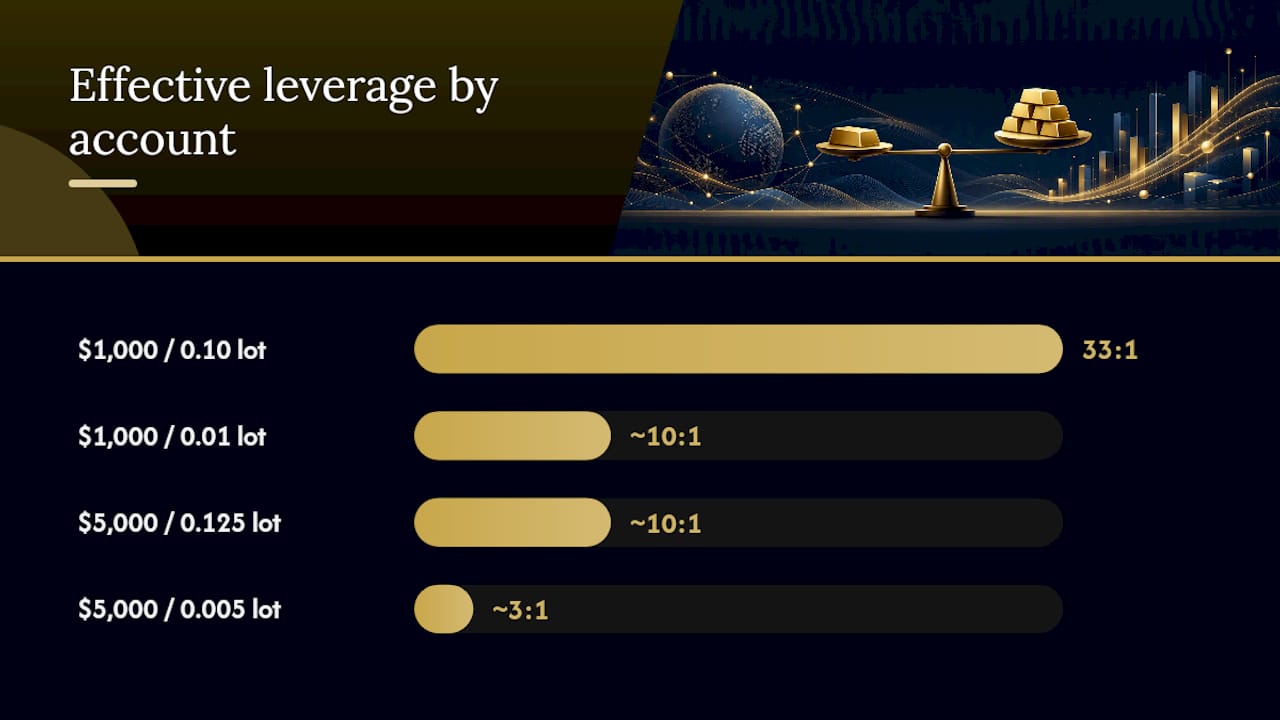
The 33:1 row is where most retail traders operate without realizing it.
Pro Tip: Before opening any position, calculate your effective leverage. If the number is above 10:1 for intraday trading or above 5:1 for swing trading, reduce your lot size. The platform maximum is irrelevant to this calculation.
Using maximum available leverage as a default is one of the most common behavioral errors in gold trading. Converting the nominal leverage ratio into effective leverage, as shown above, prevents the false comfort that low initial margin numbers create. Adding correlated positions, such as a second gold instrument or a silver position, increases your effective leverage across the whole account, not just on each individual trade.
Six rules and a daily checklist for trading XAUUSD with leverage
The single most important rule: size every trade from the stop-loss, not from the available margin. Everything else follows from that.
Eight rules for leveraged gold trading
- Risk 1–2% of equity per trade. Never risk more than 2% on a single XAUUSD position. After five consecutive losses at 2%, you still have 90% of your capital.
- Set a maximum daily loss limit. If you lose 5% in a day, stop trading for that session. Losses compound faster on gold than on most instruments.
- Place stop-losses before entry. A stop-loss set after entry is not a stop-loss. It is a wish.
- Avoid trading 30 minutes before and after major US releases. CPI, NFP, FOMC statements, and Fed Chair speeches move gold sharply. Spreads widen and slippage increases during these windows. Check gold trading hours to plan around session liquidity.
- Check correlation across all open positions. Two gold positions, or gold plus silver, double your effective exposure. Treat correlated positions as one combined trade for risk calculation purposes.
- Keep effective leverage below 10:1 for intraday, below 5:1 for swing. These are not conservative suggestions. They are the ranges where a single bad session does not end a trading account.
- Increase margin buffer before weekends. Reduce position size or close positions before Friday's US close to avoid weekend gap risk and potential holiday margin increases.
- Do not increase risk after a winning streak. A sequence of wins does not change the probability of the next trade. Increasing size after wins is how accounts give back gains quickly.
Daily pre-market checklist
- Confirm margin level is above 200% before adding any new position.
- Identify the largest open exposure and check whether it still fits within the 1–2% risk rule.
- Review the economic calendar for US data releases scheduled that day.
- Check overnight gold price action for any significant gaps or moves.
- Verify that no correlated positions are compounding effective leverage beyond your target.
Pro Tip: After a sequence of three or more winning trades, review your position sizes before the next entry. Behavioral research consistently shows traders unconsciously increase size after wins, which is precisely when a mean-reverting market punishes overconfidence.
Sample risk-management plans for small, medium, and large accounts
Each plan follows one core rule: risk a defined percentage per trade and keep a defined percentage of equity as free margin at all times.

Small account: $1,000
With a $20 stop-loss distance on XAUUSD and $10 at risk, the correct lot size is 0.005 lots (0.5 oz). At $3,300 gold and 50:1 leverage, required margin is approximately $33. Free margin after entry: $967.
Maximum effective leverage: 5:1. At this account size, one standard lot is never appropriate. Micro-lots are the only viable sizing unit. Scale up only after the account grows through verified strategy performance, not through increased risk per trade.
Medium account: $25,000
With a $20 stop distance, the correct lot size is 0.125 lots (12.5 oz). Notional value: $41,250. Required margin at 50:1: $825. Free margin after entry: $24,175.
Maximum effective leverage: 10:1 for intraday, 5:1 for swing. At this account size, a trader can run multiple positions simultaneously, but each must be sized independently and correlation must be checked across all open trades.
Large account: $100,000
With a $20 stop distance and $750 at risk, the correct lot size is 0.375 lots (37.5 oz). Notional: $123,750. Required margin at 50:1: $2,475. Free margin after entry: $97,525.
Maximum effective leverage: 5:1 for swing, 3:1 for position trades. At larger account sizes, the absolute dollar value of losses grows even at low percentage risk. Reducing the percentage risk per trade as account size grows is a standard professional practice. Scale down, not up, when a strategy enters a drawdown period.
How copy trading and auto-trading change your leverage risk
Copying a strategy does not remove leverage risk. It transfers the sizing decisions to the strategy provider, which can amplify or reduce your effective leverage depending on how lot scaling is configured and how much equity you allocate.
Key points to understand before copying any XAUUSD strategy:
- Lot scaling rules matter. If a strategy opens 1.00 lot on a $50,000 account and you copy it with $5,000, a proportional copy would open 0.10 lots. But if the platform uses fixed-lot copying, you may receive the full 1.00 lot, creating 10x the intended effective leverage on your account.
- Correlation aggregates across copied trades. A high-frequency gold strategy may hold multiple positions simultaneously. Each one adds to your total notional exposure and effective leverage.
- Small accounts face disproportionate margin pressure. Copying a strategy designed for a $50,000 account into a $2,000 account, even with proportional scaling, can push effective leverage to levels that trigger margin calls on normal drawdowns.
- Drawdown statistics are the most important number to check. A strategy with a 30% historical drawdown applied to a $2,000 account means a $600 loss before recovery. Confirm you can absorb that drawdown without a margin call.
Pro Tip: Before copying any XAUUSD strategy, verify four things: a live-verified performance record (not a demo account), maximum historical drawdown, the lot-scaling method the platform uses, and the margin policy during high-volatility periods. A strategy that looks profitable on paper can still trigger a margin call on your specific account size if the scaling is wrong.
For traders evaluating copy trading safety and governance, the lot-scaling method and verified track record are the two non-negotiable checkpoints. Sonicaigold's XAUUSD copy-trading approach uses the COPYX system with independently verified performance data, which addresses the core transparency requirement directly.
A practical perspective on trading gold with leverage
Gold is one of the few markets where the same instrument attracts both long-term macro investors and short-term scalpers, often at the same time. That creates a volatility profile that punishes traders who apply forex-style leverage assumptions without adjusting for gold's larger per-unit moves.
The traders who survive long-term on XAUUSD are not the ones who found a better entry signal. They are the ones who sized positions so that a $40 adverse move, which happens regularly, did not end their account. Discipline in position sizing is not a conservative approach to trading. It is the prerequisite for staying in the market long enough for an edge to pay off.
Rules matter more than forecasts on XAUUSD. The math is not complicated. The execution is.
Sonicaigold offers managed gold exposure with verified risk controls
Traders who want exposure to XAUUSD without managing position sizing, margin buffers, and news-avoidance windows manually have a direct alternative. Sonicaigold's gold copy-trading service handles those decisions through an algorithm-driven strategy with 18 consecutive months of independently verified performance, executed automatically via the COPYX system.

The strategy targets a high win rate with controlled drawdown, and performance data is publicly available through live Myfxbook verification. That transparency addresses the single most important checkpoint for any copy-trading arrangement: a live-verified track record rather than a backtested projection. For traders who have worked through the risk calculations in this guide and concluded that manual sizing is not where they want to spend their time, the Sonicaigold gold copy-trading page outlines the setup process and account requirements.
Sources
- Federal Register / Vol. 90, No. 13 / Wednesday, January 22, 2025 / Rules and Regulations
- XAU/USD Risk Management Guide Designed For Serious Traders in 2026
- CFD Margin Call and Stop-Out Guide 2026: How to Protect Your Account | MarketCFD
- Gold outlook 2026 | World Gold Council