
A copy-trading account is secure when three things hold: only you can log in, you see every trade and change as it happens, and you know the first steps if something looks wrong. Copying does not change who owns your account. It adds a link to a strategy, so the link, the login and the alerts are what you protect. This guide covers each in plain steps, including how that applies to copying the Sonic AI gold strategy through COPYX.
TL;DR
- Copy trading adds two exposures: your login, and the connection between your account and the strategy.
- Use two-factor authentication with a factor that resists phishing, such as a passkey or security key, rather than SMS codes alone.
- Turn on trade and login alerts, then compare them against your statement every week.
- Never enter credentials or one-time codes on a page reached from a text message.
- If something looks wrong, contact your broker first, then file a report with the authorities. Do not wait.
Table of Contents
- What copy trading changes about account security
- Step 1: Lock down the login
- Step 2: Recognize phishing aimed at traders
- Step 3: Turn on alerts and read them
- Step 4: Verify that what is copied is what you expect
- Step 5: Control the technical side of execution
- If you suspect unauthorized access
- Security is not the same as risk of loss
- Our perspective on copy-trading security
- Copy the Sonic AI gold strategy with a setup you can check
- FAQ
- Sources
What copy trading changes about account security
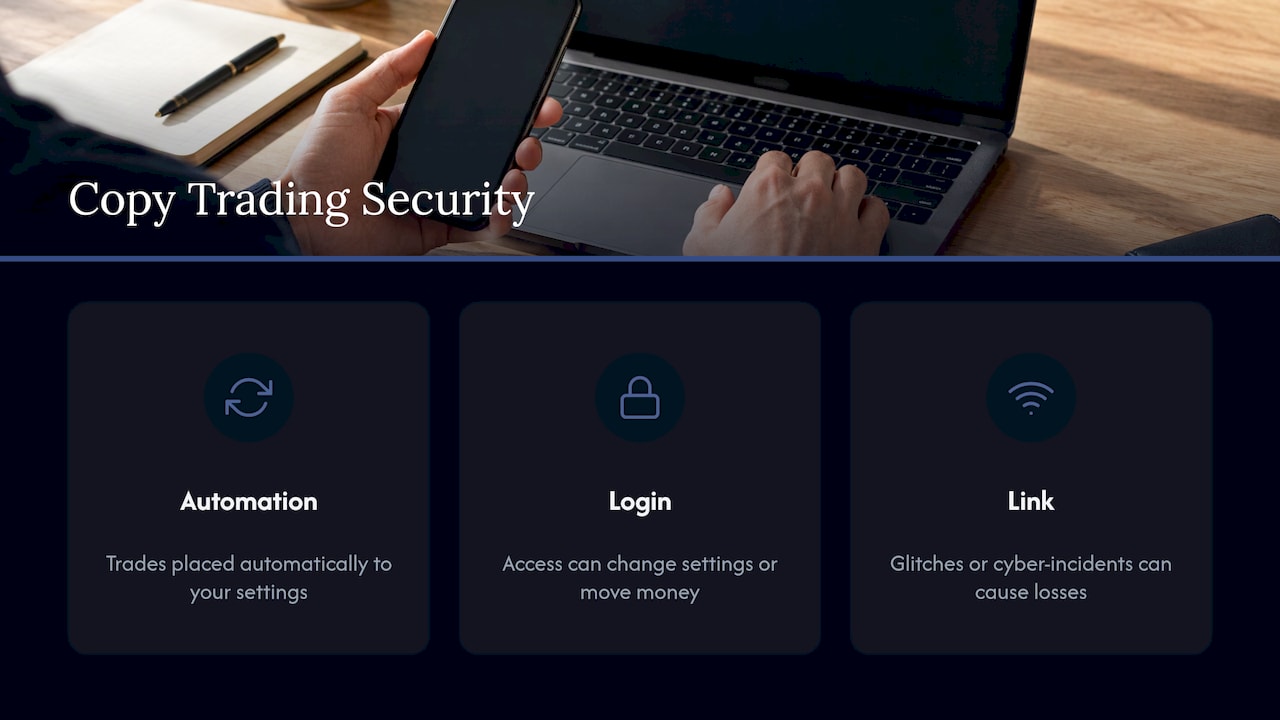
In copy trading, the strategy's trades are placed in your account automatically, in proportion to your settings. You do not click each order. That is the benefit for busy professionals and new traders: no screen-watching and no manual entry errors.
It also means two things need protecting that a manual trader does not think about.
The login. Whoever gets into your broker account can change settings, stop the copying or move money. Account takeover is a login problem, not a copy-trading problem, and the fix is the same one every investor needs.
The link. The connection between your account and the strategy is an automated process. The international body of securities regulators, IOSCO, notes in its 2025 report on online imitative trading that platforms can suffer technical glitches or cyber-incidents that cause investor losses. It adds that where algorithms automate the process, security vulnerabilities become a prominent risk. In practice, that means choosing a setup you can monitor and keeping the number of connected services small.
A third point is worth separating out. Security is about who can act in your account. Investment risk is about how much the strategy can gain or lose. This article covers the first. For sizing the second, see our guide to multiplier math for your percentage risk.
Step 1: Lock down the login
Most unauthorized access starts with a stolen password and a code that was handed over or intercepted. Do these in order.
- Use a unique password. A long passphrase stored in a password manager, never reused from another site.
- Turn on two-factor authentication (2FA). This asks for a second proof, besides the password, at login.
- Choose the strongest second factor your broker offers. Singapore's regulator, MAS, states in its Guidelines on Anti-Scam Measures for Brokers (effective 30 June 2027) that brokers there must offer at least one phishing-resistant factor, such as biometrics or device-bound cryptographic keys. It also says one-time passwords from hardware tokens, authenticator apps or SMS remain susceptible to phishing. The rule is Singapore's, but the reasoning applies to any account: if your broker offers a passkey or security key, use it over SMS codes.
- Check your sessions. MAS also expects limits of one active session by default and automatic timeouts after inactivity. Log out when you finish, and do not stay signed in on shared or public devices.
- Secure your email. Your email account resets your broker password. Give it the same 2FA.
A broker that supports these features gives you the most protection. When you review the broker requirements for copying Sonic AI through COPYX, include these login options in the checklist. Our 5 broker checks for copying Sonic AI via COPYX walks through what the account needs before you connect.
Step 2: Recognize phishing aimed at traders
Phishing is the most common route in. Hong Kong's Securities and Futures Commission described in its June 2025 circular a wave of unauthorized trading incidents carried out through SMS phishing. The attackers captured both passwords and the second-factor data, including SMS one-time codes and biometrics, by sitting between the victim and the real site. The regulator pushes firms to warn clients not to click links in text messages and not to enter credentials or codes on pages reached that way.
The habits that follow from this are simple:
- Type your broker's address yourself or use a saved bookmark. Do not follow links in texts or emails, even ones that look urgent.
- Treat any message asking for a one-time code as hostile. Your broker does not need you to read a code back to them.
- Be wary of anyone who contacts you offering to "fix" your copy-trading connection, recover losses or increase your returns.
- Never share your login, your investor password or your remote-access screen with a signal seller or strategy manager.
These rules matter more when your trading is automatic. A hands-off account is checked less often, which gives a thief more time before you notice.
Step 3: Turn on alerts and read them
Alerts are the cheapest security control you have. They turn an invisible takeover into something you see in minutes.
MAS expects brokers to send real-time alerts by default for every trade, separately at placement and at execution, with details such as the instrument, price, quantity, order type and timestamp. It also expects alerts for logins from a new device or browser. The same guidelines say alerts must not contain clickable links or QR codes that lead to credential-entry sites. Whatever your broker's country, look for the equivalent settings and switch them on.
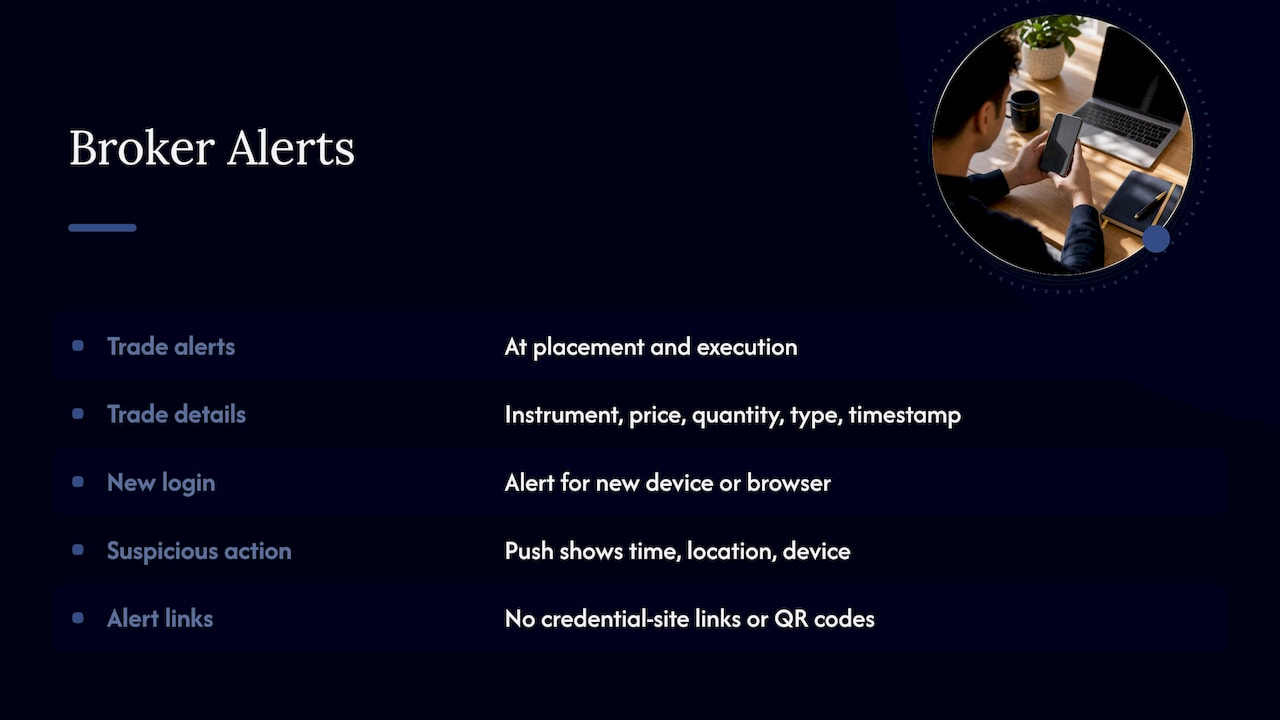
Security firm Trail of Bits, in its Account Takeover Recommended Practices, makes a further point. It says email and SMS alerts can be unreliable for fraud warnings because an attacker may already control them. It recommends in-app push notifications that show the time, location and device of a suspicious action. If your broker offers push alerts in its app, use them in addition to email.
What the alerts should look like for a copied gold strategy
With a single-instrument strategy such as XAUUSD (the gold price quoted in US dollars), you know what normal looks like. Every trade you see should be a gold trade. Alerts about other instruments, unexpected deposits, withdrawal requests or changed settings are the signal to act.
You can then build a short routine:
| When | What to check | What counts as a red flag |
|---|---|---|
| Each alert | Instrument, size and time of trade | Any instrument other than gold, or a size that does not fit your settings |
| Weekly | Broker statement against the strategy's published results | Trades or balance changes you cannot explain |
| After any login alert | Device, location and time | A device or place you do not recognize |
| Monthly | Linked services, API keys, withdrawal details | Anything you did not add |
The SFC circular lists signs that firms watch for: sudden changes in transaction volume, pattern or type, an IP address that changes location in a short period, and multiple accounts tied to the same device. You cannot see most of that from your side, but a sudden change in the pattern of trades in your own account is visible, and it is the first thing to check.
Step 4: Verify that what is copied is what you expect
Security also means being able to confirm that the trades in your account match the strategy you chose, and that the strategy's results are shown by someone independent. Sonic AI's gold results are verified on MyFXBook, so you can compare the strategy's public record with what your own statement shows. That comparison is the practical test of whether copying works as intended and whether anything unexpected has been added.
Two guides on our blog show how: what a transparent copy-trading record lets you see, and a seven-step third-party verification for XAUUSD copy traders. For regulator-backed questions to ask before you connect any account, use the six due diligence checks.
If your account is smaller, the same security steps apply, and a few additional checks apply to sizing. See copy trading with a small account.
Step 5: Control the technical side of execution
Automated copying depends on fast, accurate execution, and failures there look like security problems even when they are not. A delayed or mis-sized copy is a different issue from an intruder, but you diagnose both through the same statement review. IOSCO also flags timing and pricing risks where a lead trader's large following moves prices against the people copying. An execution risk management guide for retail traders explains slippage and fill quality in plain terms, which helps you tell a normal price difference from something that needs a call to your broker.
Keep the setup small. Each extra connected app, API key or third-party service is another door. Connect what you need to copy the strategy and nothing else. If you trade several accounts, such as with a prop firm, follow five technical rules for multi-account copy trading so settings do not collide.
If you suspect unauthorized access
Act in this order. Speed matters more than a perfect diagnosis.
- Contact your broker immediately using the phone number or secure message form on their official site. Ask them to restrict new orders and freeze withdrawals and transfers while they review.
- Change your password from a clean device, then your email password, and re-check 2FA on both.
- Stop the copying if you need to pause. Our guide to stopping copy trading in two minutes shows the exit and a 7 to 30 day test plan for restarting.
- File reports. The Arizona Attorney General's Identity Theft Repair Toolkit tells US victims to file a police report and keep the report number. For brokerage accounts it directs you to report to your broker or account manager as soon as possible and to file a complaint with the US Securities and Exchange Commission. Hong Kong's SFC similarly encourages clients to report unauthorized trading promptly to police.
- Keep records. Save screenshots of alerts, statements and emails with timestamps. FINRA's checklist for compromised accounts tells firms to preserve logs, IP addresses and device identifiers, so your own records help the broker's review.
Expect recovery to take steps. Trail of Bits recommends that recovery involve human review of government ID and approval through more than one contact method, with a waiting period of at least 24 hours before withdrawals after sensitive changes. Those pauses protect you, so do not treat them as obstacles.
If money has left your account, a securities lawyer or your state securities regulator can advise on recovery options for your situation.
Security is not the same as risk of loss
You can have a perfectly secure account and still lose money on trades, because that is how markets work. IOSCO's report, drawing on research commissioned by France's AMF, notes that copy trading can push inexperienced investors toward more risk-taking, and that lead traders may change strategies or products without notice. Two habits address that:
- Size the copied exposure to an amount you can afford, and check it against your own limits before activating.
- Read what the strategy says about its instrument and method, and compare each change you see in your account with it.
Sonic AI trades gold only. That narrow scope makes your monitoring easier: one instrument, one method, one public record. For the legal side of copying from the US, see whether copy trading is legal in the US.
Our perspective on copy-trading security
Most security advice for copy trading is about the platform. We think the more useful question is how easy the account is for you to watch.
A strategy that trades one instrument, publishes its results on MyFXBook and runs through COPYX gives you a clear picture of normal. Our strategy is gold only. When every trade in your account should be XAUUSD, an unexpected instrument or a strange withdrawal stands out immediately. That is a security advantage we build the service around.
Our setup guides take you through account opening, the broker connection and the copy settings, so you do not have to work out the steps alone. Pair that with the login protections above and you have the two halves of a safe setup: a login only you control, and a strategy you can verify.
Automation is meant to save you time. Use that time for the weekly statement check. Five minutes of review is the habit that keeps an automated account yours.
Paulo
Copy the Sonic AI gold strategy with a setup you can check
Sonic AI is an auto-trading strategy built only for gold (XAUUSD), run by an experienced team, with results verified on MyFXBook. COPYX copies the trades to your account automatically, and dedicated setup guides take you through the steps, so you do not need deep trading knowledge. Fees are performance based. See how the performance fee works before you open an account.

To see the strategy and start the setup, go to Sonic AI. If you build a network, the COPYX IB Partner Program is our referral route.
FAQ
Can a copy-trading strategy withdraw money from my account?
The copy link is set up to place trades, and withdrawals are a separate action controlled by your broker login. Check the permissions you grant when you connect, and never share your login or investor password. If you see a withdrawal request you did not make, contact your broker at once.
Is SMS two-factor authentication enough?
It is better than no second factor, but SMS codes can be captured by phishing. Singapore's regulator says SMS and authenticator-app codes remain susceptible to phishing. Where your broker supports a passkey, biometrics or a security key, use it.
How do I know my copied trades are real?
Compare your broker statement with the strategy's public record. Sonic AI's gold results are verified on MyFXBook, so you can match the instrument, timing and direction of trades against your own account weekly.
What should I do first if I notice a trade I did not expect?
Contact your broker through its official channel and ask them to restrict orders and withdrawals while they review. Then change your passwords, save screenshots, and file a police report. In the US, you can also file a complaint with the SEC.
Does a secure account protect me from losses?
No. Security stops other people from acting in your account. It does not change how the strategy performs. Size your exposure to an amount you can afford and review results regularly.
Sources
- IOSCO, FR/06/2025 Online Imitative Trading Practices
- Hong Kong SFC, circular on prevention and handling of unauthorized trading
- MAS, Guidelines on Anti-Scam Measures for Brokers
- Trail of Bits, Account Takeover Recommended Practices
- Arizona Attorney General, Identity Theft Repair Toolkit
- FINRA, Firm Checklist for Compromised Accounts
- Execution risk management guide for retail traders