
Copy trading is acceptably safe for U.S. investors pursuing an automated gold (XAUUSD) strategy, provided three conditions are met: the broker is registered with the SEC, FINRA, or CFTC; performance is independently audited and publicly verifiable; and withdrawal rights are clearly documented. When those conditions hold, the main remaining risks are market risk and leverage, not fraud or custody failure.
Before depositing, confirm all three:
- Regulated broker or U.S.-compliant custody arrangement (SEC/FINRA/CFTC registration)
- Auditable performance record via Myfxbook or equivalent third-party tracker
- Clear, documented withdrawal process with no unilateral fund-locking
Market risk does not disappear once those boxes are checked. Gold is volatile, and automated strategies can lose money in adverse conditions. Copy trading is an active allocation decision, not a passive savings product.
Table of Contents
- Is copy trading safe when gold is the underlying instrument?
- How U.S. regulation shapes copy trading security
- What to verify before depositing to a copy-trading gold strategy
- How to size capital when copying a gold strategy
- How Sonicaigold addresses the safety concerns that matter
- Questions to send any platform before you allocate
- Key Takeaways
- Why gold-only copy trading deserves a more precise safety standard
- Sonicaigold: a vetted starting point for automated gold trading
- Useful sources to verify claims and registrations
Is copy trading safe when gold is the underlying instrument?
Gold (XAUUSD) adds specific failure modes that equity-focused copy traders rarely encounter. Liquidity thins during off-hours, spreads widen around economic data releases, and automated strategies can generate slippage when follower order volume exceeds what the market absorbs cleanly.
The core risks for a gold copy-trading follower:
- Market risk: Gold can move significantly in a session on macro news. Automated strategies built on historical patterns can underperform sharply when volatility regimes shift.
- Execution risk: Follower returns often lag lead-trader PnL because of slippage and timing differences. The signal is identical; the fill is not.
- Counterparty and custody risk: Unregulated offshore brokers commingle client funds. If the broker fails, recovery is uncertain regardless of strategy performance.
- Incentive misalignment: Volume-based commissions can push lead traders to overtrade, boosting their revenue while eroding follower returns.
- Operational risk: Platform outages and poor execution routing affect followers disproportionately, since they have no manual override in a fully automated setup.
- Fee drag: Performance fees, spread markups, and overnight swap costs on gold positions reduce gross returns materially. A strategy showing 30% gross ROI may deliver around 20% net after costs.
Pro Tip: The single most reliable predictor of follower underperformance is a short or unverifiable track record. A continuous, auditable history spanning multiple market conditions is the first filter to apply, before reviewing any return figure.

How U.S. regulation shapes copy trading security
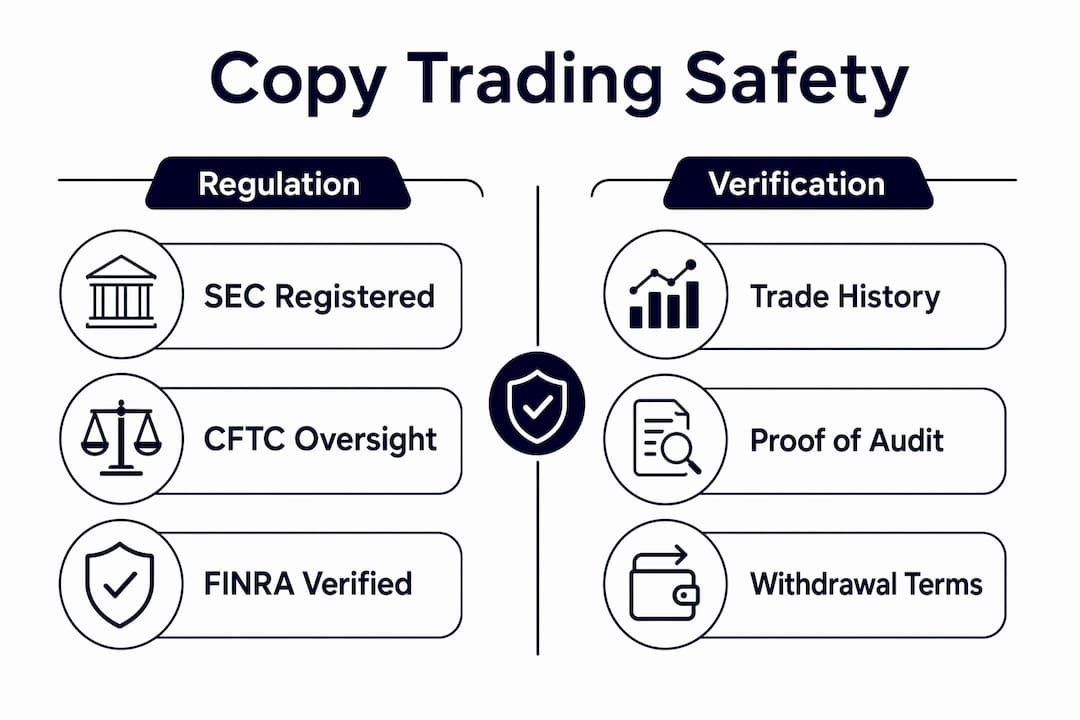
U.S. investors have specific regulatory protections that many global copy-trading platforms do not provide. Legitimate U.S.-facing platforms must generally register with the SEC, FINRA, or the CFTC, each of which enforces KYC, segregated client accounts, and recordkeeping standards that materially reduce custody and fraud risk.
Which regulator applies depends on the instrument. CFTC oversight covers forex and derivatives, including spot gold traded on margin. SEC and FINRA cover securities and broker-dealers. A platform offering gold CFDs or leveraged XAUUSD to U.S. retail clients without CFTC registration is operating outside the law.
Copy trading can also qualify as portfolio management or investment advice under U.S. law, particularly when trades execute automatically without investor action. ESMA's supervisory briefing reached the same conclusion under MiFID II, and IOSCO has flagged mis-selling, inadequate suitability checks, and conflicts of interest as the primary investor harms in copy trading globally. U.S. regulators apply parallel logic.
Regulatory red flags to watch for:
- Offshore broker with no SEC, FINRA, or CFTC registration number
- Platform that skips KYC or accepts anonymous deposits
- No documentation of segregated client accounts
- Claims of "unregulated" or "decentralized" operation as a feature
Pro Tip: Ask for the specific regulator name and registration number, then verify it directly on BrokerCheck (FINRA), the CFTC's registration database, or the SEC's EDGAR system. A legitimate platform will provide this in under 60 seconds.
What to verify before depositing to a copy-trading gold strategy
Run this checklist before committing any capital:
- Registration: Confirm SEC/FINRA/CFTC registration number and verify it on the regulator's public database.
- Custody model: Confirm segregated accounts or a documented self-custodial arrangement. Ask for the custodian's name.
- Performance record: Require a Myfxbook-verified or equivalent audited history showing full equity curve, max drawdown, win rate, and total trade count.
- Execution quality: Ask for average slippage statistics on XAUUSD fills for followers specifically, not just lead-trader fills.
- Fee structure: Calculate projected net return after performance share, spread markup, swap, and withdrawal fees.
- Withdrawal terms: Confirm the process, timing, and whether the platform can unilaterally restrict withdrawals.
- Operational history: Request any incident reports, security audits, or uptime records.
Pro Tip: Insist on a downloadable CSV or API-accessible trade history before funding. A platform that cannot produce one is a platform that cannot be audited, and that alone is sufficient reason to pass.
How to size capital when copying a gold strategy
Position sizing is where most copy-trading losses originate, not strategy selection. A lead trader running 5% risk per trade at their account size may translate to catastrophic exposure at a follower's smaller account if leverage is not adjusted.
Practical rules:
- Allocate only a moderate portion of total trading capital to a single copy strategy.
- Spread exposure across multiple strategies with different instruments or timeframes.
- Cap follower-side leverage to match your personal drawdown tolerance, not the leader's.
- Set a stop-copy threshold at a moderate drawdown level and allow a re-evaluation period before resuming.
- Review realized PnL versus leader PnL monthly and track slippage accumulation.
For risk management fundamentals that apply directly to copy-trading position sizing, the framework at StrategyArchive covers the core mechanics clearly.
| Leader risk per trade | Follower account | Max position size | Target max drawdown |
|---|---|---|---|
| 1% | — | — | 10% |
| 2% | — | — | 15% |
| 5% | — | — | 20% |
Fee-adjusted math matters here. A strategy with a strong gross annual return on XAUUSD, after performance fees and typical spread costs, may yield significantly lower net returns. Model net returns before sizing, not after.
Pro Tip: Start with a forward-testing pilot allocation of 10% or less for the first 60–90 days. Live execution data from your own account is more reliable than any historical backtest.
How Sonicaigold addresses the safety concerns that matter
Sonicaigold's gold-only focus is a structural advantage. A strategy built exclusively around XAUUSD does not carry cross-asset complexity, and the execution team understands gold's liquidity windows, spread behavior, and volatility patterns specifically.
The platform's publicly stated proof points include 18+ months of independently verified results and an 80% win rate. These figures are presented as verifiable, not as marketing claims, and the Myfxbook guide on the site provides the verification path directly. Investors should use that guide to confirm the full equity curve and max drawdown before committing funds.
Execution runs through COPYX, which handles automatic trade copying for followers. This reduces manual intervention risk and provides fill parity between lead and follower accounts, though investors should still request slippage statistics specific to their account tier.
Key safety features to confirm with Sonicaigold before funding:
- Full CSV trade history download or API access
- Documented custody and withdrawal arrangement
- COPYX execution routing details and average follower fill delay
- Profit-share mechanics and fee schedule in writing
Pro Tip: Request the raw trade history file, not a screenshot. Verify the equity curve independently against the Myfxbook record before allocating more than a pilot amount.
Questions to send any platform before you allocate
Send these document requests and questions in writing and keep the responses on file:
Document requests:
- Audited performance report with full equity curve
- Downloadable trade history (CSV or API)
- Regulator name and registration number
- Custody agreement or segregated account documentation
- Security audit report (for automated or smart-contract platforms)
Seven questions:
- Which regulator covers this platform, and what is the registration number?
- Are client funds held in segregated accounts? Who is the custodian?
- What is the standard withdrawal processing time, and under what conditions can withdrawals be restricted?
- How is the profit share calculated, and when is it deducted?
- What is the average slippage on XAUUSD fills for followers versus the lead account?
- What is the maximum follower leverage available, and can it be capped?
- How much notice do followers receive before a strategy change or parameter adjustment?
| Question | Provider response | Supporting document | Red flag? |
|---|---|---|---|
| Regulator and registration | No registration = stop | ||
| Segregated custody | Commingled = stop | ||
| Withdrawal timing | "At our discretion" = stop | ||
| Profit-share mechanics | Undisclosed fees = review | ||
| Follower slippage stats | No data available = caution | ||
| Max follower leverage | No cap option = caution | ||
| Strategy change notice | No notice policy = caution |
A passing answer names a specific regulator, a specific custodian, and a specific withdrawal timeline. Vague or deferred answers to any of the first three questions are sufficient reason to pause.
Key Takeaways
Copy trading is safe for U.S. gold investors when the broker is regulated, performance is independently audited, and withdrawal rights are documented before any capital is committed.
| Point | Details |
|---|---|
| Regulation is the first filter | Verify SEC, FINRA, or CFTC registration before evaluating any performance claim. |
| Auditable records beat marketing | Require a full equity curve and max drawdown via Myfxbook or equivalent, not screenshots. |
| Size conservatively | Allocate 10–25% per strategy, cap follower leverage, and set a 20% stop-copy threshold. |
| Fees reduce net returns | Model net returns after performance share, spread markup, and swap costs before committing. |
| Sonicaigold's approach | Sonicaigold offers gold-only auto-trading with 18+ months of independently verified results and COPYX execution, with a Myfxbook verification path available before funding. |
Why gold-only copy trading deserves a more precise safety standard
The conventional safety advice for copy trading, "check the regulator and the drawdown," is necessary but not sufficient for a gold-focused automated strategy. Gold's behavior around macro events, central bank announcements, and geopolitical shocks is qualitatively different from equity or crypto markets. An automated strategy that performed consistently for 18 months may face a regime it was never calibrated for, and followers will absorb that drawdown in real time with no manual override.
The more useful standard is this: treat the platform's verification infrastructure as seriously as the performance numbers. A strategy with a modest but fully auditable 18-month record on Myfxbook tells you more than a spectacular two-year return with no downloadable history. The audit trail is the safety mechanism, not the headline ROI.
Sonicaigold's gold-only design and its emphasis on independently verified metrics reflect that standard. The platform's value is not just the strategy; it is the fact that the strategy can be checked. That distinction separates a legitimate copy-trading option from a marketing exercise.
Sonicaigold: a vetted starting point for automated gold trading
Investors who have completed the due-diligence steps above and want a gold-only copy-trading option with a verifiable track record have a clear next step with Sonicaigold. The platform's 18+ months of independently verified results and COPYX-powered automatic execution address the two most common failure modes in copy trading: unverifiable performance and unreliable follower fills.

Three steps to get started: visit the Myfxbook audit page and verify the full equity curve and drawdown history yourself; open the linked account through the Sonicaigold platform and confirm custody and withdrawal terms in writing; then activate COPYX with a pilot allocation of 10% or less for the first 60–90 days. If you are considering the affiliate program, review the IB program details only after you have confirmed trading performance and withdrawal mechanics to your own satisfaction.
This article is general information, not financial or investment advice. Verify current regulatory status and platform terms with the relevant authorities and a qualified professional before committing funds.
Useful sources to verify claims and registrations
Use these directly when running due diligence on any copy-trading platform:
- FINRA BrokerCheck: Verify broker and adviser registration for any U.S.-facing platform.
- CFTC Registration Database: Confirm registration for forex and derivatives platforms offering XAUUSD to U.S. clients.
- SEC EDGAR: Check investment adviser and broker-dealer registration.
- Myfxbook: Third-party performance tracker used to audit forex and gold strategy histories independently.
- IOSCO Consultation Report on Copy Trading: Global regulatory framework and investor harm analysis.
- ESMA Supervisory Briefing on Copy Trading: MiFID II compliance expectations relevant to cross-border platforms used by U.S. investors.
- State securities regulators (NASAA): For state-level registration checks on advisers and platforms not covered by federal registration alone.
- Save all documents, registration confirmations, and platform responses to a dedicated folder before and after funding any account.