
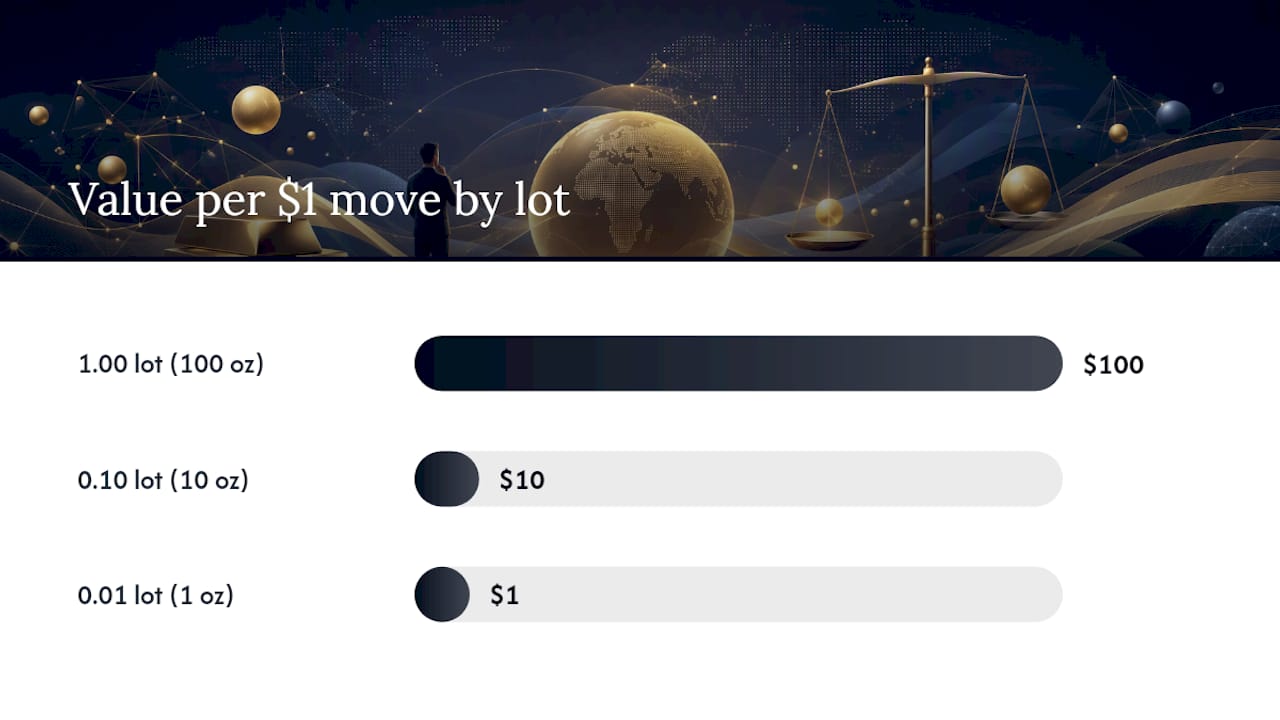
Most brokers treat one standard XAUUSD lot as 100 troy ounces, so a $1 move in gold equals roughly $100 of profit or loss per 1.00 lot. Your XAUUSD lot size comes from one formula: lot size equals your risk amount divided by your stop distance multiplied by contract size. Get the contract size confirmed in your platform first, because that single number decides every calculation that follows.
TL;DR:
- Verify the contract size on your broker's platform before calculating lot size, as it varies and directly affects risk management.
- Use the formula lot size equals risk amount divided by stop distance times contract size, then round down to your broker's minimum volume step.
- Confirm the tick value and size inside your trading platform to accurately gauge how a small price movement impacts your account.
- When your account currency isn't USD, convert your risk amount using live exchange rates to avoid unexpected deviations in lot sizing.
- Consider automated trading systems like Sonic AI to eliminate calculation errors and ensure consistent risk control across every gold trade.
Table of Contents
- What Is XAUUSD Lot Size and Why Does the Formula Matter?
- Using a Position-Size Calculator for Gold: Required Inputs and Quick Workflow
- Contract Size, Pip Value, and How Lot Maps to Dollar Exposure
- Manual Formula and Three Worked Examples You Can Use to Check Any Calculator
- Verify Your Broker's Symbol Specification and Avoid Common Mistakes
- How Account Currency, Margin, and Leverage Affect Gold Lot Sizing
- Actionable Rules and a Compact Checklist for Every Gold Trade
- Paulo's Perspective: What He Checks Before Sizing a Gold Trade
- An Editorial Take on Manual Sizing Versus Automated Risk Control
- Sonic AI: How Auto-Copy for Gold Handles Sizing and Risk for You
- Sources
What Is XAUUSD Lot Size and Why Does the Formula Matter?
XAUUSD lot size refers to how many ounces of gold you control per trade, and it drives every dollar of risk you take on. The industry's standard convention sets 1.00 lot at 100 troy ounces on most retail CFD feeds, which means each $1 shift in the gold price moves your account by about $100 per lot. That's the common convention that governs XAUUSD lot size, though it's a convention, not a law. Some brokers scale it differently, and that's exactly why you verify it before risking a dollar.
Position sizing for gold works differently from forex position sizing because gold isn't traded on a single standardized exchange the way currency pairs are. XAUUSD is typically an over-the-counter CFD product, so contract specifications vary from one broker to the next. Traders who lean on generic tutorials without checking their own platform's specification sheet are the ones who blow past their risk tolerance without realizing it.
The formula itself is simple once the contract size is confirmed:
Lot size = Risk amount ÷ (Stop-distance in dollars × Contract size in ounces)
That's the core calculation used across gold lot-size guides, and it's the backbone of every worked example in this article. Get comfortable with it, because a calculator only saves you time. It doesn't replace understanding what the number means.
Using a Position-Size Calculator for Gold: Required Inputs and Quick Workflow
A position-size calculator for XAUUSD needs five inputs before it can spit out a usable number:
- Account balance (in your account currency)
- Risk percentage per trade (commonly 0.5% to 2%)
- Entry price
- Stop-loss price
- Account currency (especially if it isn't USD)
When your account currency differs from USD, the calculator converts your risk amount using live exchange rates before running the lot-size math. That conversion step matters more than most traders assume. A 5% swing in EUR/USD or GBP/USD between when you calculated and when you executed can quietly shift your real dollar risk.
Here's the workflow that keeps you honest:
- Measure your stop-loss distance in dollars (entry price minus stop price).
- Calculate your dollar risk (account balance × risk %).
- Run the lot-size formula, or plug the numbers into a calculator.
- Round the result down to your broker's volume step.
- Verify the resulting dollar loss matches your intended risk before placing the order.
The Myfxbook position-size calculator supports XAUUSD directly and handles the currency conversion automatically. Still, run the final check yourself: multiply your rounded lot size by the stop distance and contract size, and confirm that number is a loss you can actually live with.
Contract Size, Pip Value, and How Lot Maps to Dollar Exposure
Gold's contract-size convention sets 1.00 lot at 100 troy ounces, but that number isn't universal. It's a common default, not a guarantee, and brokers do occasionally quote XAUUSD in different contract sizes or even different base units. This is the single most common cause of miscalculated risk on gold trades.
Most platforms quote XAUUSD to two decimal places, so a "tick" or "pip" typically refers to a $0.01 move. Under the standard 100 oz convention, that tiny tick carries real weight per lot:
| Lot Size | Contract Size (oz) | Value per $1 Move | Value per $0.01 Tick |
|---|---|---|---|
| 1.00 | 100 | $100 | $1.00 |
| 0.10 | 10 | $10 | $0.10 |
| 0.01 | 1 | $1 | $0.01 |
That $100-per-dollar mapping at 1.00 lot is why gold's daily volatility can chew through an account fast if your lot size is set carelessly. A 20 dollar overnight gap, not unusual for gold, means a $2,000 swing on a single 1.00 lot position.
You find your broker's actual tick size and tick value inside MetaTrader. Open Market Watch, right-click the XAUUSD symbol, and select Specification. The window lists contract size, tick size, tick value, minimum volume, and volume step, all in one place. Never assume; always confirm this before your first trade with a new broker.
Manual Formula and Three Worked Examples You Can Use to Check Any Calculator
The formula stays consistent no matter your account size:
Lot size = (Account balance × Risk %) ÷ (Stop-distance in $ × Contract size in oz)
Then confirm with a second calculation: Actual dollar loss = Rounded lot size × Stop-distance × Contract size. That second check is what separates careful traders from careless ones, because a rounded lot size can shift your real risk slightly above or below your target.
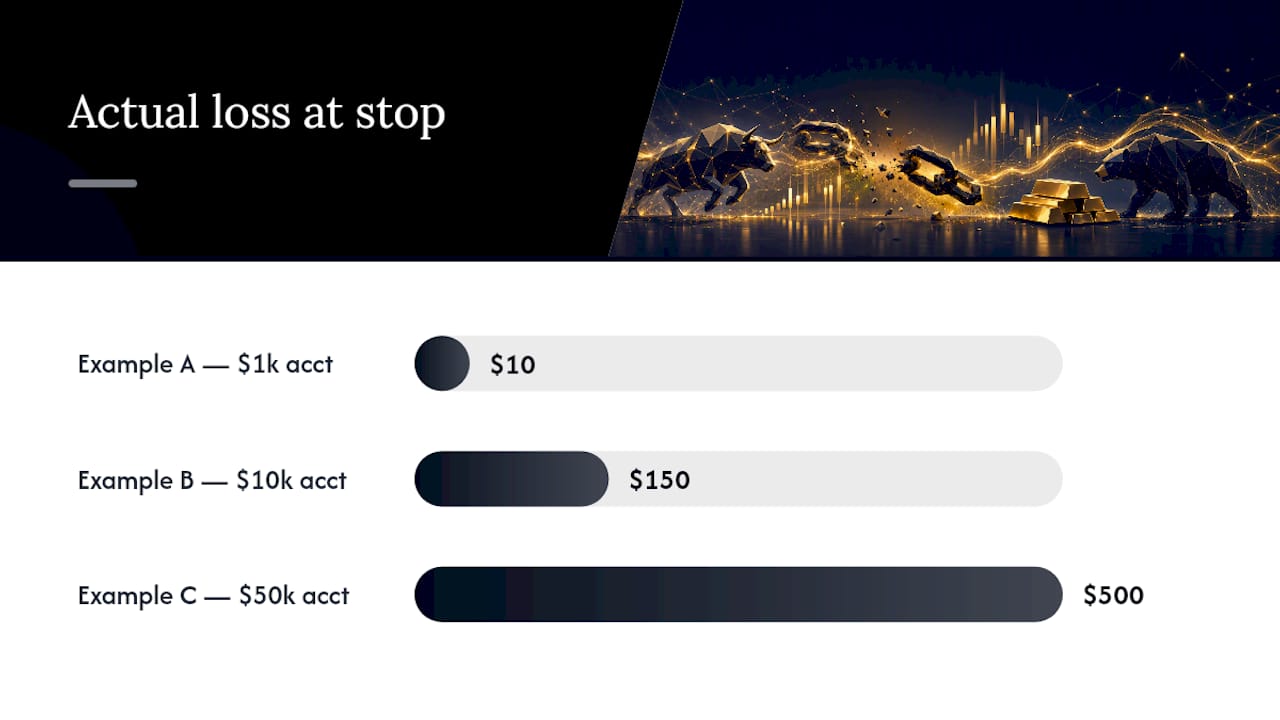
Example A: Small account, tight stop Account balance: $1,000. Risk: 1% ($10). Stop distance: $5. Contract size: 100 oz. Raw calculation: $10 ÷ ($5 × 100) = 0.02 lots. Rounded lot: 0.02. Actual loss at stop: 0.02 × $5 × 100 = $10. Right on target.
Example B: Mid-size account, medium stop Account balance: $10,000. Risk: 1.5% ($150). Stop distance: $15. Contract size: 100 oz. Raw calculation: $150 ÷ ($15 × 100) = 0.10 lots. Rounded lot: 0.10. Actual loss at stop: 0.10 × $15 × 100 = $150. Exact match.
Example C: Larger account, wide stop Account balance: $50,000. Risk: 1% ($500). Stop distance: $25. Contract size: 100 oz. Raw calculation: $500 ÷ ($25 × 100) = 0.20 lots. Rounded lot: 0.20. Actual loss at stop: 0.20 × $25 × 100 = $500. Clean.
| Example | Account | Risk $ | Stop ($) | Raw Lots | Rounded Lot | Loss at SL |
|---|---|---|---|---|---|---|
| A | $1,000 | $10 | $5 | 0.02 | 0.02 | $10 |
| B | $10,000 | $150 | $15 | 0.10 | 0.10 | $150 |
| C | $50,000 | $500 | $25 | 0.20 | 0.20 | $500 |
Pro Tip: If your raw calculation lands below your broker's minimum volume, don't force the trade. Widen your stop, add capital, raise your risk percentage slightly, or open a cent/mini account that supports smaller volume steps.
Verify Your Broker's Symbol Specification and Avoid Common Mistakes
Before you calculate anything, pull up your broker's actual XAUUSD specification. In MT4 or MT5, that means Market Watch, right-click the symbol, then Specification. Confirm these fields specifically:
- Contract size (usually 100 oz, but verify)
- Tick size and tick value
- Minimum volume (often 0.01 lots)
- Volume step (often 0.01, sometimes 0.10)
- Margin currency and margin requirement
The most frequent errors come from assuming forex conventions apply to gold, forgetting to convert currency when your account isn't in USD, ignoring the broker's volume step and rounding up instead of down, and forgetting that spread and commission eat into your effective stop distance.
Run through this checklist before every trade: contract size confirmed, dollar risk calculated, lot rounded down to the volume step, actual dollar loss at stop reverified, and spread/commission factored in.
Pro Tip: Test your exact calculation on a demo account for a session before going live. This confirms your broker applies the contract specs you expect and shows you how spread affects your real entry and exit prices.
How Account Currency, Margin, and Leverage Affect Gold Lot Sizing
When your account currency isn't USD, you need to convert your dollar risk using the current USD-to-account-currency exchange rate before running the lot-size formula. If your account is in EUR, convert your risk amount from EUR to USD first, then apply the standard formula, since contract size and pip value on XAUUSD are quoted in USD terms.
Margin and risk sizing are two separate calculations, and conflating them is a common trap. Margin tells you how large a position your leverage allows you to open. It says nothing about whether that position size fits your acceptable XAUUSD leverage risk. High leverage can technically let you open a 1.00 lot position with a small deposit, but that says nothing about whether a $100 per dollar move fits your risk tolerance.
A few practical notes worth keeping in mind:
- Gold often moves 1% to 2% in a single session, so lot size should shrink as volatility rises.
- Cross-currency accounts should double-check pip value, since it shifts with exchange-rate movement.
- Currency conversion isn't instant. A rate shift between calculation and execution can slightly change your real dollar risk, so build in a small buffer.
Actionable Rules and a Compact Checklist for Every Gold Trade
Three sentences, memorized, will keep you out of trouble: verify your broker's contract size before anything else. Calculate your risk-based lot size using the formula, not a guess. Round down to the nearest volume step and confirm the resulting dollar loss matches what you're willing to lose.
Quick reference for the standard 100 oz convention:
If your calculated lot size falls below your broker's minimum, you have four real options: increase your risk percentage slightly, tighten your stop distance, add capital to your account, or move to a cent/mini account that supports finer volume steps. Pick the option that fits your actual risk tolerance, not the one that's easiest.
Paulo's Perspective: What He Checks Before Sizing a Gold Trade
My rule is simple: I never trust a calculator's output until I've reverse-checked it by hand. Multiply the rounded lot by the stop distance and contract size, and see if that dollar figure actually matches what you're willing to lose. It takes thirty seconds and catches almost every rounding mistake before it costs you money.
The check most traders skip is confirming contract size hasn't changed after a broker update. Specifications get revised more often than people expect, and a contract size shift from 100 oz to something else silently doubles or halves your real exposure without you touching a setting.
If you want a fuller breakdown of how leverage and lot size interact on gold specifically, Sonicaigold's guide on XAUUSD leverage risk is worth a read. Sonicaigold's team built their entire approach around gold, and that specialization shows up in how carefully they treat sizing before automation ever enters the picture.
Test everything on demo first, and round conservatively. That habit alone will save you more money than any indicator ever will.
An Editorial Take on Manual Sizing Versus Automated Risk Control
The research here supports a blunt conclusion: most traders lose money on lot sizing not because the formula is hard, but because they skip the verification step. The math is one line. The discipline to check contract size on every new broker, every platform update, is where people get lazy.
Conventional advice treats a calculator as the finish line. It isn't. A calculator gives you a number; only a manual dollar-loss check confirms that number means what you think it means. That's the gap between traders who blow up accounts and traders who don't.
If there's one place to prioritize effort, it's building the habit of demo-testing every new sizing calculation before it touches a live account. Everything else, the formula, the rounding, the currency conversion, is mechanical once you've done it a few times. The habit is what actually protects your capital.
— Paulo
Sonic AI: How Auto-Copy for Gold Handles Sizing and Risk for You
Sonicaigold removes the manual sizing math entirely for traders who'd rather rely on a managed, algorithm-driven approach to gold specifically. Instead of running the formula yourself every time, Sonic AI's auto-copy system applies consistent position sizing and risk parameters across every trade, using the COPYX execution system to mirror positions automatically into your account.

The appeal here is consistency. Manual sizing errors, wrong contract size, bad rounding, forgotten currency conversion, disappear when the sizing logic runs the same way on every single trade. Sonic AI's strategy has 18 consecutive months of independently verified results with a reported 80% win rate, giving you a track record to evaluate before committing capital rather than a promise to take on faith.
If manual calculation feels like one more variable to manage on top of watching gold's volatility, take a look at how XAUUSD copy trading works and check the current verified performance numbers before you decide your next move.
This article is general information, not a substitute for advice from a qualified financial advisor. Consult a qualified financial professional about your own circumstances before acting on anything here.
Sources
- How To Calculate Gold Lot Size - GOLD Lot Size Calculator
- XAUUSD Position Size Calculator (Myfxbook)