
Yes — you can automatically copy a professionally managed gold (XAUUSD) strategy, and U.S. investors are doing it today. The mechanism is called copy trading: your account mirrors the positions of a verified strategy provider in real time, with no manual input required after setup. Sonicaigold uses COPYX for this execution layer, and its track record carries 18+ months of independently verified results. Before you allocate capital, run through this short checklist:
- Open an account with a regulated, U.S.-compatible broker
- Confirm the strategy shows raw trades and full drawdown history.
- Start with a test allocation you can afford to lose entirely
- Set a global stop-loss and a maximum drawdown limit before activating
- Schedule a weekly review — automation does not replace oversight
Pro Tip: Request the strategy's Myfxbook dashboard link before depositing anything. If the provider cannot share one, that alone is a reason to pause.
Table of Contents
- What is trade copying, and how does it differ from manual trading?
- How do you set up an auto-copy relationship for a gold strategy?
- Why copy trading can be useful for gold — and where it falls short
- How do you evaluate a gold auto-trading strategy before copying it?
- What U.S. investors must check on regulation, compliance, and taxes
- Ongoing management: a Sonic AI and COPYX example for gold investors
- Key Takeaways
- Why a focused gold auto-strategy fits certain investors better than broad ones
- Sonicaigold: gold-only auto-trading with verified performance
- Useful sources and references for U.S. investors
What is trade copying, and how does it differ from manual trading?
Copy trading is an automated system where your account mirrors the positions opened and closed by a chosen strategy or expert in real time. When the provider enters a gold trade, your account enters the same trade. When they exit, you exit. No manual decision is required on your end.
The proportionality mechanic is what makes it practical across different account sizes. Positions scale proportionally to your allocated balance, not to the provider's absolute lot size. If the strategy risks 2% of its equity on a trade, your account risks 2% of your allocated funds on the same trade.
Three distinctions matter for gold investors:
- Manual trading requires you to analyze, time, and execute every position yourself
- Signal services send alerts you must act on; copy trading executes automatically without your confirmation
- Copy trading handles entry, exit, sizing, and sync in one automated loop
For XAUUSD specifically, platform mechanics add complexity. Gold trades as a spot or CFD instrument depending on the broker, and each carries different margin, leverage, and overnight rollover rules. Execution latency matters too: a delay of even a few seconds in a fast-moving gold market can shift your fill price meaningfully from the provider's.
Pro Tip: Confirm whether your broker offers XAUUSD as a CFD or spot contract, and check the overnight swap rate before you fund. Rollover costs accumulate quickly on leveraged gold positions held for days.
How do you set up an auto-copy relationship for a gold strategy?
The standard setup process follows a clear sequence. Here is how it works for a gold-focused strategy using a COPYX-connected platform like Sonicaigold:
- Open and verify your broker account. Choose a regulated, U.S.-compatible broker that supports XAUUSD and is compatible with the COPYX execution layer. Complete KYC verification before funding.
- Fund your account. Deposit your intended allocation. Most platforms require a minimum balance; start conservatively.
- Link the copy module. Connect your broker account to COPYX or the platform's copy connector using the credentials or API key provided in the setup guide.
- Select and verify the strategy. Confirm the strategy trades XAUUSD exclusively, shows 18+ months of raw trade history, and has third-party verification via a Myfxbook dashboard or equivalent.
- Set allocation and proportional rules. Define how much of your balance the copy relationship controls. Set appropriate risk limits to limit single-trade exposure.
- Configure risk controls. Set a global stop-loss for the entire copy relationship, a maximum drawdown threshold that triggers an automatic pause, and optionally a take-profit ceiling.
- Activate and confirm. Enable copying and verify that the first mirrored trade appears correctly in your account with the right sizing.
- Run a demo or small live test first. Many platforms support a simulated mode. If not, start with a fraction of your intended allocation and review two to three live trades before scaling up.
Note that some platforms enforce "forced sync," which blocks follower customizations such as individual stop-loss adjustments. Confirm whether the platform allows you to set your own TP/SL or whether the provider's settings override yours.
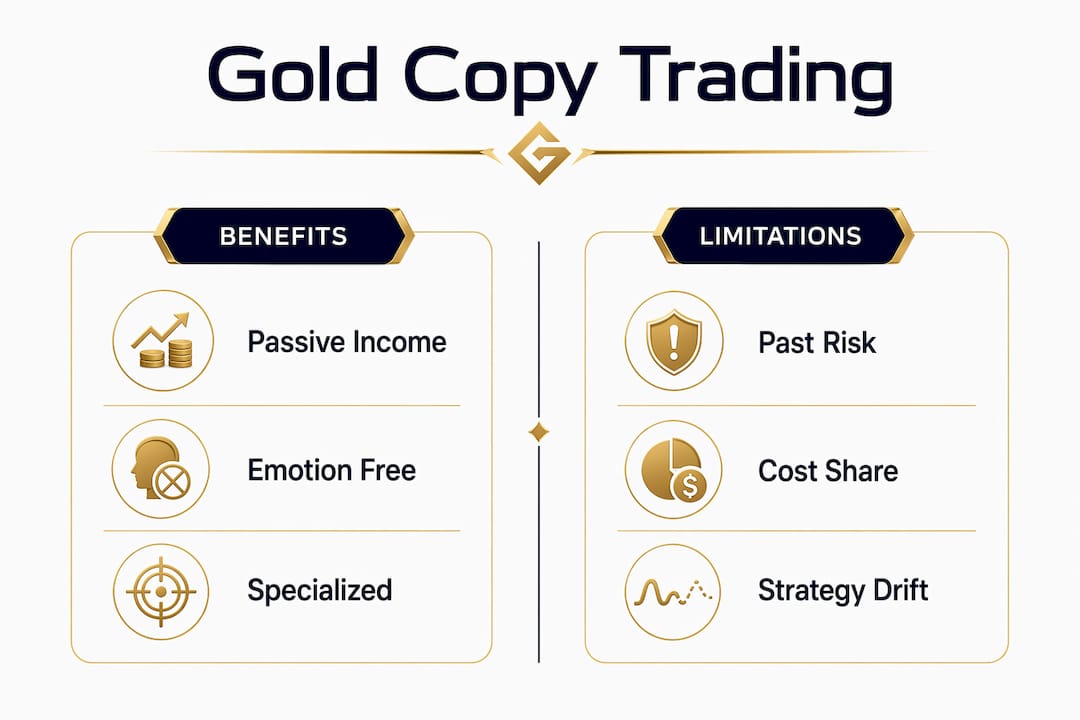
Why copy trading can be useful for gold — and where it falls short
Copy trading removes emotional decision-making from the equation. For gold, where price swings on Federal Reserve commentary or geopolitical news can be sharp and fast, that removal has real value. An algorithm or professional manager does not panic-exit a position at 3 AM; a retail investor often does.

| Benefit | Limitation |
|---|---|
| Passive exposure to a specialized XAUUSD strategy | Past performance does not guarantee future results |
| No emotional trading or manual timing required | Gold volatility can shift rapidly with macro drivers |
| Proportional sizing adapts to your account balance | Slippage means your fills may differ from the provider's |
| Observation of live trades builds market understanding | Leverage amplifies losses as well as gains |
| Profit-sharing aligns provider incentives with yours | Rollover and spread costs reduce net returns over time |
The cost structure deserves attention. Most gold copy strategies charge through profit-sharing (a percentage of net gains), subscription fees, or both. Add to that the broker's spread on XAUUSD and any overnight swap charges on leveraged positions. These costs compound, so a strategy with a strong gross win rate can deliver a lower net return than the headline suggests.
Strategy drift and changing volatility regimes can also alter results quickly. A gold strategy that performed well during a trending dollar-weakness environment may underperform when that macro driver reverses. Automation does not adapt to regime changes on its own.
How do you evaluate a gold auto-trading strategy before copying it?
A credible evaluation focuses on raw-trade transparency and drawdown behavior, not headline return figures. Use this checklist:
| Evaluation Criterion | What to Look For |
|---|---|
| Track record length | 18+ months of live, verified trades (not backtest) |
| Maximum drawdown | Full drawdown curve, not just a peak-to-trough summary |
| Win rate | Reported per trade, with losing trades visible |
| Trade frequency | Consistent activity; gaps may signal strategy changes |
| Instrument focus | Confirm trades are XAUUSD, not mixed assets |
| Third-party verification | Myfxbook or equivalent independent dashboard |
| Fee transparency | Profit-share percentage, subscription cost, and broker spread disclosed |
Red flags to avoid:
- Performance windows shorter than 12 months, especially backtest-only records
- Aggregated returns with no per-trade breakdown
- No third-party audit link or dashboard access
- Undisclosed fees buried in terms of service
- Strategies that traded multiple instruments but now claim gold specialization
Look for consistent performance over a substantial period for gold strategies specifically, because shorter windows can reflect a single favorable macro cycle rather than repeatable edge. Sonicaigold's independently verified record covers a period meeting this recommendation.
What U.S. investors must check on regulation, compliance, and taxes
The SEC is clear: copy trading carries inherent market risk, and automation does not remove it. U.S. investors face a specific regulatory landscape that differs from European frameworks.
Key compliance checks before you fund:
- Broker oversight: Confirm the broker is registered with the CFTC and NFA for forex/gold CFD products, or with the SEC for securities-based instruments. Segregated client funds are a minimum requirement.
- Investment adviser status: A platform that automates execution is not necessarily a registered investment adviser. If the provider makes discretionary decisions on your behalf, they may be required to register. Verify this before treating the service as managed-account advice.
- Tax reporting: Replicated trades generate taxable events. U.S.-compatible brokers issue 1099 forms. Gold CFD trades may be treated as Section 1256 contracts (60/40 long-term/short-term capital gains split), but this depends on the instrument structure. Confirm with a tax professional.
- Wash sale and mark-to-market rules: Frequent automated trading can trigger wash sale concerns or mark-to-market elections. Keep complete trade records from day one.
This article is general information, not legal or tax advice. Confirm current rules with the relevant regulatory body or a qualified professional for your specific situation.
Ongoing management: a Sonic AI and COPYX example for gold investors
Setup is one step. Ongoing management is what protects capital over time. Here is a repeatable routine for investors using Sonicaigold and COPYX:
- Link and activate. Connect your broker account to COPYX, allocate your chosen amount, and enable the platform's default stop-loss and maximum drawdown guard before the first trade copies.
- Weekly dashboard review. Check open positions, confirm sizing matches your allocation rules, and verify no unexpected instruments appear alongside XAUUSD.
- Monthly performance check. Compare net returns against your benchmark, review the drawdown curve, and confirm the win rate and trade frequency are consistent with the verified history.
- Watch for strategy drift. If the instrument mix changes, leverage increases, or trade frequency drops sharply, treat it as a trigger to pause and investigate.
- Pre-define intervention triggers. Set a specific drawdown threshold (for example, a 10% drawdown on your allocated balance) at which you reduce allocation or pause copying entirely.
- Confirm verification remains current. Revisit the Myfxbook performance dashboard monthly to confirm the independently verified 80% win-rate claim and 18+ months of results remain current and unaltered.
Experts recommend monthly performance reviews and per-strategy drawdown limits as standard practice. Automation handles execution; you handle oversight.
Pro Tip: Set a calendar reminder for the first Monday of each month. A 15-minute dashboard review is enough to catch drift, confirm sync, and decide whether to hold, reduce, or pause your allocation.
Key Takeaways
Automatic copy trading of a verified gold (XAUUSD) strategy is accessible to U.S. investors, but it requires confirmed broker regulation, raw-trade transparency, and active monthly oversight to manage risk effectively.
| Point | Details |
|---|---|
| Verify before you fund | Require 18+ months of raw trades and a third-party dashboard before allocating capital. |
| Set risk controls at activation | Configure a global stop-loss and maximum drawdown limit before the first trade copies. |
| Understand U.S. tax treatment | Gold CFD trades may qualify as Section 1256 contracts; confirm with a tax professional and keep full records. |
| Monitor monthly, not just at setup | Review drawdown curves, win rate, and instrument mix every month to catch strategy drift early. |
| Sonicaigold as a starting point | Sonicaigold offers gold-only auto-trading via COPYX with 18+ months of independently verified results and a Myfxbook dashboard for ongoing monitoring. |
Why a focused gold auto-strategy fits certain investors better than broad ones
Specialization in XAUUSD matters more than it might appear. A strategy built exclusively around gold develops a concentrated understanding of its specific drivers: real interest rates, dollar strength, central-bank purchasing cycles, and geopolitical risk premiums. A broad multi-asset strategy spreads attention across dozens of instruments and rarely develops that depth in any single one.
The investor who benefits most from a gold-only auto-strategy is time-constrained, seeks inflation or safe-haven exposure without managing it actively, and is comfortable with the volatility profile of a single commodity. That is a specific fit, not a universal one. Investors who need broad diversification or who cannot tolerate concentrated drawdowns in a single asset class should treat a gold auto-strategy as one allocation within a larger portfolio, not a standalone solution.
Portfolio-level risk budgeting still applies. Even a strategy with a strong verified track record should represent a defined percentage of total investable assets, with the remainder in uncorrelated positions. Strategy-level stop-losses protect the copy relationship; portfolio-level limits protect your overall financial position.
Sonicaigold: gold-only auto-trading with verified performance
Sonicaigold focuses exclusively on XAUUSD, executing through the COPYX system so trades copy automatically to your connected broker account. The strategy carries 18+ months of independently verified results and an 80% win-rate claim backed by a live Myfxbook performance dashboard, not aggregated marketing figures.

Getting started takes three steps: review the Myfxbook verification guide to confirm the raw-trade history yourself, open and fund a compatible broker account, and activate COPYX with your chosen allocation and stop-loss settings. You can also explore OptiqTrades to compare how social and copy-trading platforms differ in follower controls before committing to a setup. Start with a small allocation, confirm the first few mirrored trades match expectations, then scale on your own timeline. Visit Sonicaigold to review the full offering and access setup resources.
Useful sources and references for U.S. investors
- Investor.gov — Copy Trading (SEC resource): SEC guidance on copy trading risks and investor protections; the primary U.S. regulatory reference.
- Copy trading — Wikipedia: Explains proportional position sizing and the mechanics of how copy relationships work across different account sizes.
- What is Copy Trading? — IG: Clear definition of automated mirroring and how it applies to volatile instruments like gold.
- Copy Trading Guide — FxPro: Step-by-step setup process and guidance on ongoing monitoring and drawdown limits.
- What is Copy Trading? — FXTM: Track record evaluation criteria, including the 18+ month standard for gold strategies.
- What Is a Trade Copier? — Benzinga: Covers strategy drift risk and the limits of past performance in changing volatility environments.
- Myfxbook Guide — Sonicaigold: Primary verification resource for Sonic AI's raw-trade history and independent performance dashboard.
Keep your own records. Request raw-trade evidence directly from any provider, and cross-check it against the third-party dashboard before and after you fund.