
A trading risk disclosure is a required statement from brokers and dealers that explains the financial, operational, and legal risks tied to an account or instrument, including the risk of losing more than you deposit. The three items worth your full attention are leverage and margin exposure, counterparty and no-protection statements, and the explicit warning that losses can exceed your initial funds. Everything else in the document supports those three points.
TL;DR:
- Most disclosures warn that leverage significantly amplifies losses and that traders can owe more than their initial deposit in volatile markets.
- Broker-specific clauses, such as set-off rights and order routing discretion, can affect how your funds are managed and should be scrutinized carefully.
- Disclosures for certain instruments like options and futures include unique risks such as time decay, margin calls, and daily resets that can trigger losses or margin calls before expiration.
- Regulatory rules require brokers to disclose profit/loss ratios and trading costs clearly, but independent verification of performance is essential to confirm claims.
- Having a written risk management plan, including position sizing, loss limits, and invalidation levels, is crucial to mitigate the risks revealed in the disclosures.
Table of Contents
- Trading Risk Disclosure Basics: The Financial and Operational Risks Covered
- How Disclosure Language Changes by Instrument
- Broker and Platform Risks Worth a Second Look
- What Regulators Actually Require Brokers to Tell You
- How to Read a Trading Risk Disclosure Without Skimming Past the Important Parts
- Turning the Warnings Into a Written Risk Plan
- Fees, Profitability Claims, and the Limits of What Gets Disclosed
- Why Independent Verification Changes How You Should Read Any Claim
- An Automated Alternative Worth Reviewing on Its Own Disclosure Terms
- Sources
- FAQ
Trading Risk Disclosure Basics: The Financial and Operational Risks Covered
Every disclosure walks through the same core categories, even when the wording differs by broker. Market risk comes first: prices move against you, sometimes fast, and volatility in gold, indices, or crypto can erase a position in minutes. Leverage compounds that problem. A disclosure will typically state that borrowed capital multiplies both gains and losses, and that you can owe more than your account balance if a move runs against a leveraged position.
The rest of the document usually covers:
- Liquidity and gap risk — thin markets can leave you unable to exit at your intended price, especially around news events or after hours.
- Operational risk — server outages, delayed order execution, and slippage between the price you click and the price you get filled at.
- Legal and counterparty risk — your broker may act as the other side of your trade, which raises conflict-of-interest and set-off questions.
- Credit risk — if the broker or a liquidity provider fails, your open positions and account balance could be affected.
None of this is boilerplate. It's a map of where money actually gets lost.
How Disclosure Language Changes by Instrument
Disclosures get instrument-specific fast, because the mechanics of risk differ across products. A generic warning about "market volatility" means something different in options than it does in spot forex.
- Options — assignment risk, time decay, and early exercise can turn a paper gain into a loss overnight; leveraged options positions amplify both directions.
- Futures — contracts carry daily margin resets, so a losing streak can trigger a margin call before expiration even arrives.
- Forex and CFDs — these are typically off-exchange products, and disclosures warn that trades are not covered by SIPC or FDIC protection because there's no exchange-cleared trade sitting behind them.
- Gold and metals traded on margin — leverage mechanics resemble forex more than equities, which is why understanding XAUUSD leverage risk matters before sizing a position.
- Crypto — custody is the sticking point. Disclosures increasingly flag that exchange-held coins carry custodial risk, on top of the usual volatility and thin liquidity in altcoins.
Read the instrument section that applies to you, not the whole document from the top.
Broker and Platform Risks Worth a Second Look
Some clauses in a disclosure change how your money is actually handled, and they deserve more scrutiny than a quick skim.
- Counterparty and set-off language. Many retail forex and CFD brokers act as the counterparty to your trade, and set-off clauses let them offset your losses against other client funds or their own balance sheet. Read what this permits before you assume your account is walled off.
- Order routing and pricing sources. Disclosures often note where quotes come from and whether the broker has discretion over fill prices, which matters more than it sounds during fast markets.
- Slippage and non-guaranteed stops. A stop-loss order is not a guarantee of the exit price. Disclosures usually say so directly, and that gap can be significant in a gold spike or a forex flash crash.
- Platform availability. Scheduled maintenance and unscheduled outages both count as disclosed risks, since you can't manage a position you can't access.
- Fund protections. SIPC coverage applies to certain securities accounts, but it doesn't extend to forex, most CFDs, or futures. Know which protections apply to your specific account before assuming any exist.
What Regulators Actually Require Brokers to Tell You
Regulatory requirements aren't suggestions. The Federal Reserve's Section 240.6 disclosure rule requires retail forex dealers to provide written risk disclosure using prescribed language, obtain a signed and dated customer acknowledgement, and report the ratio of profitable to unprofitable accounts along with fee and spread details.
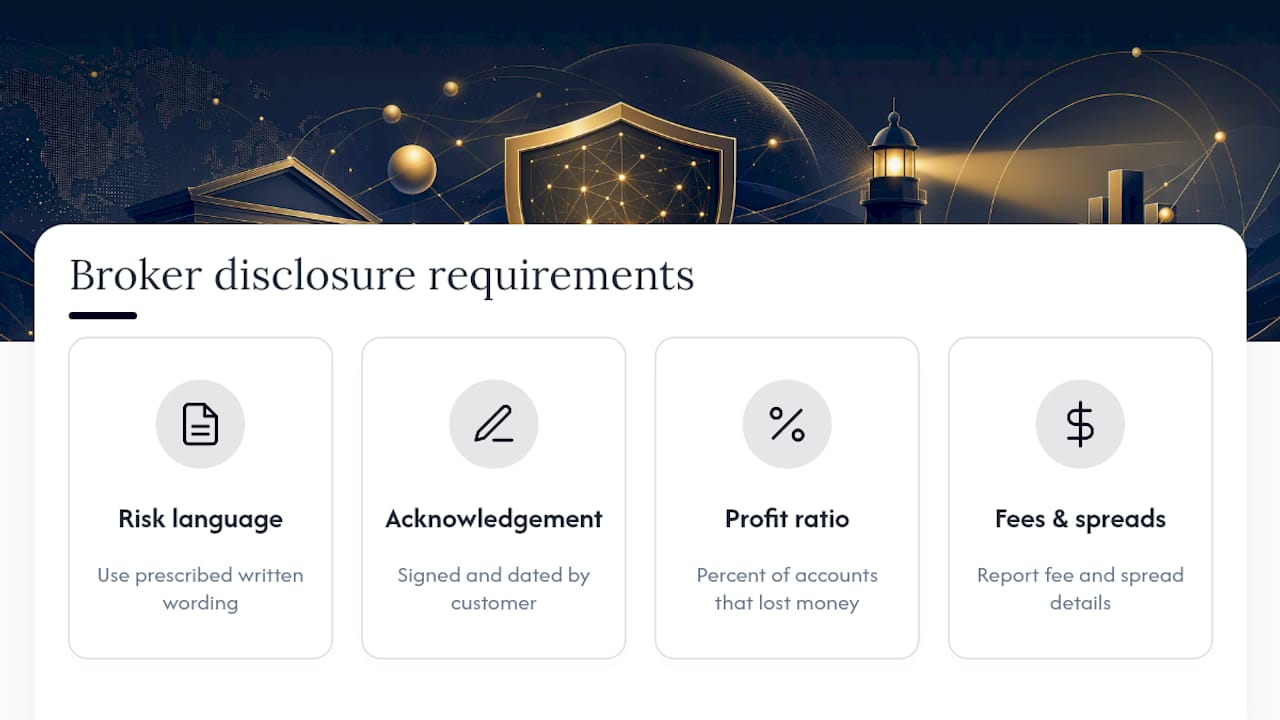
That's the substance of FINRA Rule 2270, and its language firms are required to give day-trading customers before they open an account, not after.
The profitability disclosure deserves attention on its own. Firms have to state the recent percentage of retail accounts that lost money Federal Reserve Section 240.6 disclosure regulation, which is one of the few hard numbers regulators force into marketing-adjacent material. Treat "past performance is not indicative of future results" as a literal instruction, not filler text.
How to Read a Trading Risk Disclosure Without Skimming Past the Important Parts
A disclosure only helps you if you actually extract the right five or six facts from it. Work through it like a checklist:
- Does it state your maximum leverage and what happens on a margin call?
- Does it disclose the account profitability ratio, and is the number recent?
- Is there a clear, itemized fee and spread table, or vague language about "competitive pricing"?
- Does it include set-off or counterparty language that affects how your funds are held?
- Does it explain custody, especially for crypto or amplified accounts?
Before funding any account, ask the broker directly: What's your current profitable-account ratio? What triggers a margin call on this instrument? Are client funds segregated? What's the total cost including spread markup? What happens to open positions during an outage?
Pro Tip: If a broker hesitates to answer the profitability-ratio question in writing, that's a bigger red flag than any single fee line item.
Turning the Warnings Into a Written Risk Plan
A disclosure tells you what can go wrong. It doesn't manage your account for you, which is why the next step has to be a written plan with real numbers attached.
- Size positions before you size opinions. Many professional guides point to a 1% to 2% risk-per-trade structure as a starting framework, not because it's a rule, but because it keeps a bad week from becoming a ruined account. CME Group's own examples show how quickly larger per-trade risk erodes capital during a losing streak.
- Set a daily loss limit and actually enforce it. A daily loss cap that shuts down trading for the day works only if you follow it when you're frustrated, not just when you're calm.
- Watch portfolio heat. Multiple positions tied to the same driver, gold and mining stocks, for instance, behave like one large position, not several small ones.
- Write down invalidation levels before you enter, and take a cooldown after any day you breach your own limit.
Fees, Profitability Claims, and the Limits of What Gets Disclosed
Disclosures require firms to state fees, spreads, and commissions, but the timing and format vary by broker, so ask for the numbers in writing before funding anything.
- Profitability ratios show the share of accounts that made or lost money over recent quarters. They're useful, but they say nothing about your specific strategy or risk tolerance.
- Fee tables should separate spread cost from commission from any performance-based fee; vague bundled pricing is worth pushing back on.
- Independent verification means dated, third-party-audited statements, not a screenshot of an equity curve. A neutral risk-disclosure checklist is a useful cross-reference if you want a second opinion outside the broker's own materials.
- Ask for the calculation method behind any advertised win rate or profitability figure. Firms that stand behind their numbers will show you the math.
Why Independent Verification Changes How You Should Read Any Claim
Regulatory disclosures are written to be non-exhaustive on purpose. They expect you to dig further, not stop reading once the legal minimum is satisfied. That's the gap most retail traders miss: a disclosure is a floor, not a research report.
Third-party verification matters more than most people realize, because a track record you can't independently confirm is just a claim wearing a spreadsheet. Sonic AI's gold trading results, for example, are presented as verified performance data, and that's the kind of claim worth checking against the source yourself rather than taking on faith, regardless of which provider makes it.
— Paulo
An Automated Alternative Worth Reviewing on Its Own Disclosure Terms
An automated trading strategy on gold offers an alternative to manual gold trading for people who've read enough disclosures to know the risks but don't want to sit at a screen managing every entry and exit themselves. Its Sonic AI strategy focuses exclusively on XAUUSD and uses the COPYX system to copy trades automatically into a connected account, which removes the manual execution step without removing market risk.

Before funding anything, treat Sonic AI the same way this article just walked through: check the fee and performance-fee structure, review the independently verified track record, and confirm you understand the leverage exposure on an amplified account before scaling position size. If the disclosure terms line up with what you're comfortable carrying, the Sonic AI landing page is where to start reviewing account setup and current performance reporting.
This article is general information, not a substitute for advice from a qualified financial advisor. Consult a qualified financial professional about your own circumstances before acting on anything here.
Sources
- SECTION 240.6—Disclosure (Federal Reserve)
- Finra
- Risk Management Techniques for Active Traders | Investopedia
- The 2-percent rule | CME Group
FAQ
What Is a Risk Disclosure in Trading?
It's a required written statement from a broker or dealer explaining the financial, legal, and operational risks of an account or instrument, including the possibility of losing more than you deposit.
Are Traders Required to Sign an Acknowledgement of the Disclosure?
Yes, for retail forex accounts specifically. Federal Reserve Section 240.6 requires a signed and dated acknowledgement before an account can be opened.
What Is Trading Risk?
Trading risk is the chance that a position moves against you and results in a loss, ranging from ordinary market volatility to leverage-driven losses that exceed your deposited funds.
What Does the FINRA Day-Trading Disclosure Say?
FINRA Rule 2270 states that day trading is highly risky and generally inappropriate for people with limited resources, limited experience, or low risk tolerance.
Does Sonic AI Publish a Risk Disclosure?
Sonic AI presents performance and fee details on its own site, including its fee structure, and readers should review those terms directly before copying any automated gold strategy.