
Trade copier latency is the time between the moment a copier detects the leader's order and the moment it sends the matching order to the follower's broker. Sub-5 ms end-to-end is excellent and typically means a colocated setup; 5 to 50 ms is common for well-placed cloud or VPS systems; anything routinely spiking above 100 ms needs attention. The number that actually predicts your slippage isn't the average. It's the p95 and p99 tail.
TL;DR:
- Most trade copier latency spikes above 100 ms during volatile market conditions can significantly increase slippage and trading costs.
- Proper placement and architecture, such as colocating near the broker's data center or using event-driven systems, can reduce latency to under 5 ms.
- Tail latency metrics like p95 and p99 are crucial for understanding worst-case delays that can cause costly missed opportunities.
- Running load and burst tests during high volatility periods reveals real performance and tail risks, especially with multiple followers or sequential order dispatch.
- Built-in latency measurement and continuous monitoring are essential, as averages can be misleading and do not account for spikes that impact fast strategies.
Table of Contents
- How Trade Copier Latency Is Actually Measured
- What Actually Adds Latency Between Leader and Follower
- Trade Copier Latency Benchmarks and What They Cost You
- How Latency Behaves Under Load
- How to Test Trade Copier Latency Yourself
- How to Reduce Trade Copier Latency
- When Does Latency Actually Matter for Your Strategy?
- Applying This to Gold Copy Trading
- What Traders Consistently Get Wrong About Latency
- A Managed Path to Automated Gold Execution
- Sources
- FAQ
How Trade Copier Latency Is Actually Measured
Vendors love to advertise "sub-millisecond" execution, but that phrase usually describes internal processing time, not what happens between your leader account and your follower's broker. The only measurement that matters is the full path: from when the copier detects the leader's order to when it sends the corresponding order to the follower's broker. What happens after that, meaning broker-side fills and matching, sits outside the copier's control and should be measured and reported separately.
A reliable latency test tracks three data points:
- Leader detection timestamp (when the copier sees the source trade)
- Copier send timestamp (when the follower order leaves the system)
- Follower broker receipt timestamp (when the destination broker acknowledges it)
Average latency hides the story. A copier that averages 8 ms but spikes to 120 ms during news releases will bleed money precisely when it matters most. Always ask for median, p95, and p99 figures, not a single flattering number.
What Actually Adds Latency Between Leader and Follower
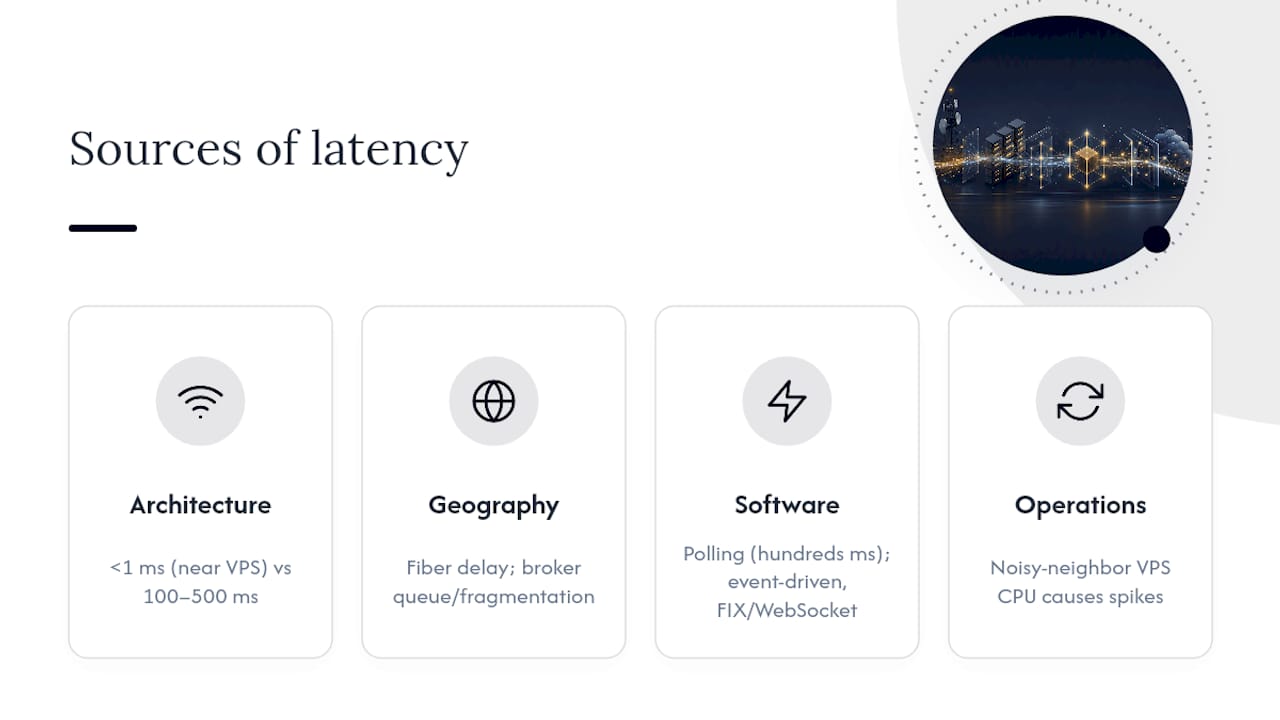
Architecture is the first variable. A local terminal running on your own machine adds network hops every time it talks to a broker server. A properly placed VPS near the broker's infrastructure removes most of those hops and can add less than 1 ms of internal latency, while a generic cloud instance sited far from the broker can tack on 100 to 500 ms.
Geography matters more than most traders assume. Fiber-optic signal travel time between, say, New York and London is a physical constraint no software can fix. Then there's the broker side: liquidity fragmentation, queue position, and differing dealing models all introduce variance a copier never controls.
Software design compounds it. Polling-based copiers that check for new orders every few hundred milliseconds lose time by design; event-driven systems that react to a push notification the instant an order fires are structurally faster. API protocol matters too, since FIX and WebSocket connections beat repeated HTTP calls. Symbol mapping and pre-trade risk checks that run sequentially for each follower can quietly serialize what should be a parallel process.
Operationally, a VPS under heavy load, or a cloud host packed with other tenants, will show latency spikes that have nothing to do with your strategy and everything to do with shared infrastructure.
Pro Tip: Before blaming your copier vendor for slow fills, check your VPS resource usage during the exact window of the delay. Noisy-neighbor CPU contention on budget cloud hosting is one of the most common and least diagnosed causes of latency spikes.
Trade Copier Latency Benchmarks and What They Cost You
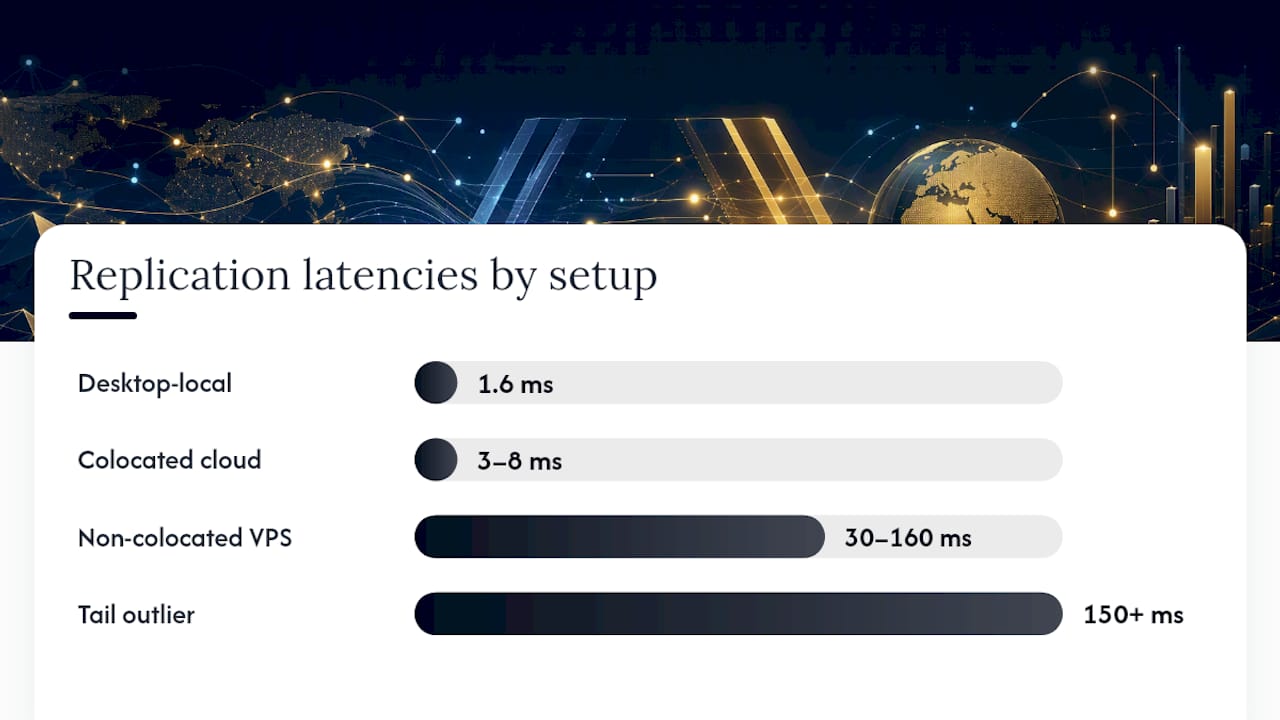
Real measured data gives a clearer picture than marketing claims. A desktop-local copier tested under high-volume conditions averaged 1.6 ms replication latency, with 99% of copies completing under 5 ms and average slippage around 0.2 ticks. That's close to the best-case ceiling for retail setups.
Cloud performance depends entirely on placement. A copier colocated inside the broker's own datacenter can hold end-to-end delay to roughly 3 to 8 ms, while a non-colocated cloud or VPS setup commonly lands in the 30 to 160 ms range, with occasional readings well past 100 ms.
The tail is where the money leaks. A copier that looks fine on average can still produce a handful of 150 ms outliers during volatile sessions, and those outliers are exactly when price is moving fastest.
The dollar math is straightforward. One tick on the E-mini S&P 500 (ES) is worth $12.50 per contract, and a 10 ms delay can be enough to miss that tick in a fast-moving market. Run five contracts across ten follower accounts and a single bad tail event costs $625, before you even factor in structural slippage from separate liquidity pools.
How Latency Behaves Under Load
Copy trading latency isn't static. It stretches the moment you add followers or the market gets volatile. A copier that dispatches orders sequentially, one follower at a time, adds a small delay increment for every additional account in the chain; ten followers copied sequentially can turn a 3 ms base latency into a much longer tail for the last account in line. Parallel dispatch and account sharding avoid that penalty, but only if the copier architecture supports it.
Cloud-based systems running multiple clients on shared infrastructure face a second problem: noisy-neighbor queuing, where another tenant's CPU spike delays your order processing with zero connection to your own trading activity.
Before trusting a copier at scale, run a burst test:
- Fire ten to twenty simultaneous leader trades across active follower accounts.
- Record processing and end-to-end time for every single copy.
- Report median, p95, and p99 separately, not blended into one average.
How to Test Trade Copier Latency Yourself
You don't need a trading desk to run a credible test. You need discipline and the right instrumentation.
- Synchronize clocks across leader and follower systems using NTP or, ideally, PTP, so your timestamps aren't lying to you.
- Fix your test variables: same symbol, same size, same time of day, repeated across at least one calm session and one high-volatility session.
- Capture logs from the copier terminal, the broker's execution reports, and, where possible, raw packet captures or WebSocket timestamps for an independent cross-check.
- Record median, p95, p99, jitter, and per-order slippage, along with environment details like VPS specs and datacenter region, because replication numbers shift dramatically with placement and broker route.
Pro Tip: Run your test during a scheduled news release, not just a quiet Tuesday afternoon. Latency that looks perfectly acceptable in calm markets often falls apart exactly when volatility spikes and you need it most.
How to Reduce Trade Copier Latency
Start with placement. Colocating your copier in or near the broker's matching engine datacenter, Chicago for CME-connected brokers, London or New York for major forex liquidity, does more for latency than any software tweak.
Next, kill polling. Event-driven detection through broker push notifications, WebSocket feeds, or FIX connections reacts the instant an order fires, instead of checking on a timer.
- Prefer FIX or native broker APIs with persistent connections over repeated HTTP requests that force a new handshake each time.
- Tune your network stack: stable NIC settings, keepalive connections, sane MTU values, and clean DNS resolution all shave off milliseconds that add up.
- Shard followers across parallel dispatch queues instead of one sequential chain, and monitor tail metrics continuously so a creeping p99 doesn't go unnoticed.
- Pre-validate margin requirements and symbol mapping ahead of time so the copier isn't running risk checks mid-trade, which serializes and slows the whole fan-out.
Pro Tip: If your copier vendor can't produce a p99 figure on request, treat that as a red flag, not a technical detail. Any serious infrastructure should have this number readily available.
When Does Latency Actually Matter for Your Strategy?
Scalping, news trading, and any strategy holding positions for seconds to minutes lives or dies on tail latency. Swing and position strategies holding for hours or days can tolerate 50 to 100 ms without meaningful cost.
Run the math before spending on infrastructure. Colocation subscriptions often run into real monthly cost, but if your strategy trades ES contracts frequently and a 10 ms delay risks a $12.50-per-contract miss across multiple daily trades, the math favors the upgrade quickly. For slower gold strategies, a well-placed generic VPS is often enough.
Applying This to Gold Copy Trading
XAUUSD moves fast during macro releases, which makes latency and structural slippage both relevant to execution quality. Sonicaigold's approach routes trades through COPYX, an automated execution layer built specifically for hands-off gold copy trading, paired with performance data reported through independent tracking. Readers evaluating any XAUUSD auto-copy setup should ask the same question posed throughout this article: what does the p99 look like, not just the average?
What Traders Consistently Get Wrong About Latency
Most traders chase the lowest average latency number a vendor will print, then get blindsided by a handful of terrible fills during the exact sessions where money actually gets made or lost. Convenience is fine for slower strategies. For anything scalping-adjacent, build monitoring that flags a shifting p99, not just a dashboard showing yesterday's average. The tail tells you what your infrastructure will do the next time it matters.
— Paulo
A Managed Path to Automated Gold Execution
If you'd rather not build and monitor your own latency infrastructure, Sonicaigold gives you a managed alternative built specifically around gold. Instead of assembling colocated VPS instances, event-driven hooks, and FIX connections yourself, Sonic AI runs the execution layer for you through COPYX, with performance independently verified over 18 consecutive winning months and reported with a stated 80% win rate.

The platform is built for traders who want XAUUSD exposure without managing broker connections, latency monitoring, or manual order entry. Setup guides walk you through connecting your account, and verification data is published for anyone comparing it against other automated approaches. If you want a hands-off way to copy a gold strategy that already accounts for execution quality, start by reviewing the Sonic AI landing page and its live MyFXBook verification results before funding an account.
This article is general information, not a substitute for advice from a qualified financial advisor. Consult a qualified financial professional about your own circumstances before acting on anything here.
Sources
- Trade Copier Software: 2026 Latency and Slippage Benchmarks
- Trade Copier Latency Benchmarks NinjaTrader 2026
- Cloud vs Local Trade Copier: Latency Benchmark 2026
- Why do follower orders fill at a different price than the leader?
FAQ
What Is a Good Latency for Trading?
Under 5 ms end-to-end is excellent and usually requires colocation; 5 to 50 ms is workable for most retail copy trading. What matters more than the average is your p95 and p99, since occasional spikes above 100 ms can cost far more than a slightly higher baseline.
Is Latency Arbitrage Illegal?
Latency arbitrage itself, exploiting speed differences between venues, isn't inherently illegal, but the legality depends heavily on jurisdiction, the specific trading venue's rules, and whether the practice violates disclosure or fair-access requirements. Traders should treat this as a compliance question for their specific broker and regulator, not a settled global answer.
What Is the Best Trade Copier Software for Low Latency?
The best-performing option depends on your architecture: a well-tuned desktop-local copier can average 1.6 ms with 99% of copies under 5 ms, while a properly colocated cloud copier can achieve similar single-digit millisecond results. For gold-specific copy trading, Sonicaigold's COPYX system handles execution automatically with independently verified performance reporting.
What Is the Lowest Latency Trading Method?
Colocating your infrastructure directly inside the broker's matching-engine datacenter produces the lowest measured latency, often in the 3 to 8 ms range end-to-end. Running your own local setup on a well-placed VPS near broker infrastructure comes close behind, adding under 1 ms of internal processing time.