
XAUUSD swap is the overnight financing charge applied when a gold position stays open past rollover, and for most retail traders holding long positions, that charge runs negative. Before opening a multi-day trade, check three things: your broker's exact long and short swap value in USD per lot per night, the rollover time in server terms, and which weekday carries the triple swap. A worked calculator example follows below, using measured broker data instead of theoretical points.
TL;DR:
- Swap rates vary significantly between brokers, with the difference on long positions reaching nearly $46 per lot per night, which can add up to thousands over a month.
- Most brokers apply a triple swap charge on Wednesdays to account for weekend settlement, increasing overall holding costs by roughly 12 to 38 effective nights in a 30-day period.
- Calculating swap costs accurately requires knowing your lot size, broker's swap value, point-to-dollar conversion, account currency, and hold duration; using automated tools simplifies this process.
- Strategies to minimize swap costs include closing positions before rollover, choosing swap-free accounts with wider spreads, timing entries to avoid triple-swap days, or using automated trading systems to manage overnight exposure.
Table of Contents
- What Are Swap Fees XAUUSD Traders Actually Pay?
- How Much Do XAUUSD Swap Rates Vary by Broker?
- When Do XAUUSD Swap Charges Actually Hit Your Account?
- Worked Examples: Calculating Real XAUUSD Holding Costs
- Practical Ways to Cut XAUUSD Swap Costs
- Deciding When Swap Should Change Your Strategy
- How Market Events and Economic News Move Swap Rates
- A Trader's View on Managing Swap in Real Positions
- A Managed Alternative to Manually Tracking Swap
- Where to Verify Live XAUUSD Swap Rates
- Sources
- FAQ
What Are Swap Fees XAUUSD Traders Actually Pay?
Swap on XAUUSD is not a flat fee. It is a nightly adjustment tied to the interest-rate differential between the US dollar and gold, which pays no yield of its own. Because gold earns nothing while the dollar carries a funding cost, brokers typically charge long positions a negative swap and sometimes credit short positions, though that credit can flip depending on rate differentials and USD funding costs.
The math a trader needs is simpler than the theory behind it. A broker quotes swap either in points, in raw dollars per lot, or as an annualized percentage. Whatever the format, the goal is the same: convert it into USD per lot per night.
For a points-based quote, multiply the swap points by the pip value for one standard lot (typically $1 per point on a 100-ounce contract, though this varies by broker's point definition). For a direct money quote, the broker has already done that conversion. For a percentage quote, apply the annual rate to the position's notional value and divide by 365 to get a daily figure.
Before running any of this through a calculator, gather:
- Your exact lot size (1.0 standard, 0.1 mini, or fractional).
- The broker's current long and short swap value for XAUUSD, in points or dollars.
- The point-to-dollar conversion the broker uses for gold.
- Your account's base currency, since swap is usually quoted in USD but debited in whatever currency you fund the account with.
- The number of nights the position will actually be held open, including any triple-swap day.
A tool like TR-MATE's XAUUSD swap calculator automates this by pulling measured broker data and normalizing it straight to USD per lot per night, which removes the guesswork of chasing down each broker's point definition.
How Much Do XAUUSD Swap Rates Vary by Broker?
Swap rates differ sharply from one broker to the next, and the gap is bigger than most traders assume. Rates vary because each broker sources interbank funding differently, applies its own markup, and quotes in different units before conversion.
Measured readings from live MT4 and MT5 Standard accounts, sampled over a 383-day period, show just how wide that gap gets:
These figures come from measured swap data normalized to USD per lot per night, and the spread between the cheapest and most expensive broker in that sample is nearly double.
A few things stand out:
- The gap between Exness and Vantage on long swap alone is roughly $46 per lot per night, which adds up fast on a 30-day hold.
- Short positions can occasionally earn a small credit, but that credit shrinks or disappears entirely on brokers with wider markups.
- No broker in this sample offers a genuinely "cheap" swap on both sides. Picking a broker for its long-swap rate might mean paying more on shorts.
Rates also move daily as interbank funding shifts, so a table like this is a snapshot, not a permanent reference.
When Do XAUUSD Swap Charges Actually Hit Your Account?
Rollover happens at the broker's server midnight, and that clock rarely matches your local time zone. A position open at 4:59 PM server time and closed one minute later can dodge a full night's swap entirely, which is why traders holding overnight need to know their broker's exact server offset.
Most brokers apply a triple swap once a week to account for weekend settlement, since the interbank market doesn't trade Saturday and Sunday but the cost of holding a position still accrues. Spot metals like XAUUSD commonly carry that triple charge on Wednesday, though this isn't universal.
A few practical notes:
- Confirm the exact triple-swap weekday with your specific broker; some shift it to Friday for certain instruments.
- Bank holidays in major financial centers can trigger extra swap charges outside the normal weekly pattern.
- Always re-check the broker's live measured swap value before entering a position you plan to hold for more than a few days, since these figures move often.
Worked Examples: Calculating Real XAUUSD Holding Costs
Take a 1.0 standard lot long XAUUSD position and a broker charging −$75 per lot per night, close to the mid-range figure from the broker table above.
- Seven-day hold: Seven calendar nights typically include one triple-swap night. That's 6 regular nights plus 1 tripled night, or 9 effective nights. At −$75 per night, the total swap cost is −$675.
- Thirty-day hold: A 30-day month contains roughly four triple-swap nights. That's 26 regular nights plus 4 tripled nights (12 effective nights), for 38 effective nights total. At −$75 per night, that's −$2,850 in swap alone.
- Scaling to 0.1 lots: Divide both totals by 10. The seven-day cost drops to −$67.50, and the 30-day cost drops to −$285.
That monthly figure isn't an outlier. Extrapolating measured per-night averages across a range of brokers, a 1-lot long XAUUSD position held 30 days can cost anywhere from roughly −$1,600 to −$2,965 in swap alone, depending entirely on which broker's measured swap rate applies. That range often exceeds the typical spread and commission cost combined for the same trade, which is the real takeaway: swap isn't a rounding error on a month-long hold. It's frequently the largest single cost line.
Practical Ways to Cut XAUUSD Swap Costs
A few tactics can meaningfully reduce what you pay in overnight financing, though each comes with a trade-off worth weighing before you commit.
- Swap-free (Islamic) accounts remove the nightly charge entirely, but brokers typically recover that cost through wider spreads or a flat administrative fee, so the total cost per trade may not actually drop.
- Closing before rollover avoids the charge altogether, which works for traders who don't need to hold overnight in the first place.
- Timing entries around the triple-swap day lets you dodge the heaviest single charge of the week, though it does nothing for the other six nights.
- Hedging or offsetting positions can neutralize directional swap exposure, but ties up margin and adds complexity.
- Choosing a broker with favorable swap on your typical direction matters more than chasing the tightest spread, if you routinely hold multi-day positions.
Comparing swap-free accounts against standard ones only makes sense when you weigh total trading cost, not swap in isolation, since a swap-free account with a wider spread can end up costing more on short-term trades.
Pro Tip: Track your broker's measured swap value weekly alongside your position size. If projected monthly swap exceeds a fixed percentage of your account (many traders cap it around 2 to 3 percent), that's your signal to reduce lot size rather than absorb the cost.
Deciding When Swap Should Change Your Strategy
Swap starts mattering once it rivals or exceeds your expected move or your spread and commission cost, not before. A day trader closing every position before rollover can largely ignore this guide. A swing trader holding gold for two or three weeks cannot.
A rough way to fold swap into your cost-per-trade planning:
- Expected cost per trade = (spread + commission) + (nightly swap × expected nights held).
- If that combined figure approaches 20 to 30 percent of your average expected profit target, swap has become a material input, not a footnote.
- Reduce lot size, shorten your holding horizon, or shift direction (long versus short) to bring that ratio back down.
Position sizing interacts directly with swap exposure. Traders working with high leverage often underestimate how swap compounds against an oversized position. It's worth reviewing how leverage amplifies both margin risk and overnight cost before scaling into a multi-week gold hold, and comparing that ongoing swap drag against execution costs like slippage to get the full cost picture.
How Market Events and Economic News Move Swap Rates
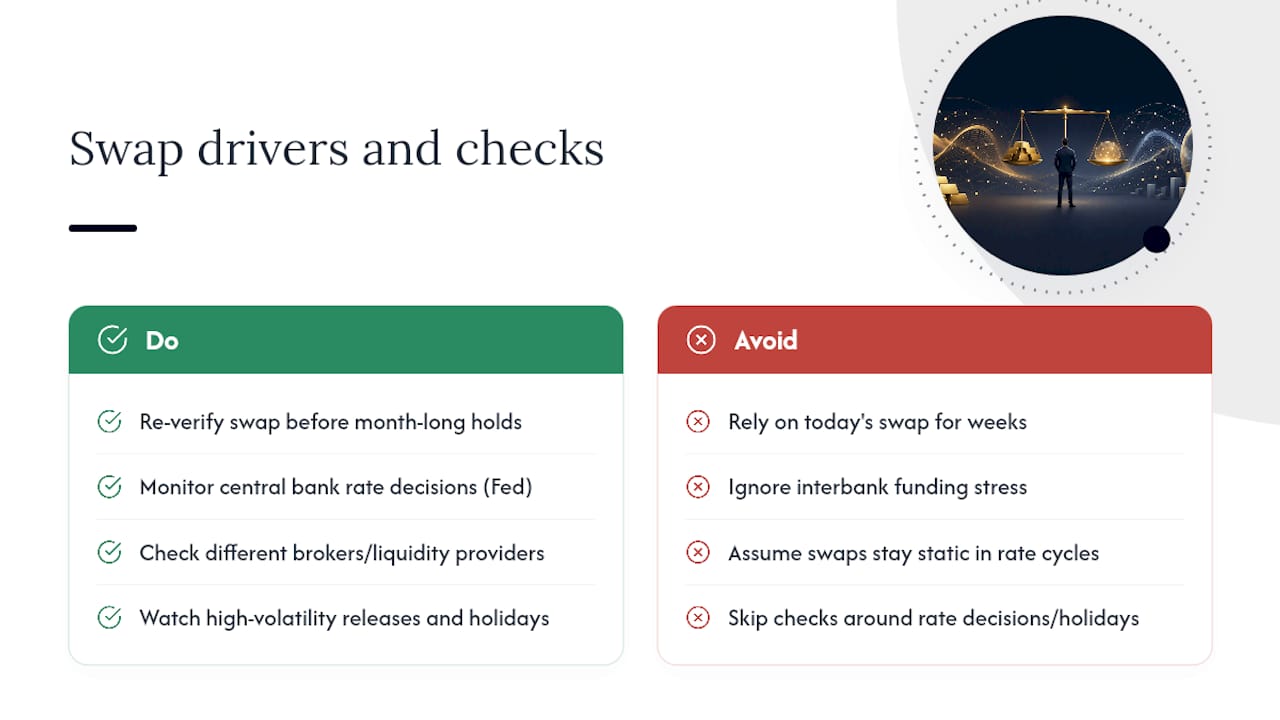
Swap rates on XAUUSD are not static, and they shift with the same forces that move gold's price itself. Central bank rate decisions, particularly from the Federal Reserve, directly change the USD funding cost that swap is built on. When the Fed raises rates, the interest-rate gap between the dollar and non-yielding gold widens, which typically pushes long swap charges more negative.
Interbank funding stress, the kind that spikes during banking crises or liquidity crunches, also feeds into broker swap calculations. A broker's swap adjustments track interbank rate movements and internal policy, which is why two brokers pulling from different liquidity providers can show meaningfully different swap values even on the same day.
Economic data releases matter less directly, but high-volatility events like Non-Farm Payrolls or Consumer Price Index prints can cause brokers to widen swap alongside spreads temporarily, especially around major rate decisions. Some brokers also adjust swap ahead of long weekends or holiday closures when interbank liquidity thins out.
The practical implication: a swap rate you check today might not hold in two weeks, especially during a rate-hiking or rate-cutting cycle. Traders planning month-long holds should re-verify swap values rather than relying on a rate captured before a major central bank meeting.
A Trader's View on Managing Swap in Real Positions
Swap gets treated as an afterthought by too many traders, and that's a mistake. It's one of the few trading costs you can actually calculate in advance with precision, unlike slippage or spread widening during volatility. Checking measured swap data before entering a multi-day gold position takes two minutes and can save hundreds of dollars over a month. The traders who build that check into their routine, rather than discovering the cost on a monthly statement, are the ones who treat gold trading as a business rather than a hobby.
— Paulo
A Managed Alternative to Manually Tracking Swap
Manually tracking swap across multiple positions works, but it takes discipline most traders don't sustain past the first few weeks. An alternative is an automated gold trading strategy that manages entries, exits, and position sizing without requiring you to calculate overnight costs on every trade.

This kind of strategy can run exclusively on XAUUSD and may be executed through systems that allow trades to copy automatically into your account without manual intervention. Some strategies have reported consistent performance verified over multiple months, with a high win rate. Because the system manages position timing and sizing systematically, it removes the day-to-day burden of deciding whether to close before rollover or absorb another night of swap. If you want to see the verified track record before deciding, review the Sonic AI performance results on Myfxbook, or check the gold copy trading setup guide to get started.
Where to Verify Live XAUUSD Swap Rates
Published swap tables age quickly, so verify numbers before committing to a hold. The TR-MATE calculator auto-fills measured broker swap and normalizes it to USD per lot per night. Myfxbook's swap calculator checks live rates across multiple brokers, and CalcPips breaks down triple-swap timing by instrument. Re-check all three before opening any position you plan to hold longer than a few days.
This article is general information, not a substitute for advice from a qualified financial advisor. Consult a qualified financial professional about your own circumstances before acting on anything here.
Sources
- XAUUSD Swap Calculator: Gold Overnight Fee & Holding Cost | TR-MATE Global
- Swap / Rollover Calculator | Myfxbook
FAQ
How Can I Avoid XAUUSD Swap Fees?
Close your position before the broker's daily rollover time, switch to a swap-free account (which usually carries wider spreads instead), or time your trade to avoid the weekly triple-swap day.
What Is a Typical Swap Fee for XAUUSD?
Measured broker data shows long swap on a standard lot commonly ranges from about −$53 to −$99 per lot per night, while short swap ranges from a small credit to a similar-sized charge depending on the broker.
What Happens if I Get Charged a Triple Swap?
Your account is debited three times the normal nightly swap rate on one weekday, usually Wednesday for spot gold, to cover the two non-trading weekend days.
What Is the Swap Fee, Exactly?
It's the interest adjustment a broker applies for holding a leveraged position overnight, reflecting the funding-rate gap between the two sides of the trade, in gold's case between the US dollar and a non-yielding asset.
What Happens if I'm Charged Swap I Didn't Expect?
The charge appears as a debit or credit in your account balance the next trading day; reviewing your broker's measured swap table or a live calculator before holding overnight prevents the surprise.