
Limiting exposure through position caps, market caps, and daily-loss halts is what separates disciplined copy trading from gambling on autopilot. These controls, combined with stop-loss/take-profit levels and a kill switch, stop a single bad trader or a single volatile symbol from wrecking an otherwise sound account. Get these five settings right and you fix the majority of the damage copy trading can do to you.
TL;DR:
- Setting conservative maximum trade sizes and daily loss limits helps prevent single trades or bad days from causing catastrophic account damage.
- Diversifying exposure by capping each leader’s influence and limiting simultaneous trades in the same symbol reduces the risk of correlated losses.
- Platform-level controls like kill switches and loss halts act as emergency brakes to stop losses if risk controls fail or a leader acts rogue.
- Regular monitoring and review of real-time metrics, slippage, and drawdowns are crucial for timely adjustments and avoiding repeated mistakes.
- Using a rules-based, pre-configured strategy like Sonic AI's COPYX reduces the need for manual tuning and ensures consistent risk management.
Table of Contents
- Key CopyX Risk Controls and What Each One Does
- How to Set These Controls in Practice
- Allocation, Correlation, and Exposure Controls
- Platform-Level Protections and Emergency Controls
- Common Mistakes, Trade-Offs, and Tuning Heuristics
- Monitoring, Reporting, and Incident Response
- How These Controls Map to Sonic AI's COPYX Gold Strategy
- A Mindset for Copy-Trading Risk Controls
- Getting Started With a Managed, Rules-Based Approach
- Sources
Key CopyX Risk Controls and What Each One Does
CopyX-style platforms give you a stack of settings, and each one closes a different door. Skipping one doesn't just weaken your setup — it leaves an entire category of risk wide open.
- Max trade size caps the dollar or lot value of any single copied trade, so one oversized signal from a leader can't eat your account in one shot.
- Max position limits total exposure to one open trade, including any scaling the leader does after entry.
- Max market size caps total exposure to a single symbol (XAUUSD, for instance), which matters most when you're following several leaders who all trade gold.
- Max open markets limits how many different symbols you're exposed to at once, keeping correlated bets from stacking unnoticed.
- Max trades/24h throttles trade frequency, which protects you from a leader having a bad, overtrading day.
- Stop-loss and take-profit can be set at the trader level (applies to everything they open) or the position level (overrides for one trade you want to manage differently).
- Max leverage / max margin controls how much borrowed exposure you're carrying, which directly affects how close you sit to liquidation.
These specific fields (Max Trade Size, Max Open Markets, Max Daily Loss, Max Margin, and Stop-Loss/Take-Profit) show up across advanced copy-trade settings precisely because they cover the most common ways accounts get overexposed. Platform-level gates layer on top: a latency cutoff that skips stale mirrors, automatic leader demotion after a drawdown breach, and a beginner clamp that caps new accounts at a fixed dollar ceiling until you've proven the setup works.
How to Set These Controls in Practice
Start conservative, then earn the right to loosen up. A $10,000 account is a useful reference point because the math scales cleanly to larger or smaller balances.
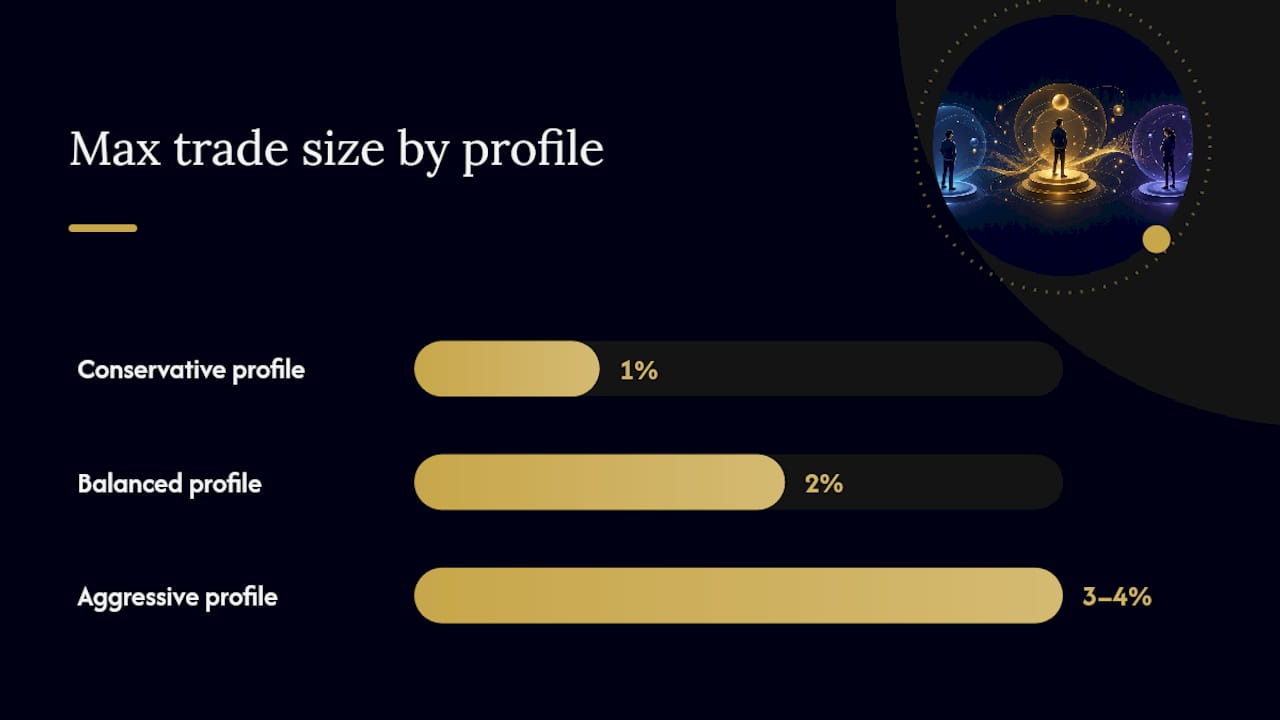
- Conservative profile: Max trade size at 1% of equity ($100), max market size at 3% ($300), max daily loss at 2% ($200), stop-loss at 1.5% per trade.
- Balanced profile: Max trade size at 2%, max market size at 5%, max daily loss at 4%, stop-loss at 2.5%.
- Aggressive profile: Max trade size at 3-4%, max market size at 8%, max daily loss at 6%, stop-loss at 3.5%, only after at least a month of clean execution data.
Starting with modest per-market exposure, roughly 2 to 5% of account value, gives you room to survive a string of losses without needing to touch the settings mid-drawdown. As your account grows, scale the dollar caps proportionally rather than resetting them from scratch. Use per-position overrides when one copied trade looks misaligned with your risk tolerance; use trader-level caps for everything else.
Pro Tip: Set your max daily loss first, before anything else. Every other setting is negotiable; this one is the wall that keeps a bad day from becoming a bad month.
Allocation, Correlation, and Exposure Controls
Copying three leaders who all happen to be long gold is the same bet made three times, not three different bets. Correlation is where copy traders get hurt without realizing it.
- Cap exposure per leader (no single trader should control more than 25-30% of your equity).
- Cap exposure per symbol across all leaders combined, not just per leader individually.
- Limit same-symbol stacking so multiple leaders can't independently push you past your intended max market size.
- Treat percent-of-equity per leader as a moving target: recalculate it after every meaningful deposit, withdrawal, or leader swap.
Your real exposure is a function of leader weight multiplied by your copy percentage, not either number alone. Ratio recalculation tools help keep your copy percentage properly scaled against what the leader is actually risking, rather than a static number set once and forgotten.
Platform-Level Protections and Emergency Controls
Hard brakes exist for the scenarios you can't manually react to fast enough.
- Kill switch: manually halts all copying instantly. Use it the moment you suspect a leader has gone rogue or a platform issue is causing bad fills.
- Daily loss halt: automatically pauses copying once your daily loss limit is hit, before you're tempted to override it emotionally.
- Latency gate: rejects mirrors that arrive too late to execute at a fair price, typically around 2,500 milliseconds as a default cutoff.
- Leader demotion: automatically drops or reduces exposure to a trader whose drawdown crosses a set threshold, often near 12%.
- Sandbox and confirm-required arming: test settings on paper before they touch live capital, and require an explicit confirmation step before going live.
Common Mistakes, Trade-Offs, and Tuning Heuristics
Settings that are too tight choke your winners before they run; settings that are too loose let a single tail event through untouched. Both failures look identical in a screenshot of a losing account, which is why so many people tune the wrong dial after a bad week.
- Chopping out: stop-losses set so tight that normal volatility triggers them constantly, turning a winning strategy into a break-even one.
- Late demotion: leader drawdown thresholds set too high, so damage is already done by the time the platform reacts.
- Ignored slippage: treating backtested or advertised results as guaranteed fills, when execution and margin mismatches mean copiers can get liquidated even when the leader isn't.
Pro Tip: Adjust latency, leader drawdown gates, and copy percentage together, not one at a time. Loosening a single clamp without checking the others is how a survivable setup turns into an unsurvivable one. Run new settings in a sandbox, move to a small live position, review the results after a set number of trades, then adjust. ISO 31000 frames this as a continual improvement loop rather than a one-time configuration, and that framing holds up well in practice.
Monitoring, Reporting, and Incident Response
Controls only work if someone is watching the numbers they're supposed to catch, which is why using trade analytics solutions can help track and analyze performance accurately.
- Track in real time: daily PnL, drawdown percentage, total open-market exposure, and execution latency or fill quality.
- Review weekly or monthly: log slippage patterns, per-leader drawdown history, and any execution gaps between signal and fill.
- Follow an incident playbook when a guard fires: pause copying immediately, triage which leader or setting caused the trigger, adjust the specific control involved, then document what changed before resuming.
A daily loss limit that fires without a follow-up review just resets the clock on the same mistake. The review step is what turns a single stopped-out day into an actual lesson.
How These Controls Map to Sonic AI's COPYX Gold Strategy
Sonic AI runs its XAUUSD strategy through COPYX with the same categories of protection covered here: hard position and market caps, daily-loss thresholds, and stop-loss/take-profit discipline applied automatically on every copied trade. That structure is a meaningful part of why the strategy has produced 18 consecutive winning months under independent verification. Gold's volatility punishes loose sizing fast, so the caps aren't a formality. They're the reason a single sharp reversal doesn't undo months of steady gains.

A Mindset for Copy-Trading Risk Controls
Chasing a high win rate matters less than respecting the caps that keep you in the game long enough to see one. Tuning is ongoing work, not a setup you finish once. If you remember one rule, make it this: set your daily loss limit before you set anything else.
— Paulo
Getting Started With a Managed, Rules-Based Approach
Building and tuning every one of these controls yourself takes real time. Sonic AI's XAUUSD strategy runs on COPYX with those position caps, daily-loss thresholds, and stop-loss discipline already configured and independently verified across 18 consecutive winning months.

That track record removes the guesswork of tuning latency gates and leader drawdown thresholds from scratch, since the strategy is managed by a team that adjusts those settings against live gold market conditions. If you want to see how the controls translate into actual performance, review the XAUUSD copy trading page for setup details, or check the live results dashboard to see the strategy's current standing before you connect an account.
This article is general information, not a substitute for advice from a qualified financial advisor. Consult a qualified financial professional about your own circumstances before acting on anything here.
Sources
- Advanced Settings
- BingX copy-desk README
- Olympus risk & ratio management
- ISO 31000:2018 – Risk management guidance handbook (preview)
- Copiers - Risk warning for copy-by-position-ratio (BingX)