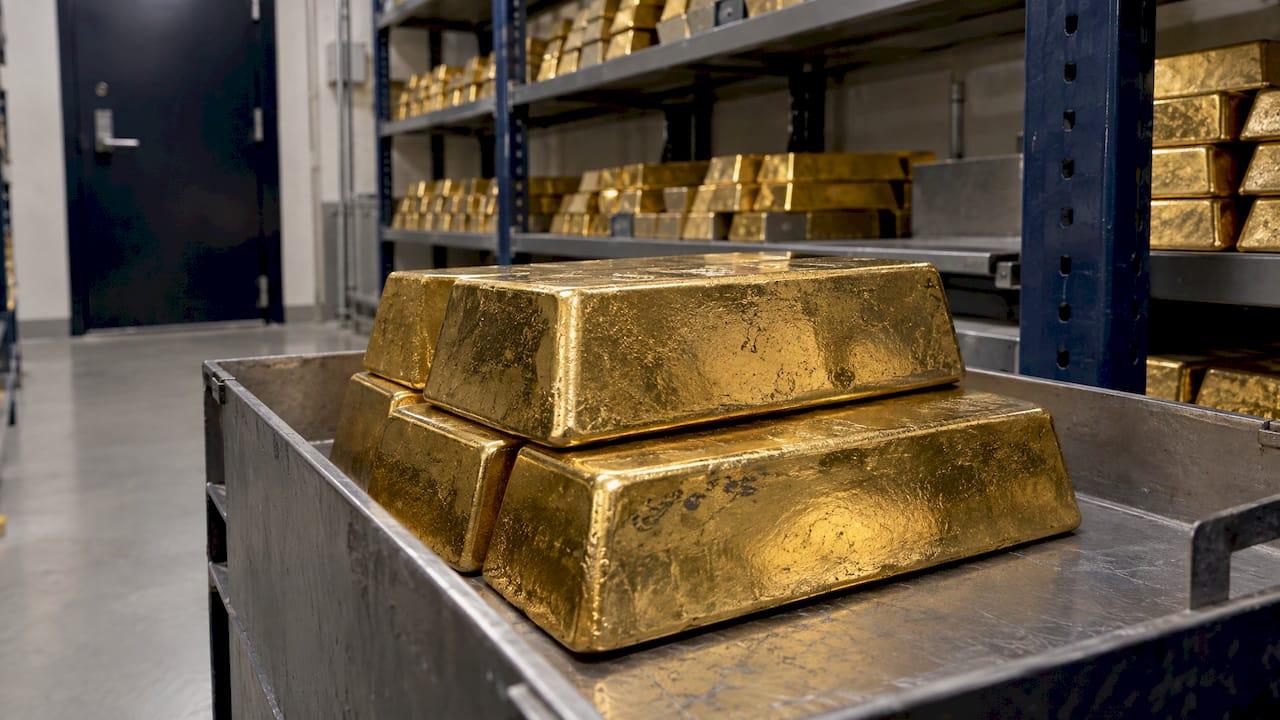
Gold hedging means holding or trading gold so that a loss elsewhere in your portfolio, or in gold itself, is partly offset. You can do it in two ways. You can add gold as a diversifier, or you can use derivatives such as puts, collars and futures to protect an existing gold position. The right choice depends on what you are protecting, for how long, and how much cost you accept.
This guide covers both uses. It explains how each strategy works, what it costs, how to size it, and where automation fits.
TL;DR
- Gold is used to hedge inflation, currency risk (mainly the US dollar) and tail events. Evidence is strong for stress periods and weaker over long inflation horizons.
- To protect gold you already own, the main tools are protective puts, collars and short futures. Puts cost a premium. Futures cost little upfront but cap your gain.
- Research on allocation sizing commonly points to single digits, roughly 2% to 10% of a portfolio. Larger shares reduce risk-adjusted returns.
- Match the hedge instrument to the exposure. A mismatch creates basis risk.
- Automated gold strategies need risk controls and transparent reporting, whether you hedge or trade.
Table of Contents
- What hedging with gold means
- How well gold works as a hedge
- Core gold hedging strategies
- Choosing and sizing a gold hedge
- Costs and risks to plan for
- Automation and risk controls
- Perspective
- Using Sonic AI alongside a gold hedge
- FAQ
- Sources
What hedging with gold means
Two different things share the name. The first is using gold to hedge other assets. The second is hedging gold itself, for example a gold ETF holding or a mining portfolio.
For the first use, the World Gold Council lists four roles for gold: portfolio diversifier, inflation hedge, currency hedge (particularly against the US dollar) and a tool for managing tail events. Its 2020 research adds that gold is a real asset with no credit or counterparty risk, and that it tends to move with risk assets in calm markets and against them in risk-off markets.
For the second use, the investor already holds gold or gold-linked assets and wants to limit the damage from a price drop. That is where options, futures and collars come in.

How well gold works as a hedge
Gold is not one hedge for everything. The evidence differs by risk.
Market stress and tail events
The World Gold Council found that gold allocations of 2.5% to 9.0% reduced weekly Value at Risk by 0.1% to 15.5%, based on data from December 1987 to July 2010. Portfolios with gold did better than those without in 18 of 24 tail-risk events. In the October 2007 to March 2009 period, an 8.5% allocation cut total portfolio loss by almost 5%.
The same council's international study found that US, European and UK investors with a 5% gold allocation reduced losses by about 5% across eight tail events.
Inflation
The picture is mixed. An NBER working paper finds gold may hedge inflation over horizons of centuries but is unreliable over practical investment horizons. A 2024 study found gold was a reliable short-term inflation hedge, with the strongest effects at lags of 1.5 to 2 months, and a weaker relationship over longer lags. For more on this, see our review of gold as an inflation hedge.
The price of protection
Hedges have a cost. Bredin, Conlon and Potì studied the question over 1980 to 2014. A 10% gold allocation removed 15% of downside risk at a one-day horizon, but at a 60-day horizon the reduction was 9%. At the longest horizon, it reduced downside risk by only 1% while surrendering 29% of risk-adjusted returns. The takeaway is to size a gold hedge deliberately and to review it over time.
Core gold hedging strategies
Each strategy trades off precision, cost, liquidity and upkeep. The table summarizes the main ones.
| Strategy | How it works | Upfront cost | Main limit |
|---|---|---|---|
| Protective put | Buy the right to sell gold at a set price | Option premium | Premium decays if gold does not fall |
| Collar | Buy a put and sell a call | Can be near zero | Upside is capped |
| Short futures | Sell futures against a long gold position | Margin, little premium | No flexibility, gains offset too |
| Allocation or rebalancing | Hold a set share of gold, trim when it grows | None beyond holding | Not a precise hedge |
| Inverse products | Funds that rise when gold falls | Fund fees | Best for short holding periods |
Protective puts
A put gives you the right, not the obligation, to sell gold at a chosen strike. The Singapore Bullion Market Association explains that the buyer pays a premium, a small percentage of the notional being hedged, which makes options a smaller cash outlay than futures.
The cost is real, though. A World Bank document gives a central bank example: on March 31, 2023, with the LBMA PM fixing at 1,979.70 USD/oz, a put costing 22.40 USD/oz to hedge 10,000 oz would cost US$224,000 in total. Your maximum loss on the hedge is the premium paid.
Collars
A collar adds a sold call to fund the put. You keep protection below the put strike and give up gains above the call strike. A practical example from Cannon Trading used gold at $3,800: buying a $3,600 put and selling a $4,000 call, each at $150 per ounce, gave a net cost of $0 with protection below $3,600 and upside capped at $4,000. Those prices are illustrative and will not match today's market. Use it to understand the structure, not as a quote.
Short futures
Selling futures against a gold holding locks in a price. The World Bank describes forwards and futures as the least expensive way to hedge future gold price moves, though they offer no flexibility. The same document notes that a standard COMEX gold futures contract is 100 troy ounces, with smaller 50 oz and 10 oz contracts also available. Because futures trade on an exchange, counterparty credit risk is almost negligible.
If you wonder how spot gold quotes differ from listed contracts, see our comparison of XAUUSD and gold futures.
Rebalancing and allocation
Sometimes the problem is simply that gold has grown too large in the portfolio, or too small to cushion a downturn. Setting a target weight and rebalancing back to it needs no derivatives. It is the lowest-maintenance approach, and it does not protect against a sudden drop the way a put does.
Choosing and sizing a gold hedge
Start with three questions. What exactly are you protecting? Over what period? How much cost can you accept?
Sizing a gold allocation
Research gives useful ranges. State Street Global Advisors tested adding 2%, 5% or 10% of a gold ETF to a hypothetical multi-asset portfolio from January 2005 to March 2018. Sharpe ratios improved, standard deviations fell, and a 10% allocation reduced maximum drawdown by almost 300 basis points. Past results on a hypothetical portfolio do not predict future ones.
The pattern across studies is that small to moderate allocations help, and large ones start to cost return. Our article on what 2% to 10% allocations miss looks at this trade-off in more detail.
Sizing a derivatives hedge
For futures, the simplest starting formula is exposure divided by the notional value of one contract. For example, hedging 10,000 oz with standard 100 oz contracts means 100 contracts for a full hedge. Options need delta. The CME Group case study of a producer hedging 10,000 oz divided 100 futures-equivalent contracts by a delta of 0.48 to arrive at 208 puts, a premium cash outlay of $1,239,680, with the maximum loss limited to the premium.

That is a producer-scale example. A retail investor with a gold ETF can scale the same arithmetic down using smaller contracts or ETF options. Recalculate whenever your exposure changes or the contract nears expiration.
Match the instrument to the exposure
Basis risk is the risk that your hedge moves differently from what you hold. Hedging a liquid gold ETF with options on the same ETF keeps it low. Hedging a basket of mining stocks with bullion futures raises it, because miners respond to costs, debt and equity markets as well as gold. Where possible, hedge with an instrument that tracks the thing you own.
Costs and risks to plan for
- Premium drag. Repeated put purchases add up. When implied volatility is high, premiums rise, and constant hedging can pull down long-term returns.
- Opportunity cost. Futures and collars protect the downside and also limit the upside.
- Margin and liquidity. Futures are marked to market daily, so you need cash available for margin calls.
- Leverage. Gold contracts control large notional values. See how traders handle 2x exposure safely.
- Alternative hedges. The World Gold Council notes that VIX futures and index options reduced drawdown and volatility more than gold, but owning short-term VIX futures can erode performance by nearly 2% a year. Gold has no such carry cost.
- Taxes and access. Rules differ by country. In Turkey, for example, the VIOP exchange applies a 10% withholding tax to proceeds from contracts other than equity and equity-index contracts. Check the rules where you live and speak with a tax professional.
If gold is the asset you trade rather than hold, the main risk is a drawdown. A written drawdown recovery plan with risk gates helps you decide in advance when to cut exposure, rather than deciding under stress.
Automation and risk controls
Some investors prefer a systematic process over manual hedging. Automation removes emotional decisions, but it adds its own risks that need controls.
The Futures Industry Association recommends that localized pre-trade risk controls be the primary tools for preventing unintended market activity. These include maximum order size, price tolerance, message throttles and kill switches. Post-trade controls such as drop copy reconciliation compare execution against an independent record.
For an investor choosing an automated gold strategy, the same ideas translate to practical questions:
- Is performance reported through an independent third-party platform?
- What is the stated drawdown, and over what period?
- How are fees charged, and are they tied to profit?
- Can you stop the strategy at any time and withdraw?
For a deeper look at position-level risk, see our guide to volatility targeting and the article on low drawdown strategies.
Perspective
We approach gold as a market to trade, not only one to hold or insure. A hedge protects what you own. A strategy that trades XAUUSD systematically aims to generate gains from gold's moves in both directions.
That is the idea behind Sonic AI. It focuses only on gold (XAUUSD), is managed by an experienced team, and executes through COPYX, so trades are copied to your account automatically. You do not need deep trading knowledge to use it.
Our reported results are 18 consecutive winning months, an 80% win rate and drawdown below 1%, verified on MyFXBook. We present these as our own results. They are not a promise of future returns, and trading gold carries risk of loss.
For investors who already hold gold or gold-linked assets, we see Sonic AI as a complementary position with a clear process and a record you can check yourself. It also removes the need to time puts and futures by hand.
Paulo
Using Sonic AI alongside a gold hedge
Investors who want gold exposure without managing orders can copy the Sonic AI strategy. It is an algorithm-driven gold strategy with automatic trade copying through COPYX, performance reporting, and setup guides for new users. Accounts are available with 12X and 24X amplified options. The cost is a performance fee, so fees are linked to trading gains. See the fee structure before you decide.

To see the strategy, its live results and the setup steps, visit Sonic AI gold copy trading. Network marketers can also review the COPYX IB Partner Program.
FAQ
What is the cheapest way to hedge gold?
Futures and forwards are generally the least expensive, because they need margin rather than a premium. The trade-off is that they give no flexibility, and they cap your gains as well as your losses. Options cost a premium but let you keep the upside.
How much gold should a portfolio hold as a hedge?
Studies commonly test allocations between 2% and 10%. The World Gold Council found benefits at 2.5% to 9.0% during tail events, while research on longer horizons shows larger allocations give up risk-adjusted return. Your own allocation depends on your goals and risk tolerance. A licensed financial adviser can help set it.
Is gold a good hedge against inflation?
Evidence is mixed. Research finds gold can work over very long horizons and over short lags of one to two months, but it is unreliable over many practical investment periods. Treat it as one part of an inflation plan.
Can I hedge gold with an automated strategy?
An automated strategy such as copy trading is not a hedge in the strict sense. It is a way to take gold exposure with a systematic process. If you want to offset an existing position, use puts, collars or futures, and confirm any automated tool has clear risk controls and verified reporting.
Sources
- World Gold Council: Gold, hedging against tail risk
- World Gold Council: Gold as a hedge, tail hedging strategies compared
- World Gold Council: Gold and tail-risk hedging, an international perspective
- NBER working paper on gold and inflation
- The Evolving Role of Gold as an Inflation Hedge (2024)
- Bredin, Conlon and Potì: The Price of Shelter
- Singapore Bullion Market Association: Hedging strategies with gold derivatives
- World Bank document on gold price risk management
- Cannon Trading: gold hedging example
- State Street Global Advisors: The Role of Gold in Today's Global Multi-Asset Portfolio
- CME Group: Hedging risk with gold futures and options
- FIA: Best practices for automated trading risk controls
- Garanti BBVA Yatirim: VIOP products