
Copy a professionally managed AI gold (XAUUSD) strategy through COPYX rather than trading manually or testing unverified bots. Sonic AI stands out as the leading option because of its independently verified 18 consecutive winning months, an 80% win rate claim, and built-in risk controls. Review the live results, then follow the setup guide to enable automatic copying.
TL;DR:
- Verify that the AI strategy has at least 18 months of independent, broker-linked performance data, with an acceptable drawdown level that matches the claimed win rate.
- Ensure risk controls like position sizing, daily loss limits, and exposure caps are clearly documented and active within the system.
- Be cautious of strategies promising high win rates without considering profit factor, maximum drawdown, or how they perform during volatile market conditions.
- Start with modest account allocations to a copy trading platform and gradually scale up after observing consistent live performance over multiple market regimes.
- Regularly monitor your account weekly, review drawdown levels, and understand how to pause or adjust copying before high-impact news events or sudden market shifts.
Table of Contents
- What Makes a Top AI Forex Strategy for Gold Trading
- How Do You Evaluate an AI Gold Strategy Before Copying It?
- How to Set Up COPYX to Start Copying a Gold Strategy
- What AI Techniques Actually Power These Trading Systems
- AI Forex Strategies vs. Traditional Manual Trading
- How AI Systems Adapt to Shifting Gold Market Conditions
- Common Pitfalls to Avoid With AI Forex Strategies
- An Editorial Take on Allocation and Discipline
- Start Copying Sonic AI's Verified Gold Strategy Today
- Sources
What Makes a Top AI Forex Strategy for Gold Trading
A managed AI gold strategy works differently than the DIY forex bots you've probably seen advertised. You keep full custody of your funds at your broker. The strategy provider only receives trading authority, meaning they can place and manage trades but never touch your withdrawals. That structural separation matters more than most investors realize when they're comparing options.
Gold has become the preferred instrument for this kind of systematic AI trading, and there's a real reason for that beyond marketing. XAUUSD offers deep liquidity around the clock, structured volatility patterns tied to macro events, and consistent safe-haven demand, all of which create recognizable price behavior. Institutional AI trading desks favor gold for exactly these reasons: it doesn't carry the single-company risk of an equity position, and its volatility follows patterns that machine learning models can actually learn from.
The typical system stack behind a strategy like this runs in four layers: data ingestion, a signal-generation model, a risk management layer, and an execution engine. Research on hybrid forecasting models combining sentiment analysis with time-series data shows this kind of layered approach can generate strong backtest results when tied to disciplined execution.
What actually separates a credible strategy from marketing noise comes down to verification. Here's what to look for:
- Independent, broker-linked performance reporting (Myfxbook-style tracking, not internal screenshots)
- A verification period measured in months, not weeks
- Documented win rate alongside drawdown data, not win rate alone
- A named team with a stated methodology, not an anonymous "algorithm"
Sonic AI's verification profile: 18 consecutive winning months, an 80% win rate, and independently tracked results that any prospective investor can review before committing capital.
How Do You Evaluate an AI Gold Strategy Before Copying It?
Vetting a provider takes fifteen minutes if you know what to check. Most investors skip straight to the win rate and miss the numbers that actually predict whether a strategy survives a rough month.
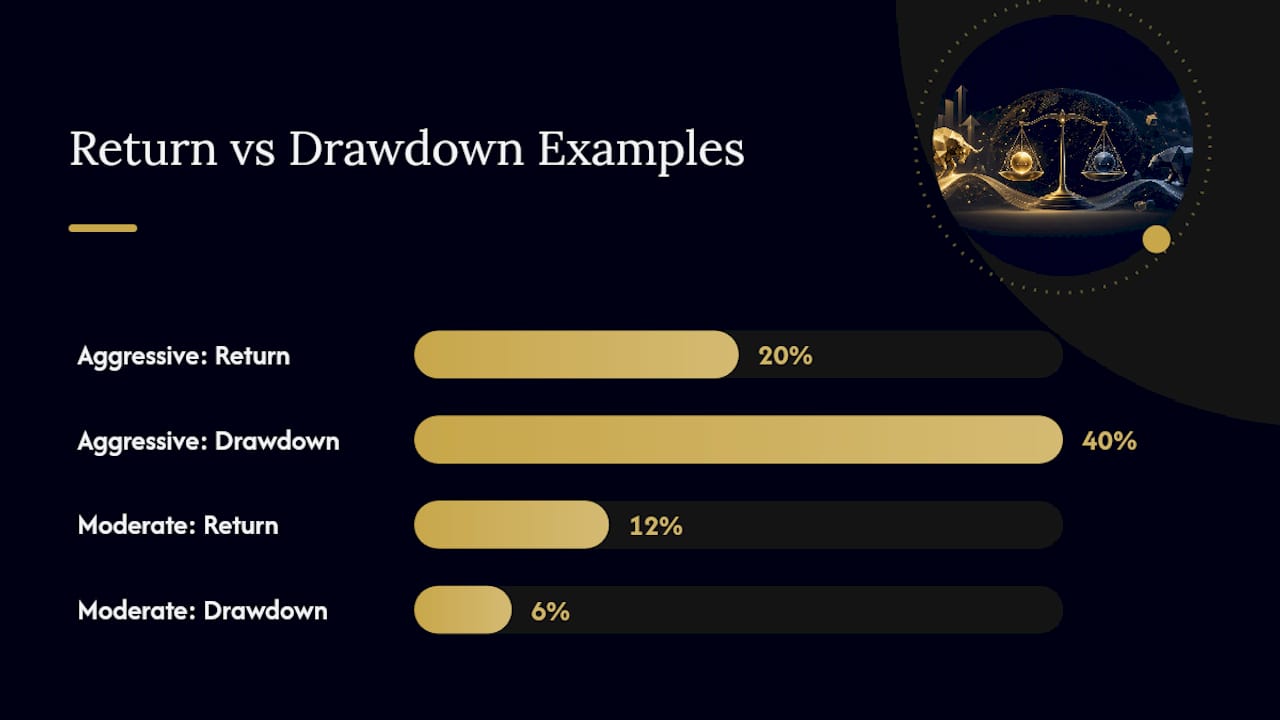
- Verified net returns and drawdown. Look for a broker-linked or Myfxbook-style track record, not a spreadsheet. Copy trading platforms consistently emphasize reviewing drawdown and profit factor alongside raw returns, and for good reason: a strategy that returns 20% with a 40% drawdown is far riskier than one returning 12% with a 6% drawdown.
- Profit factor over headline win rate. A high win rate paired with a few catastrophic losses can still produce a losing month. Seasoned allocators weigh profit factor and maximum drawdown more heavily than win rate alone (profit factor and drawdown data should be verified broker-linked).
- Months of live verification. Anything under six months of continuous, broker-linked data should be treated as a sample too small to trust. Eighteen months, like Sonic AI's published record, gives you multiple market regimes to judge performance against.
- Risk controls baked into the system. Ask whether the provider enforces per-trade position sizing, daily loss limits, and exposure caps, or whether it relies on discretionary judgment during volatile sessions.
- Fee transparency. Understand exactly how profit-share or commission is calculated and when it's deducted, so you know what you actually keep. Sonic AI publishes its fee structure rather than burying it in fine print.
Watch for red flags that disqualify a provider outright: unverifiable screenshots instead of live tracking links, inconsistent reporting between months, vague or shifting refund policies, and any promise of "guaranteed" returns. No legitimate strategy guarantees outcomes in a market as volatile as gold.
Pro Tip: Cross-check the provider's stated drawdown against its actual verified feed rather than a summary claim. A gap between the two is the fastest way to spot inflated marketing numbers.
How to Set Up COPYX to Start Copying a Gold Strategy
Getting a managed AI gold strategy running takes less time than most investors expect, usually under thirty minutes once your broker account is funded.
Account setup. Open a compatible trading account, typically MT4 or MT5 depending on the provider's requirements, at the linked broker. Fund it with the amount you intend to allocate. This is your account; you retain full custody and can withdraw at any time.
Enable copy permissions. Grant trading authority only, never withdrawal access, then activate COPYX to begin mirroring the provider's trades in proportion to your account size. Apply the provider's default risk template rather than overriding it on day one.
Size your allocation. Most investors start conservatively, often in a modest range of their total trading capital, and scale up only after reviewing several months of live performance on their own account. Capping total exposure protects you from a single instrument dominating your portfolio.
Monitor on a set cadence. Check your Myfxbook-style dashboard weekly rather than daily. Daily monitoring during normal drawdowns tends to trigger panic decisions; weekly review catches genuine problems without overreacting to noise.
Know your exit controls. Understand exactly how to pause copying, reduce allocation, or withdraw funds before you need to use those controls, especially heading into high-volatility events like central bank announcements.
| Setup Stage | What You Do | What to Verify |
|---|---|---|
| Account funding | Open MT4/MT5, deposit chosen allocation | Broker supports COPYX linkage |
| Copy authorization | Grant trading authority only | No withdrawal permission granted |
| Risk template | Apply provider's default sizing | Per-trade and daily loss limits active |
| Monitoring | Weekly dashboard review | Drawdown within historical range |
For a full walkthrough of linking your platform, the MT4 XAUUSD copy trading guide covers the technical steps in detail.
What AI Techniques Actually Power These Trading Systems
Three distinct AI techniques typically get combined inside a serious gold trading system, and understanding the difference helps you evaluate what a provider is actually running.
Machine learning models analyze historical price data, volume, and macro indicators to identify statistical patterns that precede price moves. These models don't "understand" gold; they detect correlations at a scale no human could track manually.
Neural networks, particularly LSTM (Long Short-Term Memory) architectures, add the ability to weigh sequences of past price action over time, which suits gold's tendency toward multi-day trend continuation. Research combining LSTM forecasting with sentiment analysis has shown strong backtest performance when these signals feed into an automated execution layer rather than a manual decision process.
Reinforcement learning takes a different approach: instead of predicting price, the model learns which actions (buy, sell, hold, adjust size) maximize a reward function over repeated trading cycles, adjusting its own behavior based on outcomes rather than fixed rules.
Most credible managed strategies don't rely on a single technique in isolation. They stack them: a forecasting model generates the signal, a separate risk layer sizes the trade, and an execution engine handles order routing and slippage management. That layered stack is what separates an institutional-grade approach from a single-indicator bot sold as "AI-powered."
AI Forex Strategies vs. Traditional Manual Trading
Traditional discretionary trading depends on a person interpreting charts, news, and gut instinct in real time. That approach scales poorly. A trader can watch maybe two or three setups closely at once, and fatigue, emotion, and inconsistent rule application creep in over long sessions.
AI-driven strategies process volume, price action, and sentiment data continuously without fatigue, and they apply the same rule set on trade number 500 as they did on trade number one. That consistency is the core advantage, not raw predictive power. Automated gold trading systems show measurable gains in consistency, scalability, and real-time responsiveness compared to manual approaches, though the guide is clear that transparency and backtesting quality still vary widely between platforms.
The tradeoff runs the other way too. A skilled discretionary trader can adapt to a genuinely novel market event faster than a model trained on historical patterns. AI systems can also fail silently if their risk layer isn't built to handle regime shifts, which is why the risk management layer matters as much as the signal model itself.
For a passive investor comparing the two, the practical difference is time and consistency. Manual trading demands hours of daily attention and carries emotional risk. A managed AI strategy copied through COPYX requires periodic review instead of constant supervision, with performance measured against a transparent, verifiable track record rather than a trader's private notes.
How AI Systems Adapt to Shifting Gold Market Conditions
Gold doesn't trade the same way in every environment. It behaves differently during a Federal Reserve rate decision than during a quiet Asian session, and a strategy that can't distinguish between those conditions will struggle.

Well-built AI systems handle this through continuous retraining and volatility-aware position sizing rather than a single fixed rule set applied everywhere. The risk layer typically reduces position size or pauses new entries entirely when volatility spikes past historical norms, an approach institutional-style systems build in as a circuit breaker rather than an afterthought.
Execution quality plays a bigger role in this adaptation than most retail investors expect. During high-impact news releases, spreads widen and slippage increases sharply. Institutional AI systems route orders and reconcile fills back to reporting specifically to manage this, since a signal that looks profitable on paper can lose money once real-world execution costs are factored in.
The practical signal of good adaptation isn't a system that never loses. It's one that shows small, controlled drawdowns across multiple different market regimes rather than one smooth uptrend followed by a sudden collapse. A live track record spanning many consecutive months, through both calm and volatile stretches, tells you far more about adaptive capability than any backtest ever could. That's the entire argument for prioritizing verified duration over short-term performance snapshots.
Common Pitfalls to Avoid With AI Forex Strategies
The biggest mistake investors make isn't picking a bad strategy. It's misjudging what a good one can and can't promise.
Overfitting to historical data. A model tuned too precisely to past price action can look flawless in a backtest and fall apart the moment market conditions shift. This is why live, forward performance matters more than backtested results alone.
Treating win rate as the whole story. A strategy with an 80% win rate can still lose money if the losing 20% of trades are large enough. Profit factor and drawdown tell you far more about sustainability than win rate in isolation.
Ignoring execution risk. Slippage and spread widening during volatile sessions can erode returns that look strong on a signal-only basis. This is exactly why execution reconciliation matters as much as the signal model itself.
Chasing short-term hot streaks. A few strong weeks don't validate a strategy. A live, multi-month verified record with small, controlled drawdowns signals disciplined risk control far more reliably than a short burst of gains.
Over-allocating too fast. Committing your full trading capital to any single strategy, however well verified, removes your margin for error if conditions change. Leverage compounds this risk considerably, and it's worth understanding how leverage affects drawdown before scaling your allocation.
Assuming automation means zero oversight. Automated doesn't mean unsupervised. Even a well-verified system benefits from periodic review of its live dashboard rather than a "set and forget" mindset.
An Editorial Take on Allocation and Discipline
Most guides tell you to "start small," which is true but useless without numbers. A conservative allocation for a first pass at any managed gold strategy is generally recommended to be modest. Standard allocation may increase after observing live performance over time. Aggressive allocation beyond that only makes sense once you've personally observed how the strategy behaves through a drawdown, not just a winning streak.
Short winning streaks tell you almost nothing. Eighteen months of verified performance tells you how a system handles different conditions, which is the number that should drive your confidence, not last week's results. Set a review cadence, weekly is enough, and define your stop-copy trigger before you start, not after a drawdown scares you into an emotional decision.
— Paulo
Start Copying Sonic AI's Verified Gold Strategy Today
Sonic AI gives passive investors a way to access professionally managed gold trading without building a model, monitoring charts all day, or guessing which provider's claims are real. The strategy has posted 18 consecutive verified winning months with an 80% win rate, and every result sits on an independently tracked, broker-linked feed rather than a curated highlight reel.

Getting started takes four steps: review the verified performance history, open a compatible account through the gold copy trading page, follow the XAUUSD copy trading setup details, and enable COPYX to begin mirroring trades automatically. If you want to understand exactly what you keep after profit share, the fee breakdown lays out the numbers before you commit a dollar.
Check the live results now and decide for yourself whether the verified track record matches what you're looking for in a gold strategy.
This article is general information, not a substitute for advice from a qualified financial advisor. Consult a qualified financial professional about your own circumstances before acting on anything here.
Sources
- An analytical framework for real-time gold trading using sentiment and time-series forecasting — ScienceDirect
- Copy gold trading (XAUUSD) | Top gold copy portfolios on cTrader Copy