
Profit-sharing trading means you split trading profits with a capital provider, but the advertised split is only the starting point. Your real take-home, the effective split, depends on fees, drawdown rules, and payout mechanics working together. The calculation steps below show exactly how to find your number.
TL;DR:
- Fee schedules and drawdown rules significantly influence actual payouts, with strict rules or high fixed costs potentially eroding returns even under high advertised splits.
- Calculating your real earnings requires plugging expected profits, fees, and costs into a precise formula and modeling worst-case scenarios over multiple months.
- Trader strategies should focus on managing position size around drawdown limits and timing withdrawals to maximize take-home pay.
- Automated copy-trading systems can bypass fee and drawdown complexities, offering more consistent return prospects for traders prioritizing ease of management.
Table of Contents
- What Is Profit Sharing Trading and Why the Effective Split Matters More
- Common Profit-Share Models and What Their Splits Really Mean
- How Do You Calculate Your Effective Profit Split?
- Fees and Hidden Costs That Quietly Erode Your Split
- Drawdown Rules and Withdrawal Mechanics That Gate Your Payout
- What Should You Check Before Choosing a Profit-Sharing Arrangement?
- Tactics That Actually Raise Your Take-Home Pay
- Managed Copy-Trading vs. Prop-Firm Profit Share: Which Fits You?
- What Actually Moves the Needle on Your Take-Home
- A Direct Alternative for Traders Who Want Automation
- Sources
What Is Profit Sharing Trading and Why the Effective Split Matters More
Profit sharing trading is an arrangement where a trader manages capital owned by someone else, typically a proprietary trading firm or a copy-trading platform, and keeps an agreed percentage of the profits generated. The firm supplies the account, sets the rules, and takes the remaining share. That's the mechanism. What most traders never grasp until it costs them money is that the number on the marketing page and the number that lands in their bank account are rarely the same figure.
The advertised split describes gross intent. Your effective split describes what happens after commissions, monthly platform fees, and prorated challenge costs eat into that gross figure. Industry-standard splits commonly range from 70% to 90%, but the split alone tells you almost nothing about how much money you'll actually keep. Two firms offering identical headline numbers can produce wildly different take-home results depending on their fee schedule and how strictly they enforce drawdown rules.
Common Profit-Share Models and What Their Splits Really Mean
Firms structure profit sharing differently, and the model shapes how your effective split behaves over time. Recognizing which type you're looking at changes how you should read the headline number.
- Flat split: a fixed percentage (say 80/20) that never changes regardless of performance or account size, offering predictability but no upside for consistency.
- Scaling split: your percentage rises as your account balance grows, rewarding traders who compound profits rather than withdraw them.
- Tiered split: you unlock a higher percentage after hitting profit or time milestones, though tier upgrades typically apply prospectively, not retroactively.
- Conditional split: the percentage depends on meeting specific performance metrics, like a minimum win rate or a maximum drawdown threshold.
- Full retention: rarer, and usually tied to a subscription or licensing fee model where you keep 100% of profits but pay a fixed recurring cost instead.
Conservative traders who prioritize predictable income often do better under a flat or full-retention model. Aggressive traders scaling capital quickly tend to benefit more from tiered or scaling structures, even when the entry-level split looks lower on paper.
How Do You Calculate Your Effective Profit Split?
The formula is simpler than most fee schedules make it look. Effective split works out as: (gross profit × advertised split) minus monthly fees minus prorated challenge costs, then divided by gross profit to get a percentage.
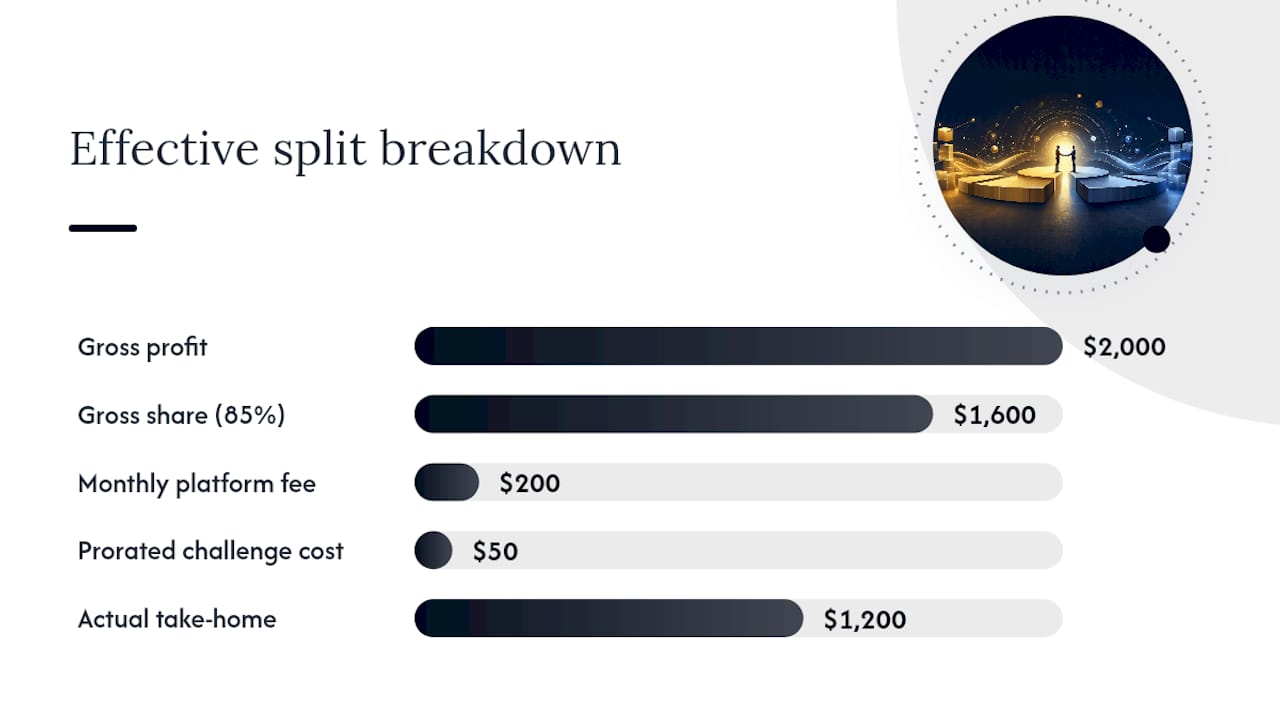
Start with gross realized profit, the raw trading gains before anything gets deducted. Subtract commissions and exchange fees to get net realized profit, since most firms base your split on the net figure, not the gross number traders assume they're working with. Then prorate any challenge or evaluation fee across your expected payout cycles rather than treating it as a one-time cost you forget about after passing.
Here's a worked example using a $2,000 monthly profit on a funded account:
| Item | Amount |
|---|---|
| Gross profit | $2,000 |
| Advertised split | 85% |
| Gross share (2,000 × advertised split) | $1,600 |
| Monthly platform fee | $200 |
| Prorated challenge cost (over 6 months) | $50 |
| Actual take-home | $1,200 |
| Effective split | 75% |
A 10-point gap can hide in plain sight. An 85% advertised split becomes a 75% effective split once you factor in the fee schedule above, on the exact same trading performance.
Fees and Hidden Costs That Quietly Erode Your Split
The gap between advertised and effective almost always traces back to line items buried in the terms and conditions. Most traders skim past these during signup and pay for it every month afterward.
- Non-refundable challenge fees: paid upfront to access an evaluation account, regardless of whether you pass.
- Monthly platform or subscription fees: recurring charges that apply whether you trade or not.
- Commissions and exchange fees: subtracted before your profit split is even calculated.
- Withdrawal fees: flat or percentage-based charges deducted each time you request a payout.
- Minimum payout thresholds: profits below the threshold roll forward, delaying access to money you've already earned.
Monthly fees can represent a significant monthly percentage of account capital, which compounds as a drag on returns over time, which compounds into a meaningful drag over a full year even before you touch commissions. Smaller accounts feel this hardest, since fixed monthly fees consume a much larger share of a $5,000 account than a $50,000 one. Read the fine print for refund policies, rollover rules on unpaid minimums, and whether fees adjust once you scale up.
Drawdown Rules and Withdrawal Mechanics That Gate Your Payout
Even a perfect effective-split calculation means nothing if drawdown rules disqualify you before payout day. Two measurement styles dominate the industry, and they behave very differently under pressure.
- Daily drawdown: resets each trading day, measured from your starting balance or equity at the open.
- Trailing drawdown: moves upward as your account grows, so your maximum loss ceiling follows your highest point, not your original balance.
- Equity vs. balance measurement: equity-based rules count unrealized losses on open trades; balance-based rules only count closed positions.
- Payout cycles and KYC delays: first withdrawals typically take longer due to identity verification, sometimes adding several business days before funds move.
- Minimum and maximum withdrawal limits: caps that can force partial payouts or delay a full withdrawal into the next cycle.
Withdrawing aggressively near a trailing-drawdown floor can shrink your buffer and push you closer to disqualification on the very next losing trade. Managing daily loss limits with intent, rather than reacting to them after a bad session, keeps this interaction from becoming a surprise.
What Should You Check Before Choosing a Profit-Sharing Arrangement?
A headline split is a marketing number until you run it through your own math. Here's the order to work through when comparing offers:
- Advertised split — the starting percentage before any deductions.
- Fee schedule — challenge cost, monthly platform fee, and how each is billed.
- Commission model — per-lot, spread-based, or a combination.
- Drawdown rules — daily versus trailing, and whether they measure equity or balance.
- Scaling speed — how quickly (and under what conditions) your split or capital allocation increases.
- Payout timing — cycle length, minimum and maximum withdrawal amounts, and first-payout KYC delays.
- Enforcement history — how strictly the firm applies its own rules when a trader is close to a violation.
To estimate your effective split over a set period, plug your expected monthly profit, fee schedule, and challenge cost into the formula from the calculation section above, then run it across three or six months to see how proration changes the outcome. Modeling expected payouts under realistic drawdown scenarios, rather than chasing the biggest number on the landing page, is what separates traders who get paid consistently from those who don't.
Pro Tip: Run your effective-split math against your worst realistic month, not your best one. A firm that looks generous during a strong month can turn punishing during a flat or losing one, once fixed fees stay constant while your profit shrinks.
Tactics That Actually Raise Your Take-Home Pay
Calculating the number is step one. Acting on it is what separates traders who complain about fee drag from traders who quietly outearn their peers on the same advertised split.
- Size positions around your drawdown ceiling, not around what feels comfortable, since a single oversized loss can end an account regardless of your split percentage.
- Run multiple funded accounts with different risk profiles: one conservative account for steady payouts, one aggressive account for scaling potential.
- Time withdrawals around payout minimums so you're not leaving profit stranded below a threshold for an extra cycle.
- Cut unnecessary monthly subscriptions on accounts you're not actively scaling, since dormant fees are pure drag with no offsetting benefit.
- Track a firm's enforcement patterns before committing more capital, since some firms interpret drawdown breaches more strictly than their own rulebook suggests.
Position sizing tied to your risk of ruin math, rather than gut feel, is the single tactic that protects every other number in your effective-split calculation.
Managed Copy-Trading vs. Prop-Firm Profit Share: Which Fits You?
Not every trader wants to manage drawdown rules and fee schedules manually. Managed copy-trading changes the economics entirely by removing challenge fees and evaluation cycles in favor of a different, often simpler, fee cadence.
- Sonic AI's COPYX system auto-copies trades on gold (XAUUSD) without requiring the user to manually manage entries or exits.
- The strategy has posted 18 consecutive winning months with independently verified performance and a stated 80% win rate.
- No challenge fee or evaluation phase means the effective-split math looks different from a funded account: fewer prorated costs, but a different withdrawal structure to review directly.
This route suits traders who want passive exposure to a single, well-tracked market rather than the operational overhead of optimizing a funded-account split across multiple rule sets.
What Actually Moves the Needle on Your Take-Home
Most content on this topic treats the profit split like the whole story. It isn't. The split is one input in a formula that includes fees, drawdown enforcement, and payout timing, and the traders who do best are the ones who model all four together before signing up for anything.
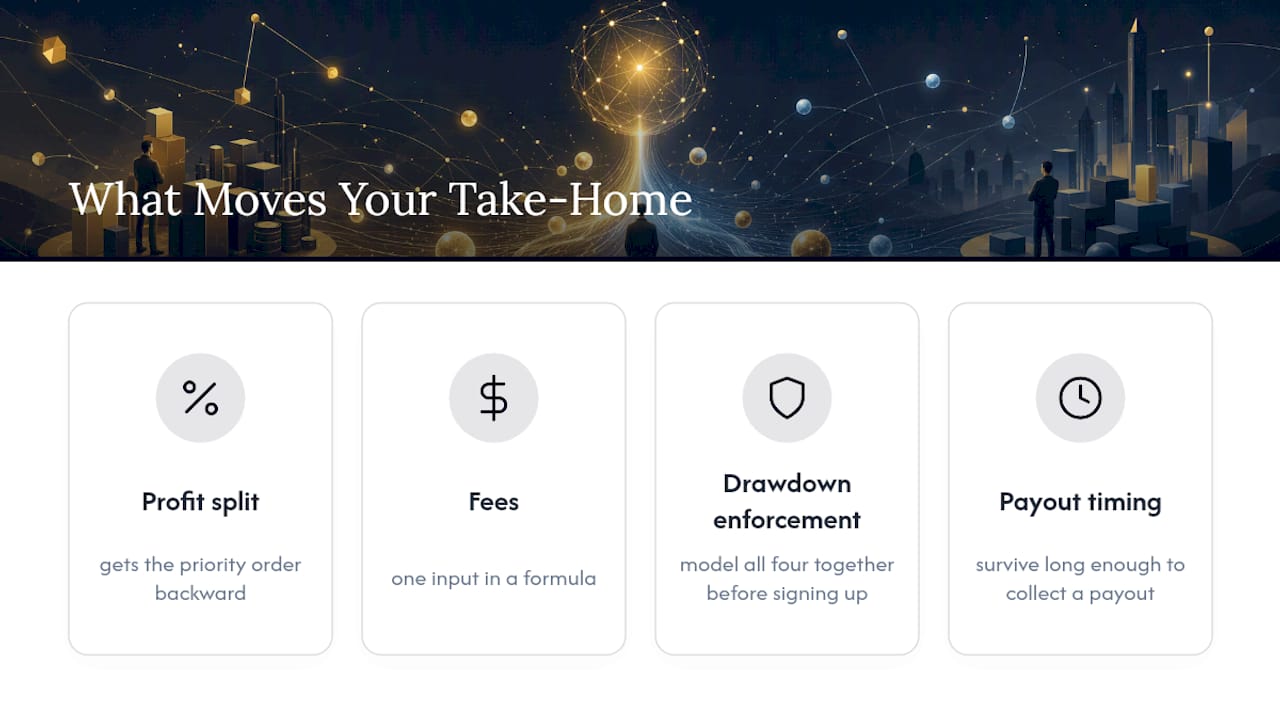
The conventional advice, "find the highest split," gets the priority order backward. What actually predicts your income isn't the headline number. It's whether the firm's rules let you survive long enough to collect a payout at all.
If there's one thing worth doing before committing capital to any arrangement, it's running your own numbers against a realistic bad month, not the best-case scenario every marketing page shows you. That single habit will save more money than chasing an extra 5 points of advertised split ever will.
— Paulo
A Direct Alternative for Traders Who Want Automation
If you'd rather skip the fee-schedule math and drawdown-rule comparisons entirely, Sonic AI's gold copy-trading model gives you a different path to the same goal: consistent returns from a single, focused market. The system copies trades automatically through COPYX, requires no manual trading decisions, and has published 18 consecutive winning months of independently verified results on gold (XAUUSD).

This fits traders who want reliable exposure to gold without the operational load of tracking daily versus trailing drawdown limits or challenge-fee proration across multiple funded accounts. It's not the only route to profit sharing in trading, but it's a straightforward one for anyone who prefers automation over spreadsheet math. Check the verified performance results and see whether the fit works for your goals before you commit capital.
This article is general information, not a substitute for advice from a qualified financial advisor. Consult a qualified financial professional about your own circumstances before acting on anything here.
Sources
- Prop Trading Profit Splits: 80% To 95% Models Compared (2026)
- Profit Splits and Withdrawal Mechanics in Prop Firm Funded Accounts: Understanding Your Take-Home Reality - NexusFi Academy
- Profit split (PropFirmsCan glossary)
- What Is Profit Split? | PropAccount