
Trading can produce genuine passive income, but only through specific methods, and "fully hands-off" is a myth even the best providers won't claim. Automation and disciplined copy trading are the two most practical paths, and both still require setup work, periodic review, and realistic expectations. Options income strategies and dividend-focused ETFs round out the list for readers who want less market exposure and more predictability.
Here's the tradeoff in plain terms: automated bots compress your active time to minutes a week but demand technical setup and ongoing maintenance. Copy trading is even lower effort at the execution level, but the real work happens upfront, in vetting who you're copying. Neither is "set and forget" in the way ads make it sound.
If you're deciding where to start, two things matter more than anything else covered here:
- Jump to the strategy comparison to see which method fits your capital and time budget.
- Jump to the provider checklist before you fund any copy-trading or bot account.
Key Takeaways
Passive income trading works best as a spectrum of semi-passive methods, where automation and vetted copy trading beat any promise of a fully hands-off return.
| Point | Details |
|---|---|
| No true "hands-off" trading | Every passive method still needs periodic monitoring, from weekly bot checks to monthly provider reviews. |
| Realistic returns vary widely | Copy trading averages roughly 5% to 20% annually; bots can hit 1% to 5% monthly under favorable conditions. |
| Vet before you fund | Require 6 to 12 months of verified live history, drawdown below 20% to 25%, and a steady equity curve. |
| Fees erode headline returns | Performance fees, spreads, and slippage can turn a strong gross return into a much smaller net one. |
| Verify gold-focused options directly | Sonic AI's XAUUSD strategy publishes Myfxbook-style verification pages; check drawdown and consistency before committing capital. |
Table of Contents
- What Does Passive Income Trading Actually Mean?
- What Are the Main Passive Income Trading Strategies?
- How Do Automated Trading Systems Actually Work?
- How Does Copy Trading Work and How Do You Vet a Provider?
- What Returns, Risks, and Costs Should You Actually Expect?
- How Do You Set Up a Passive Trading System Safely?
- How Do You Spot a Trustworthy Provider vs. a Red Flag?
- How Sonic AI's Gold Strategy Maps to the Provider Checklist
- Frequently Asked Questions
- Sources
What Does Passive Income Trading Actually Mean?
Passive income trading means generating returns from market activity that requires periodic oversight rather than constant, hands-on decision-making. It is not the same as fully passive income like rental payments or bond coupons, and it is not the same as active day trading either. It sits in between.
Active trading means you're at the screen, making entry and exit decisions in real time, often multiple times a day. It demands skill, emotional control, and hours of screen time. Semi-passive trading (where automation and copy trading live) means a system or another trader executes the decisions, and you monitor performance, adjust allocations, and step in only when something breaks. Fully passive trading barely exists in practice. Even a "set and forget" bot needs someone checking that the exchange connection hasn't failed or that a strategy hasn't drifted into a market regime it was never built for.
Here's the quick breakdown:
- Active trading: hours daily, requires trading skill, high stress, no scalability beyond your own attention.
- Copy trading: minutes weekly, requires evaluation skill instead of trading skill, moderate stress, scales across providers.
- Automated bots: minutes weekly after setup, requires technical/configuration skill, low ongoing stress, scales with capital.
- Options income (covered calls, cash-secured puts): hours monthly, requires options knowledge, moderate stress, scales with account size.
- Dividend/income ETFs: near zero ongoing time, requires almost no active skill, low stress, scales linearly with capital.
Scope matters here because it affects taxes and platform obligations. Tax authorities generally don't classify trading gains as automatically "passive" the way they treat rental income, and rules vary significantly by country and by how frequently you trade. In the United States, the IRS typically treats most trading gains as active income or capital gains rather than passive income for tax purposes, regardless of how little manual clicking you did. Day trading and discretionary intraday strategies never qualify as passive under any reasonable definition, no matter how automated your charting software looks.
What Are the Main Passive Income Trading Strategies?
Four approaches dominate this space, and each one trades capital efficiency against effort in a different way.
Automated trading bots run predefined logic (grid strategies, dollar-cost averaging, arbitrage) without you clicking a single button once configured. Grid bots work by placing buy and sell orders at set intervals within a price range, profiting from volatility in sideways markets. DCA bots accumulate positions over time regardless of price, smoothing out entry cost. Well-configured bots can generate 1% to 5% monthly on deployed capital in favorable conditions, though that range assumes the strategy matches current market conditions, which isn't guaranteed.
- Pros: consistent execution, no emotional interference, scalable across multiple pairs or assets.
- Cons: requires technical setup, vulnerable to regime changes (a grid bot built for sideways markets bleeds capital in a strong trend), and needs periodic resets.
- Risk level: medium. Capital efficiency: moderate, meaningful income typically needs several thousand dollars deployed.
Copy or social trading lets you mirror another trader's positions automatically through a broker's copy feature. You choose a trader or a signal provider, and every trade they make gets replicated proportionally in your account. It requires almost no trading knowledge from you, but it shifts all the risk onto your ability to evaluate the person you're copying.
- Pros: low technical barrier, diversifiable across multiple providers, transparent performance history on most platforms.
- Cons: you're exposed to another person's strategy drift, drawdowns, or account mismanagement, and fees eat into returns fast.
- Risk level: medium. Capital efficiency: good, many providers accept modest starting balances.
Options income strategies (covered calls, cash-secured puts, and the Wheel strategy that cycles between them) generate income by selling options premium against stock or cash positions you already hold. This is genuinely lower-touch once positions are set, often requiring only monthly management.
- Pros: defined risk on each trade, works well in flat or mildly bullish markets, doesn't require constant monitoring.
- Cons: requires meaningful capital (100 shares per covered call contract adds up fast), caps upside, and can produce large losses if the underlying moves sharply against you.
- Risk level: medium to high depending on position sizing. Capital efficiency: poor for small accounts, better as balances grow.
Income-focused ETFs and dividend strategies are the closest thing to truly passive trading income. You buy shares in dividend-paying stocks or income ETFs and collect distributions with essentially zero ongoing management.
- Pros: minimal time commitment, broad diversification, no strategy maintenance.
- Cons: lower yield ceiling than active strategies, still exposed to market drawdowns, dividend cuts happen.
- Risk level: low to medium. Capital efficiency: requires the most capital per dollar of income, but demands the least attention.
If you want genuinely low-touch execution, dividend ETFs and well-vetted copy trading sit at one end. If you're comfortable with periodic review and want higher return potential, bots and options income sit at the other.
How Do Automated Trading Systems Actually Work?
An automated system has five working parts: strategy logic (the rules that decide when to buy or sell), an execution engine (the code that places orders), risk controls (position sizing, stop losses, maximum exposure limits), exchange or broker connectivity (the API link that carries out those orders), and monitoring or alerting (the layer that tells you when something's gone wrong).
Backtesting is where most retail traders get fooled. Running a strategy against historical data and seeing a beautiful equity curve feels like proof, but it's easy to overfit a strategy to past price action in ways that fall apart on new data. Trading bots reduce daily screen time, but the real work shifts to configuration and risk engineering rather than disappearing entirely. Out-of-sample testing (checking performance on data the strategy has never seen) and walk-forward testing (repeatedly retraining on a rolling window and validating on the next chunk of time) are the two checks that separate a durable strategy from a curve-fitted illusion.
Before any system touches live capital, run through this checklist:
- Simulate slippage and realistic spreads, not just theoretical entry and exit prices.
- Stress-test against the worst historical drawdown period for the asset you're trading.
- Confirm your broker or exchange API has acceptable uptime and rate limits for your trade frequency.
- Set a maximum daily loss limit that automatically halts trading if breached.
- Build an alert system that notifies you the moment the bot disconnects or behaves unexpectedly.
Pro Tip: Run every new bot configuration in a demo account for at least two full market cycles, one trending and one ranging, before committing real capital. A strategy that only gets tested in a single market condition is a strategy you don't actually understand yet.
Expect a weekly review cadence at minimum, and a daily glance during volatile periods. On the returns side, headline win rates and monthly return percentages almost always shrink once you account for slippage, spreads, and fees.
How Does Copy Trading Work and How Do You Vet a Provider?
Copy trading mirrors another trader's positions into your account automatically, proportional to your allocated capital. When the provider opens a trade, your account opens a matching one at the same relative size; when they close it, yours closes too. Fee models vary: some providers charge a performance fee (a cut of profits only), some charge a flat subscription, and others earn through the spread built into execution. Allocation methods also differ. Proportional allocation scales trades to a percentage of your account, while fixed-size copying mirrors the exact lot size regardless of your balance, which can badly mismatch your risk tolerance if you're not careful.
Before allocating a single dollar to a signal provider, work through this sequence:
- Confirm a verified live track record spanning at least six to twelve months of live trading, not backtested or demo results.
- Check maximum drawdown history. A provider who has never dropped below roughly 20% to 25% peak-to-trough has either been lucky or hasn't been tested by a real market shock yet.
- Look at the profit factor (gross profit divided by gross loss). Above 1.5 suggests a durable edge; anything near 1.0 means you're paying fees for a coin flip.
- Study the equity curve shape. Steady, grinding gains beat a chart with one huge spike followed by flat performance, because spikes usually mean a single lucky trade, not a repeatable process.
- Confirm third-party verification exists, ideally through an independent tracking service, not just numbers the provider self-reports.
Once you've screened a provider, look at these ongoing due diligence points:
- Diversify across three to five vetted providers instead of concentrating in one "star" trader.
- Check slippage history between the provider's stated entries and what actually fills in your account.
- Review withdrawal terms and any lock-in periods before funding an account.
- Watch for platform or custodial risk, meaning the broker executing your copied trades, separate from the provider's own performance.
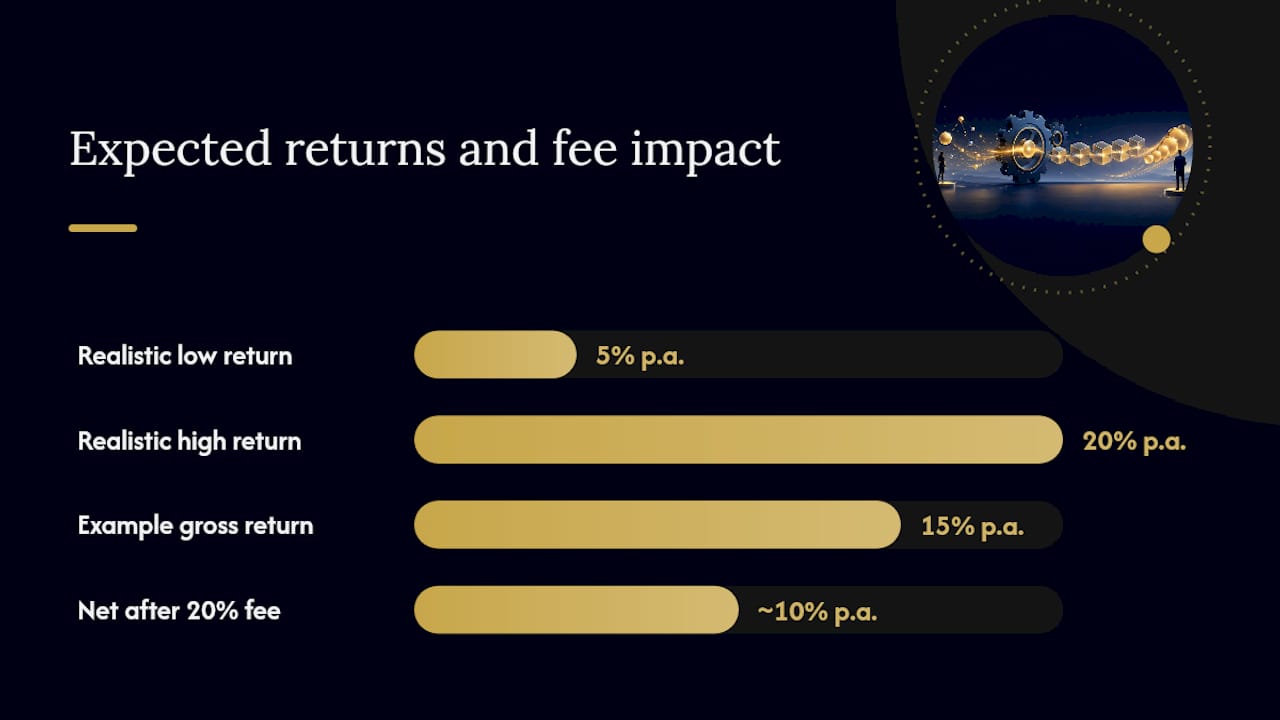
Fees quietly reshape your real return. Realistic long-term averages for disciplined copy trading setups run roughly 5% to 20% per year, and a provider charging a 20% performance fee on top of spread costs can turn a solid 15% gross return into something closer to 10% net. Anyone promising guaranteed monthly returns is not being straight with you.
What Returns, Risks, and Costs Should You Actually Expect?
Return expectations vary sharply by method, and the ranges below carry real uncertainty since markets don't repeat themselves cleanly. Disciplined copy trading tends to land in the 5% to 20% annual range, while well-run bots can produce 1% to 5% monthly on deployed capital under favorable conditions, and considerably less or negative returns when conditions shift against the strategy.
Capital requirements scale fast once you translate percentages into dollars. Here's what it actually takes:
- To generate $100 a day ($36,500/year) at a 15% annual net return, you'd need roughly $243,000 deployed. At an aggressive 3% monthly net return, you'd need closer to $122,000.
- To generate $1,000 a month ($12,000/year) at 15% annual, you'd need $80,000 deployed. At 3% monthly, closer to $33,000.
- To generate $12,000 a year at a more conservative 8% annual return, you'd need $150,000 deployed.
These numbers assume net returns after costs, which is rarely how returns are advertised. The gap between headline and net is where most disappointment happens.
Budget for these cost categories before you calculate expected income:
- Performance fees: typically 10% to 30% of profits on copy trading platforms.
- Subscription fees: flat monthly costs some signal providers charge regardless of performance.
- Spreads and swaps: the built-in cost of every trade plus overnight financing charges on leveraged positions.
- Slippage: the difference between expected and actual fill price, worse during volatile periods.
- Currency conversion: relevant if your account currency differs from the asset you're trading.
- Tax provisioning: set aside funds proactively since trading income is rarely treated as passive for tax purposes and can trigger higher effective rates than expected.
The risk list runs parallel to the cost list: drawdown (temporary account decline), strategy drift (a system that worked stops working as market conditions change), platform or broker failure, overfitting (a backtested strategy that never worked in live conditions), concentration risk (too much capital in one provider or one asset), and behavioral risk (panic-selling during a normal drawdown or over-allocating after a hot streak).
How Do You Set Up a Passive Trading System Safely?
Getting from idea to live account without blowing up your capital follows a predictable sequence.
- Define your goal and risk tolerance. Decide what monthly income you actually need and how much drawdown you can stomach without panicking.
- Pick one method to start. Don't try bots, copy trading, and options income simultaneously in month one. Master one before adding a second.
- Run a demo or backtest first. Validate the strategy or provider against historical and current data before any real money moves.
- Start with a small live pilot. Validate for 60 to 90 days with capital you can afford to lose entirely.
- Set hard risk controls. Define a maximum daily loss and an account-level equity stop before you fund anything larger.
- Establish a monitoring cadence. Weekly at minimum, daily during high volatility.
- Scale only on evidence. Increase allocation after consistent results, not after a single good month.
Before going live, confirm you've sized your capital appropriately, set firm risk limits, understand your tax reporting obligations, and kept an emergency fund untouched by trading capital. On scaling, reinvest profits during the early validation period to compound testing data, then shift toward withdrawing a portion once performance stabilizes. Pause any strategy immediately if drawdown exceeds your predefined limit, regardless of how convinced you are it will recover.
How Do You Spot a Trustworthy Provider vs. a Red Flag?
Every credible provider, bot vendor, or copy-trading service should be able to satisfy a short checklist. If they can't, that's your answer.
- Audited or independently verified performance, not just a self-reported dashboard.
- Third-party tracking through an independent verification service that shows live, unedited trade history.
- Named team credentials rather than an anonymous "expert trading team."
- A transparent fee schedule listed clearly, not buried or disclosed only after you've funded an account.
- Documented strategy logic, even at a high level, explaining what the system actually does.
- Evidence of scale, meaning real client capital under management over a meaningful stretch of time.
Red flags include guaranteed fixed returns (no legitimate trading strategy can promise this), opaque fee-sharing arrangements, unverifiable track records that only exist as screenshots, suspiciously smooth equity curves with no visible drawdown, and platform lock-in clauses that make withdrawing your capital difficult.
Pro Tip: If a provider's marketing leads with a win rate and says nothing about maximum drawdown, that's the number they're hoping you won't ask about. Always ask for the drawdown figure before the win rate.
A credible provider satisfies each item above with a specific, checkable answer, not a vague reassurance. That distinction alone eliminates most of the sketchy options in this space.
When automation or copy trading makes sense, and when it doesn't
Automation earns its place when you have capital to spare for real testing and want to learn the mechanics yourself. Copy trading fits better if you'd rather diversify across other people's expertise than build your own system. I'd avoid both if you're working with capital you can't afford to lose, have no emergency fund, or can't check an account at least weekly. Passive trading still needs a present, attentive owner.

How Sonic AI's Gold Strategy Maps to the Provider Checklist
If gold specifically interests you as the underlying asset, Sonic AI's gold-focused auto-trading strategy is worth evaluating against the checklist above rather than taking any performance claim at face value. The service runs on COPYX for automatic trade execution, meaning trades from the managed strategy replicate into your account without manual intervention, which fits the low-touch model this article has walked through.

On the verification side, Sonic AI publishes live performance and Myfxbook-style results pages so prospective followers can check drawdown, win rate, and consistency before funding an account, rather than relying on marketing copy alone. The XAUUSD strategy page lays out an 18-month track record and win-rate statistics, which you should treat the same way this article recommends treating any provider: verify the drawdown figure and equity curve shape yourself before deciding whether the approach fits your risk tolerance.
This section reflects Sonicaigold's own offering, and Sonic AI earns revenue when clients fund accounts and activate the strategy. Run a small live pilot before committing meaningful capital, exactly as the setup steps above suggest. Check the verification pages first, size your position conservatively, and treat the first 60 to 90 days as a test, not a commitment.
Frequently Asked Questions
Can trading really generate passive income, or is it always active work in disguise? Trading can generate semi-passive income through automation and copy trading, but it always requires periodic oversight. Anyone claiming a fully hands-off trading income stream with no monitoring is overselling the reality.
How much money do I need to make $1,000 a month from passive trading? At a 15% annual net return, you'd need roughly $80,000 deployed to generate $1,000 monthly. At a more aggressive 3% monthly bot return, the figure drops to around $33,000, though higher returns carry higher risk.
Is copy trading safer than running my own trading bot? Neither is inherently safer. Copy trading shifts execution risk onto your ability to vet a provider's track record, while running a bot shifts risk onto your configuration and testing discipline. Both require real due diligence.
What's the biggest red flag when evaluating a copy trading or signal provider? A guaranteed fixed return is the clearest red flag, since no legitimate strategy can promise one. A close second is a provider who highlights win rate but won't disclose maximum drawdown.
Do I have to pay taxes on passive trading income? Yes, in most jurisdictions. Trading gains are typically treated as active income or capital gains for tax purposes rather than passive income, regardless of how automated the execution was. Check your specific country's tax rules before assuming favorable treatment.
This article is general information, not a substitute for advice from a qualified financial advisor. Consult a qualified financial professional about your own circumstances before acting on anything here.
Sources
- Is Copy Trading Passive Income? (2026) | ForexTradeLab
- How to Build Passive Income With Trading Bots in 2026 | TradingBotExperts
- Passive Income by Trading 2026 - Tutorial and List of Methods
- Building Passive Income Through Forex Copy Trading