
Mirror trading replicates strategies and algorithms; copy trading replicates individual traders. Choose mirror trading if you want systematic, rules-based exposure with less day-to-day noise. Choose copy trading if you'd rather follow a human trader's judgment, with full visibility into their decisions and the ability to intervene at any time.
TL;DR:
- Mirror trading relies on tested algorithmic strategies, making it suitable for systematic, rules-based exposure with minimal need for oversight.
- Copy trading involves following real traders, offering transparency through trade histories and the ability to intervene or stop at any point.
- Both methods carry risks like model decay in mirror trading or trader inconsistency in copy trading, and neither guarantees future success.
- Verified, long-term track records and clear risk controls are essential when evaluating both mirror or copy trading options.
- Starting with small allocations and confirming live results help in assessing platform reliability and strategy performance before scaling (or funding a larger account).
Table of Contents
- Mirror Trading vs Copy Trading: What Actually Separates Them
- What Is Mirror Trading? How It Works and Where It's Used
- What Is Copy Trading? Mechanics, Platform Features, and Asset Focus
- Key Differences: Automation, Control, Transparency, and Fees
- Pros and Cons of Each Approach
- How to Choose Between Mirror and Copy Trading
- Regulatory and Safety Considerations
- Applied Example: Evaluating a Verified, Strategy-Based Offering
- My Take on Choosing Between the Two
- Getting Started With Sonicaigold's Gold Strategy
- Sources
- FAQ
Mirror Trading vs Copy Trading: What Actually Separates Them
The confusion between these two terms is understandable. Regulators themselves group them together. The IOSCO consultation report on online imitative trading practices treats copy trading, mirror trading, and social trading as points on the same spectrum, noting the labels are often used interchangeably across markets even though the underlying mechanics differ. That's the core of the "mirror trading vs copy trading" question: it's not really a battle between two competing products. It's a choice between two different sources of trading decisions, algorithm or human, each with its own risk profile.
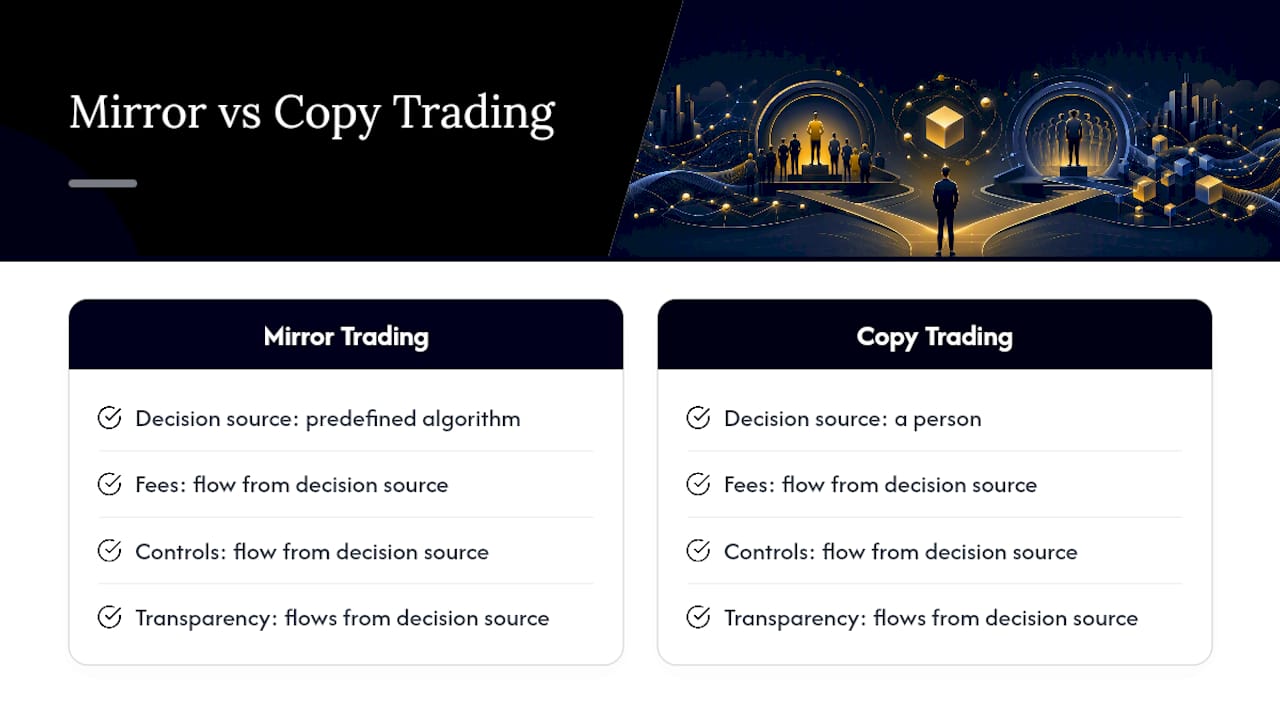
Mirror trading assigns your capital to a predefined strategy or algorithm. Copy trading assigns it to a person. Everything else, the fees, the controls, the transparency, the failure modes, flows from that one distinction.
What Is Mirror Trading? How It Works and Where It's Used
Mirror trading works by having a platform apply a strategy's generated signals directly to your account, without you evaluating each trade individually. You pick the strategy once, based on its published rules and past results, and the system executes on your behalf going forward.
Three implementation paths dominate: broker-hosted strategy libraries, Expert Advisors running on MT4 or MT5, and platform-side algorithmic engines that manage execution internally. Investopedia's overview of mirror trading notes that most strategies here are backtested extensively before ever touching live capital, which is part of the appeal. You're buying into a tested rule set, not a personality.
Forex and CFD markets remain the natural home for mirror trading, largely because algorithmic strategies need liquid, continuously quoted instruments to execute cleanly. Brokers that list these strategies typically require a minimum live track record and defined drawdown limits before approval. That verification step matters more than most people realize. A strategy that only exists as a backtest, with no live trading history, is a much bigger unknown than one with 12 or 18 months of real executed trades behind it.
What Is Copy Trading? Mechanics, Platform Features, and Asset Focus
Copy trading works through proportional allocation. You commit a set amount of capital to a specific trader, and the platform scales that trader's positions to match your account size.
The social layer is what sets copy trading apart. eToro's comparison of copy and mirror trading describes trader profiles showing full trade history, win rates, risk scores, and often direct commentary explaining the reasoning behind a position. You're not copying a black box. You're copying a visible track record you can audit yourself.
Platforms generally give you three layers of control: a full disconnect from the trader at any time, the ability to manually close an individual copied trade, and an overall stop-loss on the whole copy relationship. Asset focus skews broad, forex, stocks, crypto, commodities, since it depends entirely on what the lead trader chooses to trade rather than what one algorithm is built for.
Key Differences: Automation, Control, Transparency, and Fees
The practical differences come down to five variables, and they compound in ways that matter more once real money is involved.
- Signal source: mirror trading runs on algorithmic rules; copy trading runs on a person's live decisions, judgment calls included.
- Control granularity: copy trading lets you intervene trade by trade; mirror trading generally only lets you turn the whole strategy on or off.
- Transparency: copy trading shows a readable trade history and often a rationale; mirror trading can be a closed system where you see outputs but not the logic behind them.
- Primary risk: mirror strategies face overfitting and model decay, where a strategy tuned to past data stops working when conditions shift. Copy trading faces human inconsistency, a trader having a bad month, changing their risk appetite, or going quiet during volatility.
- Cost exposure: both incur spreads and slippage, but strategies with higher trade frequency, common in some mirror systems, generate more transaction costs over time even when the win rate looks strong on paper.
Proportional execution deserves a closer look because it's where a lot of first-time users get surprised. If a lead trader or algorithm takes a position sized for a $50,000 account and you've allocated $2,000, the platform scales the position down. But scaling isn't always perfectly linear, especially with minimum lot sizes in forex, which means small accounts sometimes can't mirror or copy exactly proportionally. That gap between "intended" and "actual" exposure is a quiet source of tracking error that few beginners check for before funding an account.
Neither structure comes with a guarantee. Educational material on mirror trading's history and mechanics is consistent on this point: past performance in either model is not a reliable predictor of what happens next, regardless of how clean the historical equity curve looks.
Pros and Cons of Each Approach
Mirror trading's strength is discipline. An algorithm doesn't panic, doesn't revenge trade after a loss, and executes the same rules at 3 a.m. as it does at noon. It also scales cleanly, since the same logic can run across thousands of accounts without degrading. The downside is opacity. Unless the strategy provider publishes detailed logic, you're trusting a result without fully understanding how it was produced, and model risk, the strategy breaking down when market conditions change, is hard to spot until it's already happened.
Copy trading's strength is transparency and control. You can watch a trader's history, read their reasoning, and pull out instantly if something feels wrong. It also doubles as a learning tool, since you see real decisions being made in real time. The tradeoff is that you're exposed to one person's behavior, including their bad weeks, and results tend to swing with that individual's discipline rather than a fixed rule set.
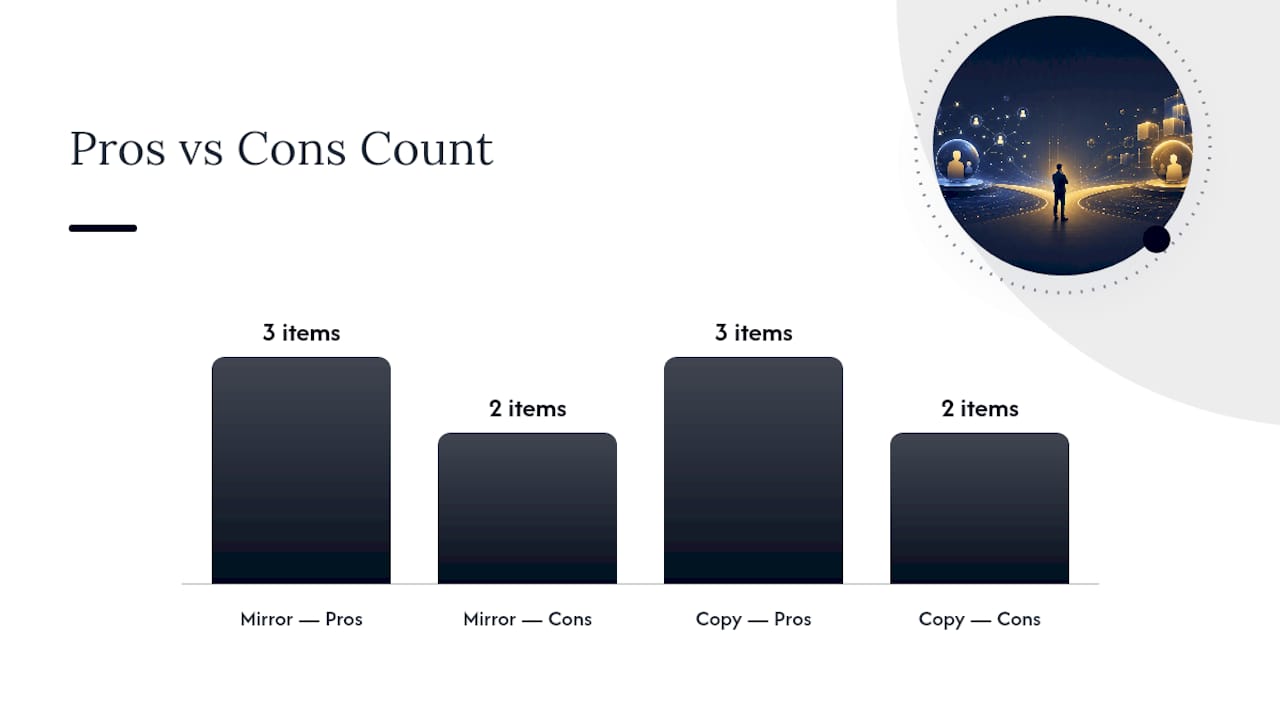
- Mirror trading pros: consistency, scalability, testable logic before you commit capital.
- Mirror trading cons: limited transparency, exposure to model decay.
- Copy trading pros: full visibility, granular control, educational value.
- Copy trading cons: dependent on one trader's consistency, harder to predict.
Plenty of experienced investors run both at once, a mirrored strategy for steady, rules-based exposure and one or two copied traders for diversification against a single algorithm's blind spots.
How to Choose Between Mirror and Copy Trading
Start with your own temperament before looking at any strategy or trader. If you want to "set it and forget it" with minimal daily decisions, lean mirror. If you want to watch, learn, and adjust in real time, lean copy.
From there, run this checklist against any option you're considering:
- Check the live track record length. A few weeks of live results tells you almost nothing; look for at least six to twelve months of verified live trading, not backtested projections.
- Ask for maximum drawdown, not just returns. A strategy boasting high win rate but a 40% historical drawdown carries more risk than the headline suggests.
- Confirm platform controls exist. You want a working stop-loss setting, a disconnect or kill-switch, and clear proportional sizing rules before you fund anything.
- Ask how results were verified. Third-party audit trails and platform-verified statements carry far more weight than a screenshot of an equity curve.
- Match allocation size to conviction. Start small, confirm the live behavior matches the marketed behavior, then scale up.
Pro Tip: Treat your first allocation as a live audit, not a commitment. A month or two of real, funded results at a small size tells you more than any backtest or testimonial ever will.
Regulatory and Safety Considerations
Regulatory treatment varies by jurisdiction, and this is one area where the fine print actually matters. The FCA's guidance on copy trading notes that depending on the level of automation and discretion involved, copying arrangements can cross into territory that looks like portfolio management, which carries its own licensing obligations for the firms offering it. That distinction affects what protections you're entitled to as a client, so it's worth checking how your platform is authorized in your own market.
Independent verification matters because self-reported results are, by definition, unverifiable. Look for platform-side audits, segregated client funds, and identity verification (KYC) as baseline signals of legitimacy. Beyond that, keep leverage modest relative to account size and treat any live-verified track record as a floor for due diligence, not a finish line.
Applied Example: Evaluating a Verified, Strategy-Based Offering
Sonicaigold's gold-focused strategy is a useful case study for applying the checklist above, precisely because it sits in the mirror trading category: a managed, algorithm-driven approach to XAUUSD rather than a roster of individual traders to pick from. Trades execute automatically through an automatic trade execution system once a user connects their account, which removes manual decision-making from the equation entirely.
A certain service reports a significant number of consecutive winning months and a high win rate, independently verified. Before treating any performance claim like that as decision-ready, request the same three things you'd ask of any strategy: a linked, independently hosted results page (Myfxbook-style reporting is the industry standard here), documented maximum drawdown, and confirmation that stop-loss and proportional sizing controls are configurable at the account level.
An 18-month winning streak is a meaningful data point, but it describes what already happened under specific market conditions. It tells you the strategy has survived real volatility. It does not tell you gold's next 18 months will look anything like the last 18.
That's not a knock on the track record. It's just the same caveat that applies to every mirror or copy strategy on the market.
My Take on Choosing Between the Two
Systematic investors who dislike second-guessing decisions do better with mirror trading. People who want to understand every trade and retain veto power do better with copy trading. Neither is objectively superior, but I'd push back on treating either as a slam dunk without first funding a small test account and watching real, independently verified results for a few weeks. Verification beats persuasion every time.
— Paulo
Getting Started With Sonicaigold's Gold Strategy
If the mirror trading model above sounds like the better fit, a strategy-driven approach to gold gives you rules-based consistency without needing to evaluate individual traders or build your own system from scratch. An example applies this model to XAUUSD, using an automatic execution system to execute trades once your account is connected, with proportional sizing and stop-loss profiles configurable to your own risk tolerance.

Before allocating anything, review the independently verified Myfxbook results yourself rather than taking any summary at face value. From there, start with a modest allocation, confirm live behavior matches the published track record over a few weeks, and only scale up once you're satisfied. You can see the full breakdown of how the strategy and XAUUSD copy trading setup work before connecting an account.
Sources
Regulatory and technical claims in this guide draw from primary sources worth bookmarking if you want to dig deeper before allocating capital.
- Online Imitative Trading Practices: Copy Trading, Mirror Trading, Social Trading (IOSCO CR/10/2024)
- Mirror trading: Overview, benefits, limitations (Investopedia)
- Copy Trading vs Mirror Trading Guide (eToro)
This article is general information, not a substitute for advice from a qualified financial advisor. Consult a qualified financial professional about your own circumstances before acting on anything here.
FAQ
Is Mirror Trading a Good Idea?
It can be, if the strategy has a verified live track record and documented drawdown limits, not just a backtest. The main risk is model decay, where a strategy tuned to past market conditions underperforms once those conditions change.
Is Copy Trading Actually Profitable?
Results depend entirely on the trader you copy, and no method guarantees profit. Checking a trader's full history, drawdown behavior, and consistency over time gives you a far better read than their headline returns alone.
Which Brokers Allow Mirror Trading?
Availability varies by jurisdiction and broker, and mirror trading is most common through MT4/MT5 Expert Advisors or broker-hosted strategy libraries in forex and CFD markets. Always confirm a broker's authorization status in your own country before connecting funds.
Does Mirror Trading Increase Your Odds of Success?
Not automatically. A verified, disciplined strategy with a real drawdown record improves your odds over guessing on your own, but no algorithm removes market risk entirely. Offerings like Sonicaigold's gold strategy address this by publishing independent verification rather than asking users to take performance on faith.