
The most reliable gold scalping strategy right now combines a three-timeframe filter (M15 for bias, 5M for approach, M1 for the trigger) with two repeatable setups: sweep-and-reclaim and break-and-retest. Every trade runs on fixed fractional risk, a stop placed at a defined structural point, and a hard daily loss limit. Nothing discretionary, nothing improvised.
TL;DR:
- Gold scalping performs best during the London session and overlapping hours, when spreads are tight and directional moves are clear.
- Traders should confirm favorable trading conditions, including normal spreads, no major news, and sufficient profit margins, before executing trades.
- The strategy uses a three-timeframe approach with specific setups, focusing on mechanical entries to avoid emotional trading and overconfidence.
- Risk per trade should stay at 0.5% of capital, with a daily loss limit of 2%, to prevent sizable losses from streaks and slippage.
- Automated, verified copy-trading options offer a suitable alternative for those unable to dedicate continuous screen time.
Table of Contents
- What Conditions Have to Be True Before You Scalp Gold
- The Three-Timeframe Workflow: M15, M5, and M1
- Two Setups: Sweep-and-Reclaim and Break-and-Retest
- Running the Playbook: Checklist and a Worked Example
- Risk Management and Cost Control for Gold Scalps
- Indicators, Platform Settings, and Execution Hygiene
- Publisher Evidence and How to Verify Any Automated Gold Strategy
- Suitability and the Discipline It Actually Takes
- A Verified Alternative When You'd Rather Not Watch Five Charts at Once
- Sources
- FAQ
What Conditions Have to Be True Before You Scalp Gold
Gold scalping only works when liquidity and spread cooperate. The London session and the London-New York overlap produce the tightest spreads and the cleanest directional moves, largely because central bank buying activity tends to concentrate order flow during these hours, amplifying intraday swings rather than flattening them. Outside those windows, XAUUSD often chops without follow-through, which grinds down a scalper's win rate fast.
Before opening a chart, run through a short live-condition check:
- Spread is inside your broker's normal range for gold, not widened
- No red-folder news event is due in the next 15 to 30 minutes
- Your commission plus expected slippage still leaves room for profit on a $2 to $8 scalp
- You've reviewed gold trading hours for the session you're trading
Scalping gold is not for everyone. It rewards traders who can sit still, follow rules without editing them mid-trade, and have already put in demo hours. If you flinch at a stop-out or feel compelled to revenge trade after a loss, scalping will expose that flaw faster than any other style of trading.
The Three-Timeframe Workflow: M15, M5, and M1
Treat each timeframe as a different job, not three views of the same chart. M15 sets the bias. M5 tracks the approach. M1 pulls the trigger. Trading M1 in isolation is just reacting to noise without context.
- M15 (bias): Mark the session high and low, the previous day's high and low, and plot an EMA 50 or session VWAP to read the prevailing lean.
- M5 (approach): Watch price move toward one of those marked levels. Layer EMA 9 and EMA 21 for short-term direction, and use ATR(14) to size a dynamic stop rather than guessing a fixed pip value.
- M1 (trigger): Wait for a specific candle. That means a wick sweep past a marked level followed by a close back inside the range, or a clean rejection wick at a retest. Anything less defined gets skipped.
Pro Tip: Write your M15 levels down before the session opens. If you're marking levels while price is already moving, you're trading your emotions, not your plan.
Two Setups: Sweep-and-Reclaim and Break-and-Retest
Stick to two setups. Adding a third or fourth "just in case" pattern is how scalpers turn a mechanical edge into a coin flip.
Sweep-and-reclaim mirrors how institutional flow often hunts liquidity before reversing. Price pushes 10 to 30 pips past a marked high or low, triggering stops from breakout traders, then snaps back. The entry trigger is an M1 candle closing back inside the original range.
- Entry: M1 close back inside the swept level
- Stop: a few pips beyond the sweep wick's extreme
- Target: fixed $3 to $7 per 0.01 lot, or the opposite side of the M5 range, whichever comes first
Break-and-retest is the continuation cousin. Price breaks a level on M5 in the direction of the M15 bias, pulls back to retest that level, and gets rejected on M1.
- Entry: M1 rejection wick at the retest of the broken level
- Stop: just behind the retest low or high
- Target: partial close at the first measured move, trail the remainder with the ATR-based stop
Scalp ranges commonly fall between $2 and $8 per 0.01 lot, which is a tight enough band that spread and slippage can eat the edge if you're not disciplined about entries.
Skip both setups entirely when a major news release is inside 15 minutes, when the H1 chart shows an unresolved wide-range candle still absorbing volume, or when live spread has widened beyond your normal threshold. Forcing a trade into any of those conditions is how a clean two-setup system turns into a losing one.
Running the Playbook: Checklist and a Worked Example
Before the session starts, confirm four things: current spread, any scheduled news, how much of your daily loss limit remains, and whether your M15 levels are already marked. Skipping any one of these is how good rules produce bad trades.
- Confirm bias on M15 (are you above or below the session VWAP or EMA 50?).
- Wait for price to approach a marked level on M5.
- Watch M1 for the trigger candle: sweep-and-reclaim close or break-and-retest rejection.
- Enter on the trigger candle's close, not mid-candle.
- Place the stop at the structural point (sweep wick or retest extreme).
- Set take-profit per the setup's rule, and move to breakeven after the first partial target.
Here's the position-sizing math. Say you're risking $50 on a trade (0.5% of a $10,000 account) and your stop, based on ATR, sits 25 pips away. On XAUUSD, where one standard pip on a 0.01 lot is roughly worth $0.10, that stop distance means you can trade approximately 2 lots of 0.01 (0.02 lot) before you exceed your $50 risk. Round down, not up, when the math is close.
Take partial profit at your first target, move the stop to breakeven on the remainder, and let ATR trail the rest. If price stalls for more than two or three M1 candles without progress, close the trade. Scalping isn't the place to hope.
Risk Management and Cost Control for Gold Scalps
Anything higher and a short losing streak, which is normal even in a good system, can wreck your week. Pair that with a daily loss stop of around 2% of equity: when you hit it, you're done for the session, no exceptions.
| Rule | Recommended Setting |
|---|---|
| Risk per trade | 0.5% of equity |
| Daily loss limit | 2% of equity |
| Max consecutive losses before stopping | 3 |
| Max trades per session | 5 to 8 |
| Spread ceiling before pausing | Widened spread beyond your normal threshold |
Lot size math always works backward from dollar risk: divide your risk amount by the stop distance in pips, then convert to lot size based on your broker's pip value. If the math produces a lot size below your broker's minimum, skip the trade rather than round up and over-risk.
Spreads and slippage are where scalping strategies quietly bleed out. Slippage on XAUUSD can turn a winning setup into a break-even one if you're not tracking fill quality trade by trade.
Pro Tip: Log your actual fill price against your intended entry every single trade for one week. Most traders are shocked at how much slippage is quietly stealing from their edge.
Indicators, Platform Settings, and Execution Hygiene
Keep the indicator stack light. Loading a chart with a dozen overlays doesn't improve a mechanical strategy, it slows down your trigger recognition.
- EMA 9 and EMA 21 on the 5M chart for short-term direction
- EMA 50 on the 15M chart as the directional filter
- ATR(14) on the 5M chart for dynamic stop sizing
- RSI(14) as a secondary confirmation, not a standalone signal
- Session VWAP if your platform supports it, for an intraday fair-value reference
On the platform side, a low-latency broker connection and one-click execution or hotkeys matter more for scalping than for any other trading style. A VPS is only necessary if you're running algorithmic execution rather than clicking trades manually. Log spread, slippage, and fill quality after every session, not just after losing ones.
Publisher Evidence and How to Verify Any Automated Gold Strategy
Sonicaigold states an 80% win-rate claim with under 1% drawdown sustained across 18 consecutive months. Those figures are publisher claims, and any trader evaluating them, or any other automated gold strategy, should verify them independently rather than take them at face value.
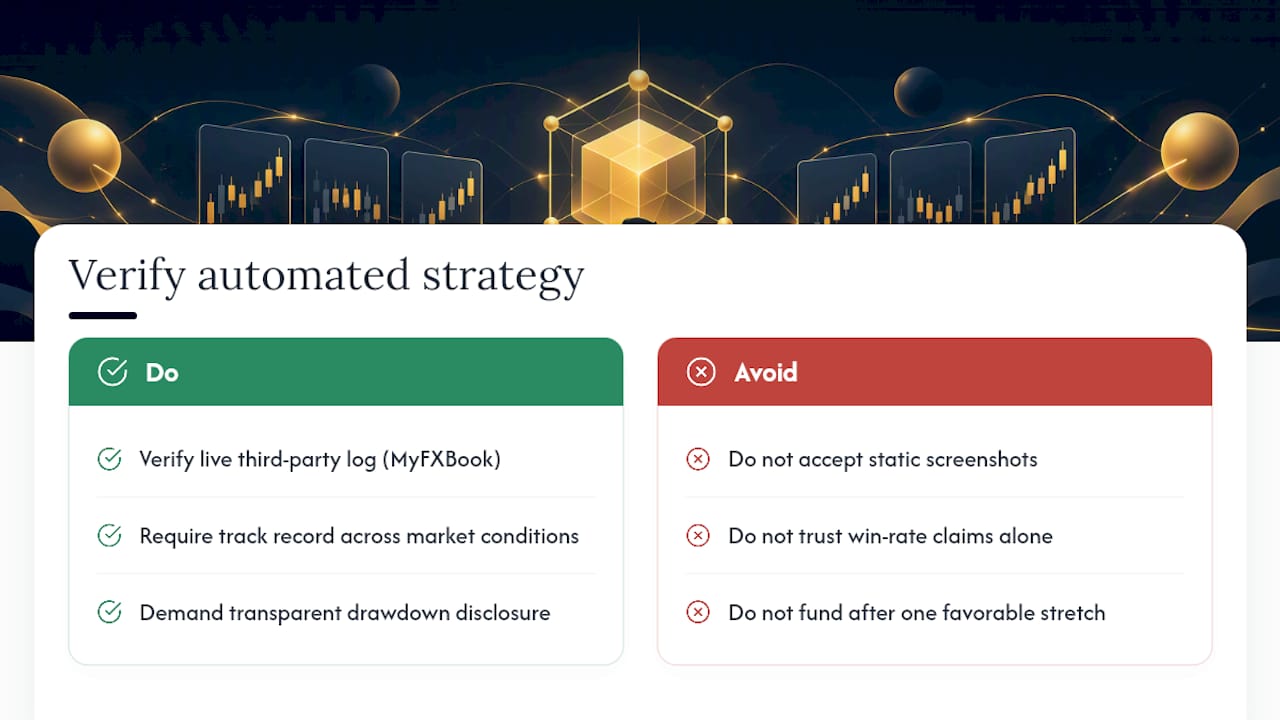
Check three things before funding an account: a live, third-party-verifiable performance log such as MyFXBook rather than a static screenshot, a track record spanning multiple market conditions rather than one favorable stretch, and transparent disclosure of drawdown periods, not just win streaks. A strategy that hides its losing months is telling you more than one that shows them.
Suitability and the Discipline It Actually Takes
This approach fits disciplined intraday traders and demo-practiced beginners willing to follow rules exactly. It doesn't fit anyone tempted to overtrade or chase missed setups. Practice until execution feels boring before risking real capital.
— Paulo
A Verified Alternative When You'd Rather Not Watch Five Charts at Once
Manual scalping demands screen time, sharp execution, and the discipline to walk away after a bad hour, three things not every trader has to spare. Sonicaigold offers a different route to gold exposure: a professionally managed, algorithm-driven strategy with 18 consecutive months of independently verified performance, executed automatically through the COPYX system so you're copying trades rather than clicking them yourself.

Before allocating anything, check the live verified performance results rather than taking published win-rate figures on faith. Traders who want more exposure once they've reviewed the track record can look at the 12X and 24X amplified account options; those weighing costs can review the performance fee structure directly. If manual scalping's screen-time demands aren't a fit for your schedule, start by reviewing the Sonic AI results page and test the approach with a small allocation before scaling up.
Sources
Review the liquidity sweep mechanics, the XAUUSD scalping guide, and current gold market statistics to confirm any claim before trading on it.
This article is general information, not a substitute for advice from a qualified financial advisor. Consult a qualified financial professional about your own circumstances before acting on anything here.
- Liquidity sweeps: entry & exit strategies — International Trading Institute
- Gold Scalping Strategy: XAU/USD Scalping Guide — ForexTradeLab
- The Ultimate 1-Minute Gold Scalping Strategy: Trading Liquidity Sweeps in 2026 — Trade Like Master
- Gold
FAQ
What Is the Best Strategy for Scalping Gold?
The most consistent approach combines a three-timeframe filter, M15 for bias, 5M for approach, M1 for the trigger, with two mechanical setups: sweep-and-reclaim and break-and-retest. Both rely on fixed fractional risk and a defined stop rather than discretionary judgment calls.
Is Scalping Gold Profitable?
It can be, but only with strict risk control and disciplined execution, since gold's volatility cuts both ways fast. Typical scalp targets run $2 to $8 per 0.01 lot, and profitability depends heavily on keeping spread and slippage from eating that margin.
What Is the Best Time Frame for Scalping Gold?
Most scalpers use the 5-minute chart for trade approach and the 1-minute chart for entry timing, filtered by a 15-minute chart for overall bias. This three-timeframe combination is widely recommended over trading any single timeframe alone.
What Is the 5-Minute Scalping Strategy for XAUUSD?
It uses the 5-minute chart to watch price approach a marked level, often the session high or low, while EMA 9 and EMA 21 confirm short-term direction and ATR(14) sizes the stop. The actual entry trigger still comes from the 1-minute chart once price reaches that zone.
Is Gold Scalping Suitable for Beginners?
It can work for beginners who've practiced on a demo account until the entry and stop rules feel automatic, since scalping punishes hesitation and improvisation quickly. Traders who prefer a hands-off approach can also look at a verified copy-trading option like Sonic AI instead of executing manually.