
A verified trading result is a public record of closed trades tied to a broker statement or an independent audit, not a screenshot chosen by the trader. The single clearest signal that a track record is real is a continuous, broker-linked closed-trades feed or an audited report that shows losses alongside wins. Anything short of that, no matter how polished, is a claim, not proof.
TL;DR:
- True verified trading results must involve continuous, broker-linked data or independent audits that cannot be edited after the fact, unlike static screenshots.
- Key performance metrics like profit factor, maximum drawdown, and expectancy should be checked together, with sample sizes of at least 30 trades for reliable conclusions.
- Confirm raw trade exports and look for signs of account resets or missing periods to ensure the track record reflects genuine, unmanipulated performance.
- Verified results are withstanding scrutiny when the provider offers transparent, broker-connected data, full trade history, and out-of-sample validation, unlike curated or cherry-picked reports.
- A verified track record doesn't guarantee future performance, especially in changing market conditions, so ongoing live testing and risk matching are crucial before significant capital allocation.
Table of Contents
- What Verified Trading Results Actually Look Like
- Key Metrics to Check and Practical Benchmarks
- A Step-by-Step Checklist to Verify Any Claimed Track Record
- Common Pitfalls That Make "Verified" Results Unreliable
- How to Use Verified Results When Choosing a Strategy or Signal Provider
- What Strong Verification Looks Like: Sonic AI's Gold Track Record
- Verified Performance Services vs. Myfxbook: What's the Difference?
- Legal and Regulatory Considerations for Verified Trading Claims
- Case Studies: When Verified Track Records Held Up and When They Didn't
- How Market Conditions Affect the Reliability of Verified Results
- How I Weigh Verified Results Against Live Testing
- How to Try Sonic AI and Where to Review the Verified Results
- Sources
What Verified Trading Results Actually Look Like
Verification comes in a range of formats, and they are not equally trustworthy. A static screenshot of an account balance proves almost nothing. It can be cropped, edited, or pulled from a demo account with no risk attached. A live dashboard that updates automatically from a broker feed is a different category entirely, because it shows every trade in sequence, including the ones that lost money.
The strongest formats share one trait: they cannot be quietly edited after the fact. That includes:
- Broker-linked statements or read-only account links that pull directly from the trading platform, not from a spreadsheet the trader maintains.
- Third-party audit pages where an outside service confirms account activity independent of the trader.
- Public APIs or JSON feeds that stream closed trades from a live database, often updated every few minutes rather than once a month.
- Downloadable trade logs that let you reconcile every entry, exit, and timestamp yourself.
Open-source trading projects offer a useful model here. Some publish live trade logs and JSON APIs that write directly from the strategy's trade database to a public endpoint, giving outside observers a near-immutable record instead of a curated summary. That's a meaningfully higher bar than a monthly PDF report, and it's worth using as your baseline when judging anyone claiming a verified track record.
Key Metrics to Check and Practical Benchmarks
Win rate alone tells you almost nothing. A trader with a 75% win rate can still lose money if the average loss dwarfs the average win. Real evaluation requires looking at several metrics together, not picking the one that sounds best.
A structured performance review leans on five core numbers: win rate, profit factor, expectancy, maximum drawdown, and average R-multiple. Each measures something different, and none of them is reliable in isolation.
| Metric | What it measures | What to watch for |
|---|---|---|
| Win rate | Percent of trades that close in profit | Meaningless without average win/loss size |
| Profit factor | Gross profit divided by gross loss | Above 1.3 to 1.5 is a reasonable working benchmark over enough trades |
| Expectancy | Average dollar result per trade | Should stay positive across different market conditions |
| Max drawdown | Largest peak-to-trough equity decline | Tells you how much pain you'd tolerate holding the account |
| Average R-multiple | Reward relative to risk per trade | Reveals if wins are actually bigger than losses |
Profit factor paired with drawdown and trade count gives you a compact health check that's harder to fake than a headline win-rate number. A trader can cherry-pick a winning streak, but sustaining a strong profit factor across hundreds of trades and multiple drawdown cycles is much harder to fabricate.
Sample size matters just as much as the metrics themselves. Guides on performance review recommend at least 30 trades per filter segment before drawing conclusions about a strategy's edge in a specific setup, time frame, or instrument.
Pro Tip: Ask for the raw trade export, then calculate profit factor and max drawdown yourself. If the numbers a provider reports don't match what you compute from their own data, that mismatch is worth more than any other red flag on this list.
A Step-by-Step Checklist to Verify Any Claimed Track Record
Verifying a track record isn't complicated, but it does take a specific sequence of checks. Skipping steps is how traders end up funding a strategy built on a curated highlight reel.
- Request the full closed-trades export or live API feed. Confirm the timestamps run continuously, with no unexplained gaps.
- Confirm broker linkage or independent audit. Ask for a read-only account link or a statement directly from the broker, not a document the trader typed up.
- Look for walk-forward or out-of-sample validation. A strategy tested only on the data it was built on is far more likely to fail live. Walk-forward validation that holds back a final period during optimization is one of the most reliable guards against curve-fitting.
- Compute the core metrics yourself. Don't take win rate or profit factor at face value. Pull the raw numbers and check the equity curve for consistency rather than sudden jumps.
- Watch for account resets, withdrawals, or edited history. An equity curve that resets to zero or jumps without explanation usually means capital was added or removed, which distorts the real return.
Running a strategy against a relevant benchmark adds another layer of context. One professional trader's practice of running after-action reviews against benchmarks like SPY, QQQ, or GLD applies directly here: if a gold strategy can't outperform GLD over a comparable period, the "verified" results may still be a poor use of your capital, verified or not.
Common Pitfalls That Make "Verified" Results Unreliable
Plenty of track records carry the word "verified" while hiding something important. The label itself proves nothing if you don't know what was checked.
- Truncated tables and cropped screenshots that conveniently start after a losing stretch ends.
- Cherry-picked windows showing only the best three or six months of a much longer, messier history.
- Survivorship bias, where failed accounts or strategies simply disappear from the provider's marketing instead of being disclosed.
- Curve-fitting without walk-forward validation, where a strategy was tuned to fit historical data perfectly but was never tested on unseen data.
- Small sample sizes presented as if they were statistically meaningful, sometimes fewer than 20 or 30 trades total.
- Sudden account resets or unexplained withdrawals that break the continuity of the equity curve and make drawdown figures unreliable.
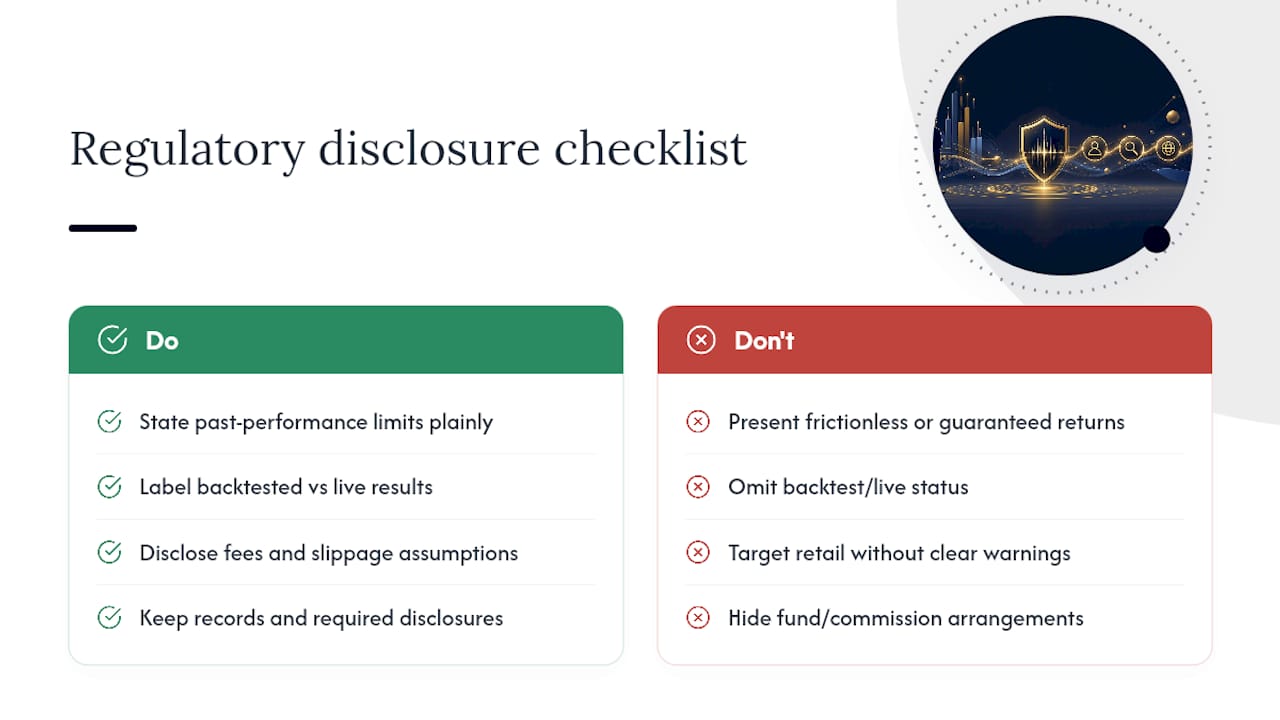
Legitimate providers tend to include blunt disclosures rather than avoid them. Responsible presentations of backtest and live results typically carry explicit warnings that past performance does not guarantee future results, along with realistic assumptions about fees and slippage. A provider that omits these caveats entirely is telling you something, even if it isn't saying it directly.
How to Use Verified Results When Choosing a Strategy or Signal Provider
Verification tells you a track record is real. It doesn't tell you whether that strategy fits your goals. Those are two separate questions, and traders who conflate them end up allocating capital to strategies that technically have honest numbers but the wrong risk profile for their situation.
Start by matching the reported drawdown pattern to what you could actually tolerate watching happen to your own account. A strategy with a real, verified 40% max drawdown might be mathematically sound and still wrong for you if that kind of swing would push you to intervene manually.
- Match reported metrics and drawdown patterns to your own risk tolerance and time horizon, not just the headline return.
- Prefer providers that let you run a small live trial with tracked, immutable records rather than asking you to commit full size on day one.
- Ask providers directly: how far back does your trade history go, is it broker-linked, and can I see a losing month?
- Scale allocation gradually. Start with a minimal position, confirm the live results match the historical pattern over a defined period, then increase according to a rule you set in advance, not an emotional reaction to a good week.
Pro Tip: Treat the first month of any live trial as a verification exercise, not a profit target. You're testing whether the provider's real-time numbers match their historical claims, not trying to get rich in 30 days.
What Strong Verification Looks Like: Sonic AI's Gold Track Record
Sonic AI's automated gold strategy publishes the kind of documentation this checklist calls for.
Readers can check the components directly:
- The Sonic AI Myfxbook results page shows verified trade history and performance metrics tied to broker-style reporting, not curated screenshots.
- Trade execution runs through COPYX, which copies trades automatically from the managed strategy into a linked account, giving a direct, broker-connected record of what actually happened.
- The live setup and results page details how execution and verification are structured for anyone evaluating the strategy before committing capital.
That combination, broker-linked data, full trade-history availability, and a public results feed, maps closely to the checklist above: it's the difference between a claim and a record you can actually inspect.
Verified Performance Services vs. Myfxbook: What's the Difference?
Not all verification standards check the same things, and that distinction matters when you're comparing two providers who both claim to be "verified." Some services focus narrowly on confirming that an account exists and trades occurred. Others go further and validate the statistical integrity of the results.
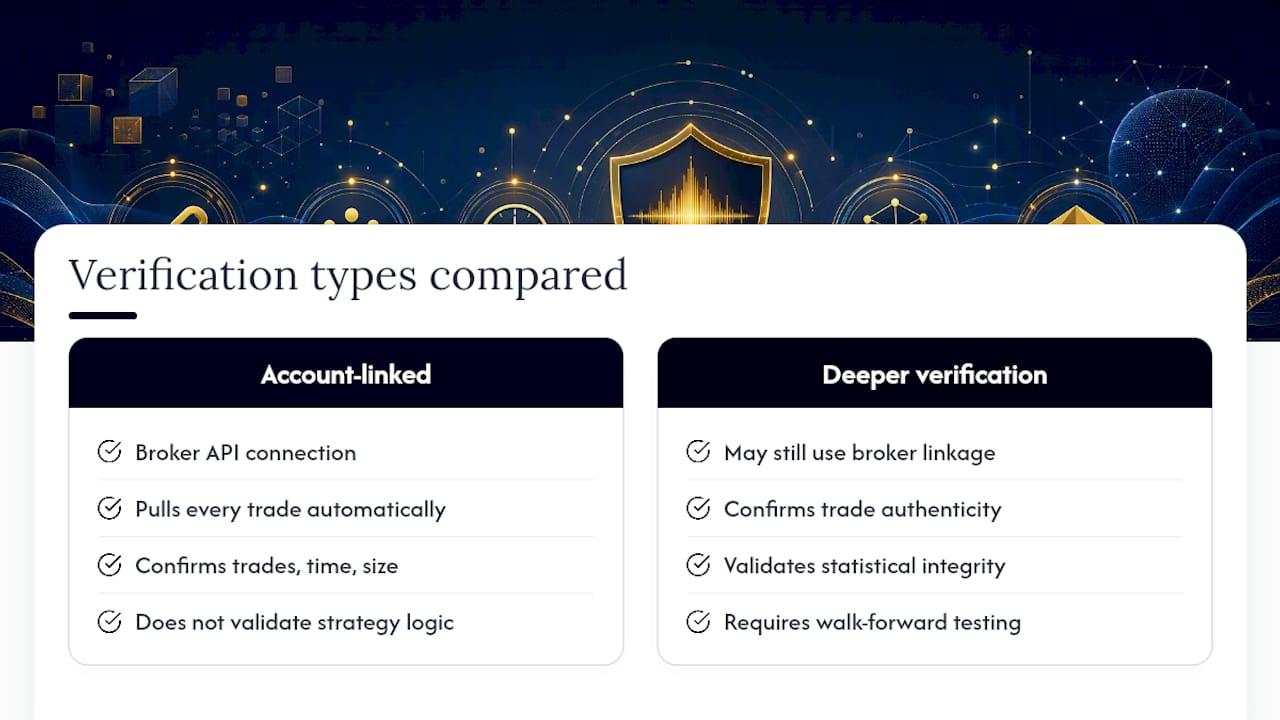
Myfxbook-style platforms work by connecting directly to a trading account through the broker's API, pulling every trade automatically rather than relying on the trader to upload data. This is a strong baseline: it confirms trades happened, when they happened, and at what size. What it typically doesn't do is validate the strategy's underlying logic or confirm the trades weren't cherry-picked into a separate account that only holds the winners.
Verified performance standards that go beyond simple account linkage often add requirements around walk-forward testing, out-of-sample periods, and disclosure of parameter changes over time. Open-source strategy projects illustrate this well by committing parameter changes to version control alongside in-sample and hold-out results, so anyone reviewing the strategy can see exactly when and why the logic changed, not just what the equity curve did afterward.
The practical takeaway: account-linked verification confirms trades are real. Deeper verification standards confirm the strategy behind those trades wasn't reverse-engineered from the same data it's being tested on. Ask which type of verification you're actually looking at before assuming "verified" means the same thing across two different providers.
Legal and Regulatory Considerations for Verified Trading Claims
Claiming a track record is "verified" carries real regulatory weight in most jurisdictions, and the rules differ depending on whether the provider is a registered advisor, a signal service, or an individual sharing personal results. Financial regulators in many countries treat performance claims used to solicit money from others as a form of advertising, which means those claims can be subject to disclosure and record-keeping requirements even when no formal advisory relationship exists.
The most consistent legal expectation across markets is disclosure of limitations. Reputable providers state plainly that past performance doesn't guarantee future results, disclose whether figures are backtested or live, and note realistic assumptions about fees and slippage rather than presenting frictionless returns. Omitting these disclosures doesn't just look questionable. In many jurisdictions it can cross into misleading advertising, particularly when the audience being solicited includes retail investors who may not understand the difference between a backtest and a live account.
Jurisdiction matters enormously here. What counts as an acceptable performance claim for a regulated broker-dealer in one country can be treated very differently for an unregistered signal provider marketing internationally. Rules around client fund segregation, profit-sharing arrangements, and affiliate commission disclosures also vary by regulator and by whether the entity handles client money directly or only provides copy-trading infrastructure. Traders evaluating a provider should treat clean regulatory disclosure as part of the verification process itself, not a separate legal footnote. A provider willing to state its limitations clearly is generally a better sign than one whose marketing reads as a guarantee.
Case Studies: When Verified Track Records Held Up and When They Didn't
The value of verification becomes obvious once you compare what happens when it's present versus absent. Strategies that publish continuous, broker-linked data tend to survive scrutiny even during rough stretches, because losing periods are visible alongside winning ones and don't undermine the provider's credibility. The absence of hidden gaps is itself a form of proof.
Fraudulent or misleading track records tend to share a recognizable pattern regardless of the market involved. A provider shows strong early results, attracts capital, then either restricts withdrawals, resets the account, or stops updating the public record right around the point where performance starts to weaken. In several widely publicized signal-provider collapses, investigators found that the "verified" results being marketed were pulled from a single account funded with far less capital than what was actually being solicited from clients, a structure that let a small, real winning streak stand in for a much larger and unverified promise.
The contrast isn't really about strategy quality. It's about whether the underlying data was ever exposed to outside scrutiny in real time. A mediocre strategy with a fully transparent, continuously updated record is a known quantity. A spectacular strategy with no visible losing streak, no broker linkage, and no explanation for gaps in the trade history is an unknown one, dressed up to look otherwise. Traders who treat "verified" as a label rather than a process are the ones most often caught out by the second pattern.
How Market Conditions Affect the Reliability of Verified Results
A verified track record proves that a set of trades really happened. It doesn't guarantee those same results will repeat once market conditions shift. Gold, in particular, behaves very differently during periods of low volatility versus during macro shocks tied to interest rate decisions, geopolitical events, or currency instability. A strategy verified over 18 months of one type of market regime carries different reliability than one verified across multiple distinct regimes.
This is where walk-forward validation earns its place in the checklist rather than being a nice-to-have. A strategy tested only against the conditions it already knows can produce an impressive verified record that quietly depends on those exact conditions continuing. The moment volatility patterns change, an otherwise legitimate track record can stop predicting future performance, even though nothing about the historical data was falsified.
Traders should treat a long verified run as a genuinely strong signal, not a permanent guarantee. Ask whether the strategy adapts its parameters over time, and whether the provider discloses when and why those adjustments happen. A track record that survived a shift in market conditions and kept its core metrics intact tells you more about durability than one that has only ever operated in a single, calm regime.
How I Weigh Verified Results Against Live Testing
Verification earns a strategy the right to a small allocation, not a large one. My own rule is simple: confirm the broker-linked data and walk-forward testing first, then trial with capital you could lose without consequence, scaling only when live results track the verified history over a defined period.
One-off snapshots age badly. Ongoing review, month over month, catches drift that a single audit never will. Verification lowers risk. It doesn't remove it, and no track record, however clean, changes that.
— Paulo
How to Try Sonic AI and Where to Review the Verified Results
An automated gold trading strategy (XAUUSD) can be managed by a team and executed through COPYX, which copies trades automatically into linked accounts without requiring manual trading decisions.

Before committing capital, review the public verification pages yourself rather than taking any summary at face value. Check the Myfxbook-style results page for the full trade history and confirm the metrics against what's described in this article. If you're researching signal distribution models more broadly, the Signal Partners affiliate network is a useful reference point for how verification and partner structures work across the industry.
Once you've confirmed the data matches the claims, the next step is straightforward: visit the live setup page to see current execution details and start the process of connecting your account.
This article is general information, not a substitute for advice from a qualified financial advisor. Consult a qualified financial professional about your own circumstances before acting on anything here.
Sources
- How to Review Trading Performance: A 2026 Guide
- weemaba999/TradingLab999
- How to Analyze Your Trading Performance (2026)