
Trading affiliate marketing is earning commissions by referring traders to brokers, using CPA, revenue share, or per-lot rebates as the payment structure. It works as a reliable income channel only when you pick regulated partners and verify tracking before you scale. The immediate next step: shortlist two or three programs from a regulated broker, run a test link, and confirm attribution before committing content or ad spend to any one offer.
TL;DR:
- Verify server-to-server tracking and detailed client metrics before scaling any trading affiliate program to ensure accurate attribution and prevent revenue loss.
- Prioritize regulated brokers with transparent clawback, hold, and payout terms over those offering the highest headline rates to protect long-term income.
- Use incognito link testing to confirm tracking reliability and avoid programs with vague or delayed reporting, especially before launching large campaigns.
- Prefer revenue share or hybrid models over CPA or CPL if your audience tends to trade actively or long-term, as these can generate income over multiple months or years.
- Focus on programs with operational trust, clear onboarding processes, and predictable payouts; these features outperform high but unreliable rates in sustainable earnings.
Table of Contents
- Best Trading Affiliate Programs Worth Your Time
- How Does Affiliate Tracking Actually Work?
- Which Commission Model Pays the Most?
- What Should You Check Before Joining a Program?
- How Do You Actually Get Started as an Affiliate?
- Which Channels Convert Best for Trading Offers?
- When Should You Build an IB Network?
- Typical Payout Methods and Reporting Metrics
- What Can You Realistically Earn, and When?
- What Legal and Compliance Rules Apply to Affiliates?
- How Do You Avoid Promoting a Scam Broker?
- What Makes a Trading Affiliate Program Actually Stand Out?
- What the Research Actually Supports
- Sonic AI's Affiliate Route for Gold Copy Trading
- Sources
Best Trading Affiliate Programs Worth Your Time
Not every program deserves your traffic. Some pay fast and track cleanly; others bury you in reversed commissions and vague reporting. Here's what stands out among the programs affiliates actually recommend.
cTrader Affiliate Program runs through Impact, a widely used affiliate platform, which means signup, link generation, and reporting all happen inside a system you can trust to log clicks accurately. Onboarding is unusually well documented, down to the exact steps for testing links before you publish. It suits publishers who want a clear path from signup to first payout without guesswork.
Interactive Brokers' influencer program targets a narrower goal: Open & Funded Accounts, not just clicks. It uses performance-based pricing and pays on monthly Net-30 invoicing, which makes cash flow predictable if you're a finance creator with an audience that actually funds accounts rather than just watches videos.
Vantage's CPA program advertises high headline payouts for tier-one geographies, backed by a full kit of banners and landing pages. The catch: live cabinet terms decide the final payable amount, not the number on the marketing page.
Olymp Trade, running its partner flow through Kingfin, publicizes revenue share up to 80% and CPA up to $250, but geo eligibility and live account terms swing those figures considerably.
TradingView's affiliate program is the clean example of pure revenue share, paying a recurring cut of subscription revenue rather than a one-time bounty. IG shows up frequently in affiliate research as a regulated, established broker option for affiliates who prioritize counterparty stability over headline rates.
Beyond broker-direct programs, several networks aggregate offers across brokers: MyLead, AVAZ, AvaPartner, Acceleration Partners, Olavivo, FPM.global, Datify.Link, Libertex, FoxOffers, and FireAds each run trading and finance verticals with their own dashboards, payout schedules, and geo restrictions. Networks trade a bit of per-lead payout for diversification. If one broker pauses a campaign or changes terms, your income doesn't collapse.
| Program | Commission model | Headline range | Tracking quality | Payout cadence | Best for |
|---|---|---|---|---|---|
| cTrader Affiliate Program | CPA / hybrid | Varies by broker partner | Impact-managed, strong link tools | Per Impact terms | Publishers wanting fast onboarding |
| Interactive Brokers | Performance-based CPA | Tied to funded accounts | Standard reporting | Monthly, Net-30 | Finance influencers with funded-account audiences |
| Vantage Forex CPA | CPA | Up to high tier-1 figures | Cabinet-based reporting | Per cabinet terms | Paid traffic targeting tier-1 geos |
| Olymp Trade / Kingfin | RevShare up to 80% / CPA up to $250 | Geo-dependent | Kingfin dashboard | Per cabinet terms | Affiliates with emerging-market traffic |
| TradingView | Revenue share | Recurring subscription cut | Standard SaaS affiliate tracking | Monthly | Content creators with engaged niche audiences |
| Trading affiliate networks (MyLead, AVAZ, AvaPartner, etc.) | Mixed CPL/CPA/hybrid | Varies by offer | Varies by network | Varies by network | Affiliates wanting offer diversification |
Geo eligibility changes constantly. A CPA that looks generous for a UK visitor can shrink for a visitor from a restricted market, so confirm country rules inside the partner dashboard, not the marketing page, before you route traffic.
How Does Affiliate Tracking Actually Work?
Every commission traces back to a link, a cookie, and a server call, and the weakest link in that chain is usually the cookie. Browser privacy settings, ad blockers, and third-party cookie restrictions can all quietly erase a referral before it's ever recorded.
That's why the better programs use server-to-server (S2S) postback, a direct handoff between the broker's server and the affiliate network's server that doesn't depend on the visitor's browser cooperating. It's the difference between a referral surviving a cleared cache and one that vanishes.
Partner portals typically expose:
- First-time deposit (FTD) counts per referred client
- Lot volume traded, which drives rebate and revenue-share payouts
- Reversals and clawbacks tied to chargebacks or churned accounts
Pro Tip: Before you commit real traffic to a program, click your own affiliate link in an incognito window, complete a dummy signup if allowed, and check whether the click shows up in the partner dashboard within a few hours. If it doesn't, don't trust the payouts either.
Which Commission Model Pays the Most?
The model that pays the most depends entirely on your traffic type, not on which one has the biggest number attached. Trading affiliate programs typically pay through CPL, CPA, revenue share, per-lot rebates, or a hybrid of these.
- CPL (cost per lead): a flat fee for a qualified sign-up, regardless of whether the lead ever deposits. Fits high-volume, low-intent traffic like paid social.
- CPA (cost per acquisition): a lump sum once a referred trader funds their account. Fits content that pre-qualifies buying intent, like comparison reviews.
- Revenue share: a recurring percentage of the broker's revenue from that client, paid for as long as the client trades. Fits long-term content like YouTube channels and evergreen blogs.
- Per-lot rebate: a fixed amount per traded lot, common with forex and CFD brokers. Fits affiliates whose audience trades actively rather than buys and holds.
- Hybrid: an upfront CPA paired with an ongoing rebate, letting you balance immediate cash flow against long-term upside.
A quick comparison: a $200 flat CPA on 20 conversions a month nets $4,000 immediately. A 25% revenue share on the same 20 clients might pay $150 a month total at first, but it compounds as clients keep trading, often overtaking the CPA total within a year.
Watch for hold periods and clawback clauses. Many programs hold commissions for 30 to 90 days and reverse them if the client withdraws funds or triggers a chargeback within that window. Budget your cash flow around the hold period, not the payout date on paper.
What Should You Check Before Joining a Program?
Skip the sign-up button until you've confirmed these:
- S2S tracking is available, not just browser-cookie tracking.
- Reporting granularity shows per-client FTDs, lot volume, and reversals, not just a lump total.
- Payout reliability has a track record; ask how long the program has paid affiliates without a missed cycle.
- Regulatory standing of the broker (FCA, CySEC, ASIC, or equivalent) is publicly verifiable.
- Geo coverage matches where your actual audience lives, not where you assume it lives.
- Marketing restrictions are written down, including whether paid search or specific claims are banned.
- Hold and clawback terms are stated in writing, not just described verbally.
Send the affiliate manager a direct message: "Can you confirm your S2S postback setup, average payout turnaround, and clawback window in writing?" A manager who answers specifically and quickly is a good sign. One who deflects to "check the dashboard" without details is a warning sign.
Pro Tip: If a program won't put its clawback terms in writing before you sign up, assume the worst-case version applies and plan your cash flow accordingly.
Regulatory standing matters more than it looks on paper. A program tied to an FCA, CySEC, or ASIC-regulated broker reduces the odds of a sudden shutdown wiping out your pending commissions.
How Do You Actually Get Started as an Affiliate?
- Apply through the program's official portal (often Impact, a proprietary dashboard, or a network like the ones listed above). Most applications ask for your website, traffic sources, and estimated monthly volume.
- Generate your unique tracking link, using sub-IDs to separate traffic by channel, whether that's a specific YouTube video, blog post, or ad campaign.
- Test the link in an incognito browser, confirming it redirects correctly and that the click registers in your dashboard within a reasonable window, exactly as cTrader's onboarding guide recommends.
- Publish a small first campaign, one piece of content or one modest ad set, and track FTDs and reversals closely for two to four weeks before scaling spend.
Labeling each sub-ID clearly from day one prevents a costly mix-up later: without it, you can't tell which channel actually converts.
Which Channels Convert Best for Trading Offers?
Tutorials, demo-account walkthroughs, and honest comparison pages consistently outperform generic banner ads, because trading offers need trust before a click turns into a funded account.
- YouTube: demo trades and platform walkthroughs build credibility fast; pin your affiliate link and disclose it in the description.
- Blogs: comparison and review content ranks well and pre-qualifies readers who are already comparing brokers.
- Telegram and Discord: community endorsements work, but only with consistent, honest performance talk, not hype.
- Paid search: effective, but regulators in several markets restrict trading ad language, so review platform and regional ad policies before spending.
Pro Tip: Always disclose the affiliate relationship clearly. It's not just an ethics issue; several ad platforms and regulators require it, and undisclosed promotion can get your account suspended.
When Should You Build an IB Network?
Once your own referral volume plateaus, recruiting sub-affiliates (sub-IBs) under you is the next lever. You earn an override commission, a smaller cut of what your sub-IBs generate, on top of your direct earnings.
- Recruit sub-IBs once you have proof of consistent conversion data to show them.
- Confirm your platform supports multi-tier tracking, since override math only works if the software can attribute activity across layers correctly.
- Keep reporting and payout processes clean; a growing IB network multiplies any tracking or compliance gap you already have.
Typical Payout Methods and Reporting Metrics
Most programs pay through bank wire, PayPal, Skrill, Neteller, or cryptocurrency, with wire and e-wallet options dominating among regulated brokers. Crypto payouts show up more often with offshore or CPA-heavy networks, largely because they settle faster across borders.
Reporting dashboards typically track:
- Clicks and unique visitors to your affiliate link
- Registrations (sign-ups that haven't funded yet)
- First-time deposits (FTDs), the metric most CPA payouts hinge on
- Lot volume, which drives rebate and revenue-share calculations
- Reversals and chargebacks, subtracted from your pending balance
Payout frequency ranges from weekly to monthly, with monthly the most common among established brokers. Interactive Brokers, for example, invoices monthly on Net-30 terms, meaning a client's activity in January gets paid out toward the end of February. Programs with weekly payouts often carry higher scrutiny of fraud and reversals, since faster payouts mean less time to catch fake or churned accounts before money moves.
Check whether your dashboard shows data in near real time or on a delay. A 24 to 48 hour reporting lag is normal. A delay measured in weeks is a sign the program's tracking infrastructure is thinner than its marketing suggests.
What Can You Realistically Earn, and When?
Earnings vary enormously by traffic quality, commission model, and how long you've been running a given channel, so treat any flat number you see elsewhere with skepticism. A single high-intent comparison article ranking for a competitive broker term can produce a handful of CPA conversions a month; a YouTube channel with an engaged subscriber base running revenue share can compound into a meaningful monthly figure over a year or more as referred clients keep trading.
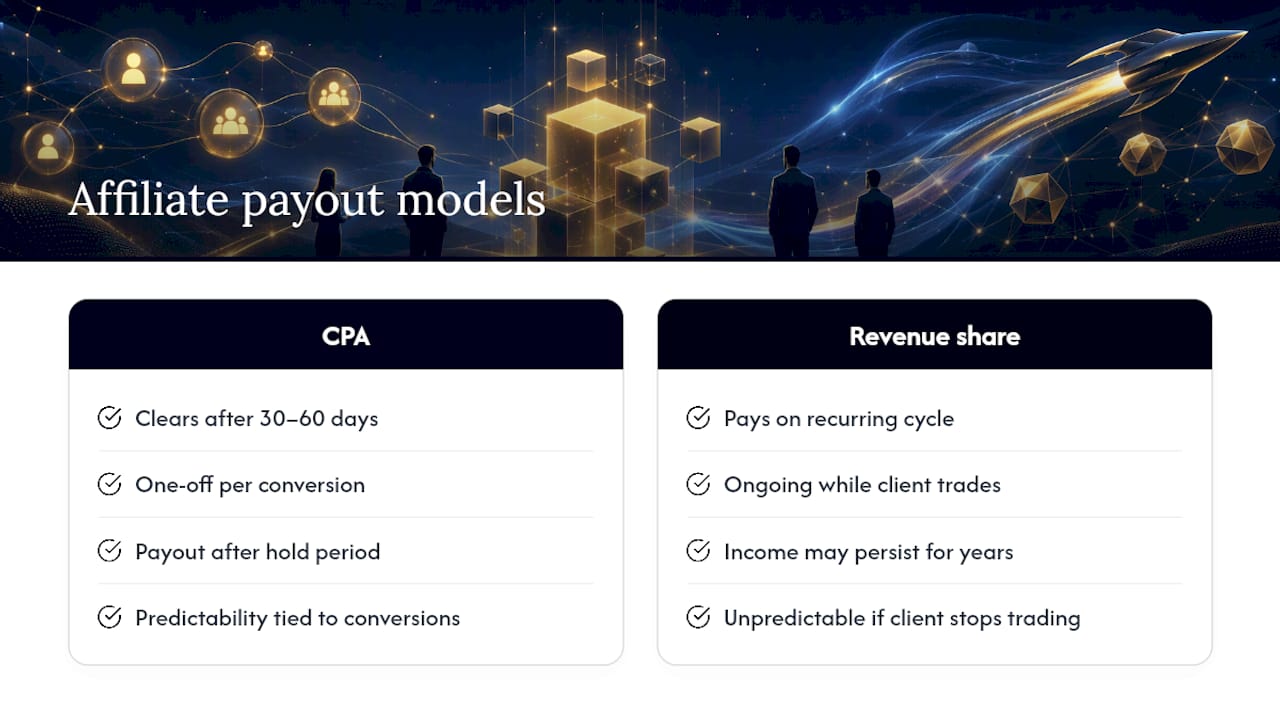
The bigger variable is timing, not size. CPA payouts typically clear once the hold period passes, commonly 30 to 60 days after a client's first deposit. Revenue share pays out on a recurring cycle tied to the client's ongoing trading activity, which means your first month's referral might generate income for years, or it might generate nothing if that client stops trading within weeks.
New affiliates should expect a ramp-up period before payouts feel meaningful. The first month usually validates whether your tracking and content actually convert. Real income growth tends to show up in months three through six, once you've refined which content or channel produces the highest-quality referrals and dropped the ones that don't.
Anyone promising a fixed monthly figure regardless of traffic source is skipping the part where results depend entirely on your audience's actual buying intent.
What Legal and Compliance Rules Apply to Affiliates?
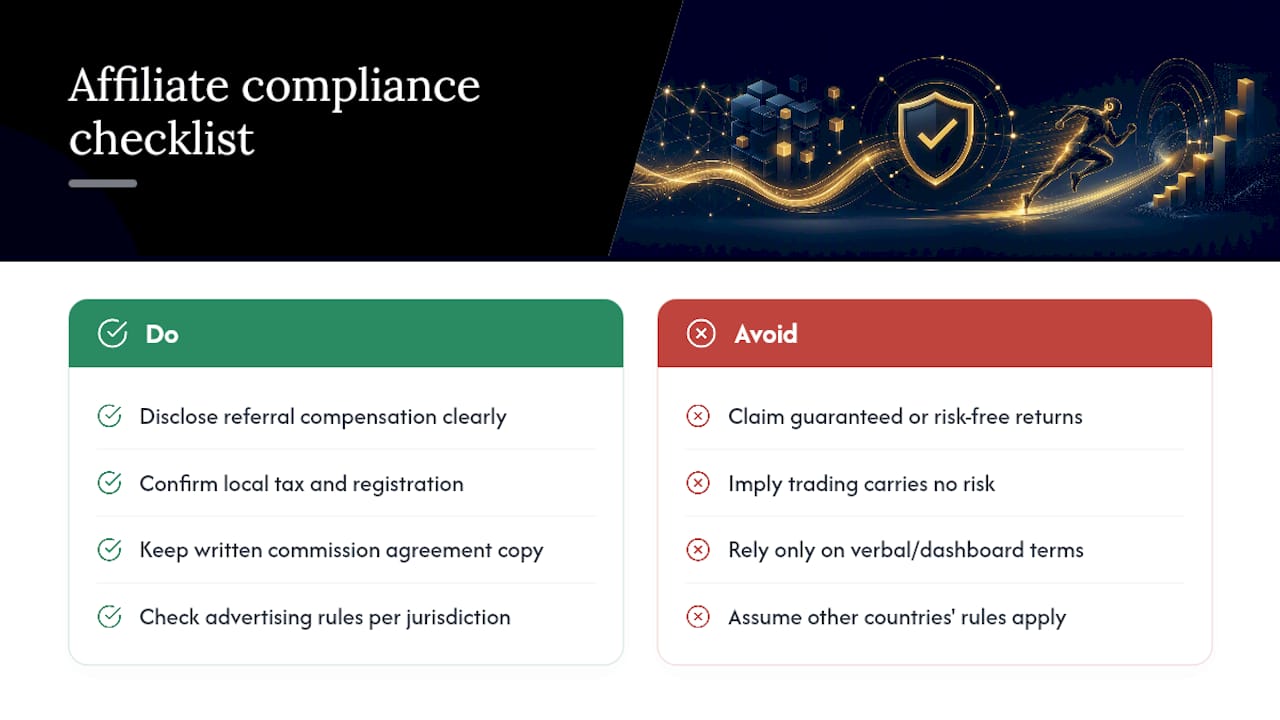
Financial promotion rules apply to affiliates, not just to the brokers themselves, in most regulated markets. If you publish content that could be read as advice to open a trading account, several regulators expect a clear disclosure that you're being compensated for the referral.
Requirements to formally incorporate vary by jurisdiction. There's no universal rule requiring an LLC or similar entity just to run affiliate links, though larger brokers sometimes prefer a formal business entity once your volume or payout size crosses a certain threshold, mainly for contract and tax purposes. Confirm your own local tax and business registration requirements before assuming your situation matches another affiliate's setup in a different country.
Every jurisdiction treats trading promotion differently. What's an acceptable claim in one market may violate advertising standards in another, particularly around guaranteed returns or risk-free framing. Never state or imply that trading carries no risk. That single habit causes more account suspensions and regulatory complaints than any other affiliate mistake.
Keep a written record of the commission agreement, including the clawback and hold-period terms, separate from the marketing page you originally saw. Verbal or dashboard-only terms that later change without notice are one of the most common affiliate disputes, and a saved copy of the original terms is your only real protection.
How Do You Avoid Promoting a Scam Broker?
The affiliate's reputation rises and falls with the broker's, so vetting the broker protects your own audience's trust as much as your income. Confirm regulatory status directly on the regulator's own register (FCA, CySEC, ASIC, or the equivalent for the broker's claimed jurisdiction), never just on the broker's own site.
Watch for classic red flags shared with other high-pressure financial promotions: guaranteed returns, pressure to deposit quickly, unusually generous CPAs with no clear funding source, and affiliate managers who won't answer direct questions about clawback terms. The patterns overlap heavily with the tactics seen in pump-and-dump promotions elsewhere in finance: urgency, vague mechanics, and reluctance to put terms in writing.
Test withdrawal speed with a small personal account before promoting heavily, if the broker allows it. A broker that stalls small withdrawals will stall your audience's larger ones, and that damage lands on your reputation, not just theirs.
What Makes a Trading Affiliate Program Actually Stand Out?
The programs affiliates keep recommending share a pattern: they win on operational trust, not on the biggest number on the landing page.
cTrader's edge is process clarity, a documented onboarding flow through Impact that removes guesswork. Interactive Brokers' edge is payout predictability, monthly Net-30 invoicing that experienced influencers can plan cash flow around. Vantage's edge is marketing firepower, a full kit of creative assets paired with high headline CPAs for tier-one traffic. TradingView's edge is compounding, a recurring revenue share that rewards content built to last rather than one-off promotions.
Networks like MyLead, AVAZ, AvaPartner, Acceleration Partners, Olavivo, FPM.global, Datify.Link, FoxOffers, and FireAds win on choice: one dashboard, many broker offers, less dependency on a single program's terms. Libertex and Olymp Trade's Kingfin-run flow win on accessible entry points for affiliates targeting emerging-market audiences.
None of these traits substitutes for the others. A generous CPA with poor tracking still costs you money in lost attribution. A well-tracked program with a mediocre rate still beats a broken one with a flashy number, because operational reliability predicts long-term earnings better than headline rates do.
What the Research Actually Supports
The conventional advice tells new affiliates to chase the highest CPA on the page. That's backwards. A $250 CPA from a program with a two-week reporting lag and vague clawback language is worth less than a $150 CPA from a program that pays on time, every time, with S2S tracking you can verify yourself.
What gets underweighted almost everywhere: the incognito link test. It takes five minutes and it exposes more about a program's real reliability than any affiliate manager's sales pitch. Run it before you commit a single piece of content.
Prioritize regulation and tracking transparency first, commission structure second, and headline rate last. That order feels backwards to anyone chasing quick income, but it's the order that actually protects your earnings over a full year, not just your first payout cycle. A hybrid model, some upfront cash plus ongoing rebate, tends to reward patience better than a pure CPA chase ever does, particularly if your audience skews toward long-term investors rather than short-term traders.
— Paulo
Sonic AI's Affiliate Route for Gold Copy Trading
Sonicaigold runs an affiliate program built around one focused product: an algorithm-driven copy-trading strategy for gold (XAUUSD), with 18 consecutive months of independently verified performance behind it.
That focus matters for affiliates. Instead of promoting a broad multi-asset broker where your audience has to pick their own strategy, you're pointing them to one clear, transparent gold copy-trading system with automatic execution through COPYX, no manual trading skill required on the client's side. It fits affiliates whose audience already leans toward passive investing or gold as a hedge, rather than active day traders chasing short-term signals.
Performance data is public and updated, not just promised. You can review the verified track record before you promote a single link, and point your own audience to the same proof pages for their own due diligence.
The next step is straightforward: visit the affiliate registration page, review the current commission structure, and set up your first tracked link the same way you would test any other program, before you send it to your audience.
This article is general information, not a substitute for advice from a qualified financial advisor. Consult a qualified financial professional about your own circumstances before acting on anything here.
Sources
- The painfully detailed guide to getting started with the cTrader Affiliate Program
- Best Forex Affiliate Programs 2026 | Trader-First Guide
- Affiliate Programs | Interactive Brokers LLC
- Vantage Forex CPA Affiliate Program | Partner with a Top Referral Broker