
Set and forget trading means placing an entry, stop-loss, and take-profit at the moment you open a trade, then leaving the position alone until it closes. No mid-trade adjustments, no watching the screen. It suits swing and position traders working on 4H or daily charts, and traders using automation or copy-trading. It does not suit scalpers or anyone trading around major news releases.
- Main benefit: it removes emotional interference and enforces consistent risk.
- Main risk: a bad setup left alone can still hit its full stop loss with no chance to intervene.
Key Takeaways
Set and forget trading works because it removes mid-trade emotional decisions, and it only holds up when position size, stop placement, and sample size are all defined before entry.
| Point | Details |
|---|---|
| Define orders before entry | Place entry, stop-loss, and take-profit together as an OCO bracket, then don't touch them. |
| Match the strategy to the timeframe | Use set and forget on swing and position trades; avoid it in scalping or during major news. |
| Size positions by formula | Calculate size from risk percent of equity divided by stop distance, not a round-number guess. |
| Validate with a real sample | Backtest at least 100 trades with walk-forward testing before trusting expectancy numbers. |
| Consider a managed alternative | Sonic AI's gold copy-trading system automates entries, stops, and targets via COPYX with 18 months of verified results. |
Table of Contents
- What Does Set and Forget Trading Actually Involve?
- When Does Set and Forget Trading Work Best?
- How Do You Build a Set and Forget Trade Step by Step?
- How Should You Manage Risk on Every Trade?
- How Do You Validate a Set and Forget Strategy Before Trusting It?
- How Do You Handle Execution and Automation Safely?
- Why Do Traders Fail at Set and Forget, and How Do You Fix It?
- A Publisher's Take on Discipline and Automation
- Can Automated Gold Copy Trading Deliver a True Set and Forget Experience?
- Frequently Asked Questions
- Sources
What Does Set and Forget Trading Actually Involve?
The mechanics are simple: three orders placed together, then no touching. You use a limit or stop entry order to get into the trade at your chosen price, a stop-loss to define maximum loss, and a take-profit to lock in the win. Many platforms let you bundle these as an OCO (one-cancels-the-other) bracket, so when either the stop or the target fills, the other order cancels automatically.
Picture a daily gold chart where price pulls back to a prior support zone near a round number. You place a buy limit at that level, a stop-loss below the recent swing low, and a take-profit at the next resistance zone, sized for a 1:2 reward-to-risk ratio. Then you close the laptop.
- Set the entry order at a defined price, not a "feeling."
- Attach stop-loss and take-profit as OCO brackets.
- Confirm the order ticket before walking away.
- Let automation or a copy-trading system execute if you are not managing manually.
Algorithmic trading increasingly handles this execution step for retail traders who prefer rules over screen time.
When Does Set and Forget Trading Work Best?
The strategy shines on higher timeframes where noise gets filtered out. It struggles wherever price moves fast and unpredictably.
- Best fit: swing and position trading, trending markets, 4H and daily charts.
- Weak fit: scalping, day trading around unpredictable intraday swings.
- Avoid entirely: major scheduled news releases (rate decisions, jobs reports), thin holiday liquidity, and any pair or asset with erratic spread behavior.
- Quick check before entry: Is the trend clear on the daily chart? Is a news event due in the trade's expected holding period? Is the spread normal for this instrument?
Set-and-forget approaches perform best in swing and position setups and tend to break down in scalping or heavily news-driven conditions, largely because volatility spikes blow through stops that were sized for calmer price action. Gold (XAUUSD) traders feel this acutely. A stop placed comfortably outside normal range during a data-light week can get run over the moment a Federal Reserve announcement hits.
How Do You Build a Set and Forget Trade Step by Step?
A repeatable checklist beats a hunch every time. Run through these steps before every entry.
- Define your edge and timeframe (e.g., pullback continuation on the daily chart).
- Identify the entry trigger: a specific candle pattern, a moving average touch, or a support/resistance retest.
- Set your stop based on market structure or a multiple of Average True Range (ATR), not a round-number guess.
- Define your take-profit and reward-to-risk (RR) ratio before entry, not after.
- Calculate position size from your risk percentage and stop distance.
- Place the entry, stop, and take-profit as an OCO bracket, then verify the ticket shows all three legs correctly.
Pro Tip: Backtest a starter framework like a 1:2 RR target paired with a 35 to 45 percent win rate before risking real capital. That combination can still be profitable over a large sample because a winner returns twice what a loser costs, but you need at least 100 trades to know if the edge is real or a lucky streak.
Sample size matters more than any single trade outcome. Ten wins in a row proves nothing if your sample is ten trades. Backtesting and walk-forward validation are what separate a durable strategy from a hot streak you mistook for skill.
How Should You Manage Risk on Every Trade?
Risk management is the part traders skip when they are excited about a setup, and it's the part that determines whether you survive long enough to see your edge play out.
Position size comes from one formula: (Account equity × Risk %) ÷ Stop distance in price = Position size. If you risk 1% of a $10,000 account ($100) and your stop is 50 pips away, your position size divides that $100 across those 50 pips. This is your "1R" or one unit of risk, and every win or loss should be measured in R multiples rather than dollars, because R normalizes results across different account sizes and instruments.
Guardrails that keep you disciplined:
- Cap risk per trade at 0.5% to 2% of equity, never more.
- Set a daily loss limit (commonly 2 to 3R) that shuts down new entries for the day once hit.
- Set a max drawdown threshold (commonly 10 to 15% of equity) that triggers a full strategy pause and review.
- Never widen a stop after entry to "give it more room." That is not set and forget, that is hope dressed up as strategy.
Statistic callout: Average True Range measures typical price movement over a lookback period, and traders commonly set stops at 1.5 to 2 times the ATR to avoid getting stopped out by normal volatility rather than an actual trend reversal. A stop tighter than that on a volatile instrument like gold often gets clipped by ordinary noise before the trade ever gets a fair chance to work.
How Do You Validate a Set and Forget Strategy Before Trusting It?
Backtesting turns an intuition into a testable claim. Track these metrics, not just win rate alone:
- Expectancy in R (average result per trade across your sample).
- Win rate alongside average reward-to-risk, since neither number alone tells the full story.
- Maximum drawdown and longest losing streak.
- Sharpe or Sortino ratio for risk-adjusted return context.
Split your data into in-sample and out-of-sample periods, then run a walk-forward test where the strategy trades forward on data it has never seen. Consecutive-loss analysis and walk-forward validation matter specifically because set-and-forget strategies live or die on how they handle streaks, not single trades.
Automation reduces impulse errors, but it shifts the risk elsewhere: to model validity and execution quality. Slippage and gaps do not show up in a clean backtest, so verify execution logs and independent reports before trusting any autopilot system with real capital.
When a provider claims a verified track record, check the reporting platform directly, the sample size in months, and whether drawdown figures are current or cherry-picked from a strong stretch.
How Do You Handle Execution and Automation Safely?
Execution quality determines whether your backtest numbers survive contact with a live market.
- Verify OCO orders show all three legs (entry, stop, target) before walking away from the screen.
- Account for slippage and gap risk, especially around session opens and news windows, since a market order can fill well past your intended price during fast moves.
- If using automation or a copy-trading service, require transparency: a public performance history you can review, slippage logs, and a stated maximum drawdown.
- Test any new automation or broker setup on a demo account first, and confirm your broker's execution settings match what the strategy assumes.
Algorithmic execution basics apply whether you are running your own rules or copying someone else's: the order logic matters as much as the strategy behind it.
Why Do Traders Fail at Set and Forget, and How Do You Fix It?
The strategy fails almost never because the rules were wrong. It fails because someone abandoned the rules mid-trade.
- Moving a stop further away after price goes against you.
- Overleveraging a position because a setup "felt" stronger than usual.
- Trading an edge that was never properly backtested, just assumed.
- Applying the method inside conditions it was never built for, like scalping timeframes.
Pro Tip: Write your trade plan down before entry, in a format you cannot quietly edit later. A documented plan with a mandatory cooling-off period before any manual override catches most impulse decisions before they happen.
If results slip, don't panic-adjust the live strategy. Re-run the backtest, check whether your live sample size is large enough to judge, and tighten entry criteria before you tighten stops.
A Publisher's Take on Discipline and Automation
Discipline is the entire product here. Rules only work if you don't touch them, and most traders underestimate how tempting it is to intervene the moment a trade dips into a loss. That's the real argument for automation in a strategy built on the gold market specifically, where volatility spikes fast and emotional overrides do the most damage. Readers who want that discipline enforced by a system rather than willpower can review Sonic AI's verified result history and setup documentation as one example of a fully hands-off implementation.
Can Automated Gold Copy Trading Deliver a True Set and Forget Experience?
Sonicaigold is built for exactly the trader this article describes: someone who wants gold exposure without babysitting every candle. The Sonic AI gold copy trading system connects to your broker through COPYX, copying entries, stops, and targets automatically once you activate it, so the "set and forget" discipline outlined above gets enforced by the system instead of your willpower on a rough day.

Sonic AI reports 18 consecutive winning months with independently tracked results, which you can review directly on the verified performance page rather than take on faith. Before trusting any auto-trade provider with capital, check three things: a public and current track record, clear risk controls on position sizing, and transparency about drawdown, not just win rate. If gold's volatility is exactly why you wanted a rules-based approach in the first place, start by reviewing the setup guide and see whether the reported numbers match what you need from a hands-off strategy.
Frequently Asked Questions
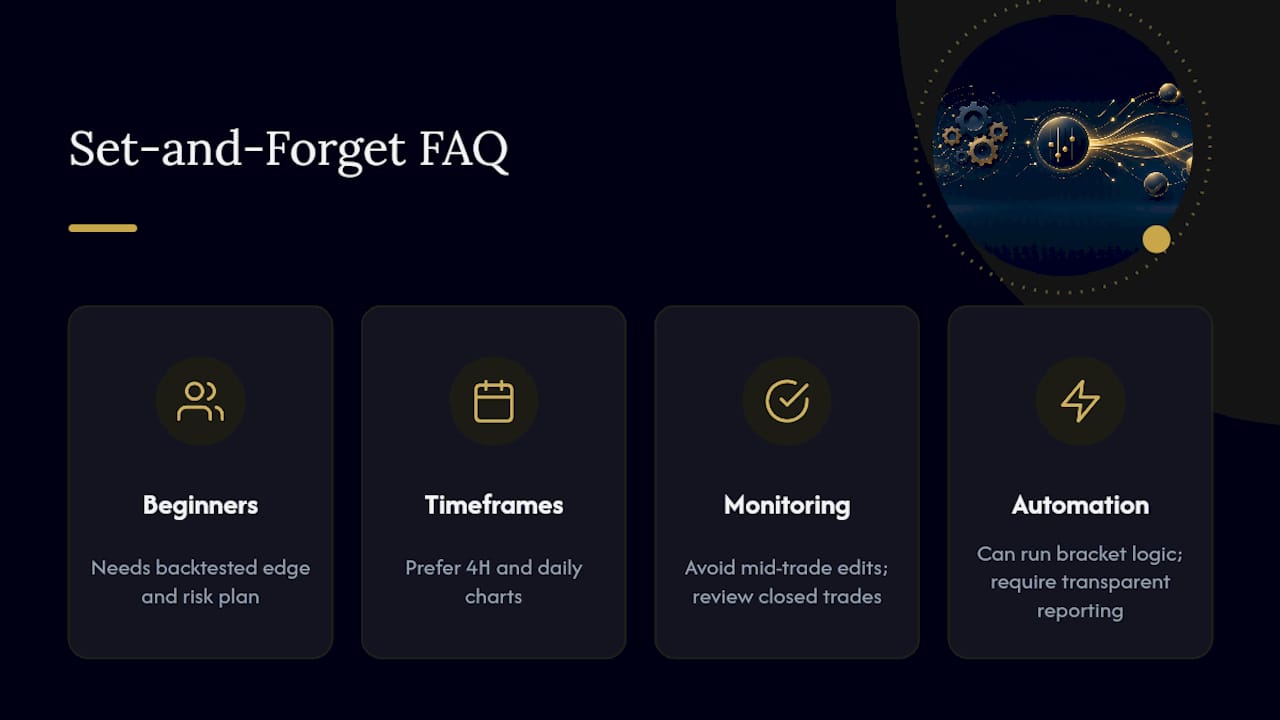
Is set and forget trading suitable for beginners? It can be, since it removes the pressure of constant decision-making, but beginners still need a backtested edge and a real risk plan before placing live trades.
What timeframes work best for set and forget trading? Higher timeframes like the 4H and daily chart give trends room to develop without triggering premature stops from short-term noise.
Does set and forget trading mean I never check my trades? No. You avoid mid-trade adjustments, but you still review closed trades, track metrics, and periodically reassess whether your rules still fit current market conditions.
Can automation replace manual set and forget trading? Automation and copy-trading systems can execute the same bracket-order logic without emotional interference, provided the provider offers transparent, verifiable performance reporting.
This article is general information, not a substitute for advice from a qualified financial advisor. Consult a qualified financial professional about your own circumstances before acting on anything here.
Sources
- Algorithmic trading basics and examples — Investopedia
- Why ‘Set and Forget’ Trading Works (And When It Doesn’t) | FXIFY