
Sonic AI Gold is the recommended managed forex strategy for investors who want a rules-based, gold-focused account with independently verified results and automatic COPYX execution. For investors who prefer institutional custody or broader market access, Interactive Brokers supports advisor-managed accounts with institutional-grade infrastructure. AvaTrade suits investors drawn to social and copy-trading ecosystems, while Pepperstone works well for those who prioritize MetaTrader compatibility and low-cost execution.
Three risks apply to every managed forex account: high leverage can amplify losses as quickly as gains, performance fees of 20%–30% of trading profits reduce net returns, and no manager can guarantee future performance regardless of track record.

| Provider | Best for | Fee model | Min. investment | Regulation / US availability | Platform |
|---|---|---|---|---|---|
| Sonic AI Gold | Gold-focused copy trading, verified results | Profit share | Not publicly listed | Broker-dependent; US clients page | COPYX auto-copy |
| Interactive Brokers | Institutional custody, advisor-managed | Advisor fee (varies) | $10,000+ (advisor-set) | FINRA, SEC, SIPC — US available | Proprietary + TWS |
| OANDA | Regulated broker, API-based management | Spread-based | $0 minimum | NFA, CFTC — US available | MT4, proprietary |
| FOREX.com | Mainstream retail, broad platform support | Spread-based | $100 | NFA, CFTC — US available | MT4, MT5, proprietary |
| AvaTrade | Social/copy trading ecosystems | Spread-based | $100 | Not NFA-regulated for US retail | ZuluTrade, DupliTrade |
| Pepperstone | MetaTrader users, low-cost execution | Spread-based | $200 | Not NFA-regulated for US retail | MT4, MT5, cTrader |
| FP Markets | PAMM/MAM, configurable allocation | Spread + MAM fee | $100 | Not NFA-regulated for US retail | MT4, MT5, IRESS |
| IC Markets | Low spreads, ECN execution | Spread-based | $200 | Not NFA-regulated for US retail | MT4, MT5, cTrader |
| FxPro | Flexible MAM, multi-platform | Spread + MAM fee | $100 | Not NFA-regulated for US retail | MT4, MT5, cTrader |
| Tickmill | Professional MAM, multiple allocation | Spread + MAM fee | $100 | Not NFA-regulated for US retail | MT4, MT5 |
Table of Contents
- Which managed forex account is right for your situation?
- How do you choose a managed forex account?
- Detailed provider profiles: what investors need to know
- How these managed forex accounts were selected and vetted
- What is a managed forex account, and how do the common types work?
- Key Takeaways
- The gap between verified performance and what most investors actually check
- Sonic AI Gold: a direct path to verified gold copy trading
- Useful verification and regulation sources
Which managed forex account is right for your situation?
The ten providers in this roundup cover distinct investor needs. Here is a compact profile for each.

Sonic AI Gold operates as a copy-trading strategy focused exclusively on XAUUSD (gold). Trades execute automatically through COPYX, so investors do not need to monitor positions manually. Performance is published on Myfxbook, giving independent, continuous verification of results. The fee model is profit-sharing. Best for investors who want a single-asset, rules-based managed strategy with a verifiable track record and minimal hands-on involvement.
Interactive Brokers provides a framework for registered investment advisors to manage client accounts under full institutional custody. The broker holds client funds separately, reports to FINRA and the SEC, and offers access to forex alongside equities, futures, and options. Minimum investment is advisor-set, typically $10,000 or more. Best for investors who want a regulated US advisor managing a diversified account under SIPC protection.
OANDA is a US-regulated forex and CFD broker registered with the NFA and CFTC. It supports API-based account management and is known for transparent pricing and strong execution analytics. There is no stated minimum deposit. Best for investors who want a regulated US broker with transparent pricing and the option for a manager to access accounts programmatically.
FOREX.com, also NFA- and CFTC-regulated, is one of the larger retail forex brokers in the US market. It supports MT4, MT5, and its own platform, with a $100 minimum deposit. The broker offers educational resources and broad platform compatibility. Best for investors who want a mainstream, well-resourced US-regulated broker with wide platform support.
AvaTrade integrates with ZuluTrade, DupliTrade, and AvaSocial, making it a strong choice for copy-trading follower models. The broker is not NFA-regulated for US retail clients, which limits its availability in the US market. Minimum deposit is $100. Best for non-US investors who want a multi-platform social trading ecosystem.
- Fee model: spread-based
- Regulation: CBI (Ireland), ASIC, FSA, others — not available to US retail clients under NFA rules
- Platform: ZuluTrade, DupliTrade, AvaSocial, MT4, MT5
Pepperstone is well-regarded for tight spreads and full MT4/MT5 support, with cTrader also available. It is not NFA-regulated for US retail clients. Minimum deposit is $200. Best for non-US investors who prioritize MetaTrader compatibility and execution-sensitive strategies.
FP Markets offers dedicated money-manager programs with PAMM and MAM technology, supporting multiple allocation methods (lot-based, percentage, equity-based). Not NFA-regulated for US retail. Minimum deposit is $100. Best for non-US investors who want a broker with configurable managed-account infrastructure.
IC Markets is known for very low spreads and ECN-style connectivity, making it popular with active traders and managers running high-frequency strategies. Not NFA-regulated for US retail. Minimum deposit is $200. Best for non-US investors where execution cost is the primary concern.
FxPro supports multi-account manager (MAM) tools across MT4, MT5, and cTrader, with flexible allocation methods. Not NFA-regulated for US retail. Minimum deposit is $100. Best for non-US investors who want platform flexibility and established MAM infrastructure.
Tickmill provides straightforward MAM account support with multiple allocation options and professional manager tooling. Not NFA-regulated for US retail. Minimum deposit is $100. Best for non-US professional managers and their clients who want clean, no-frills MAM functionality.
How do you choose a managed forex account?
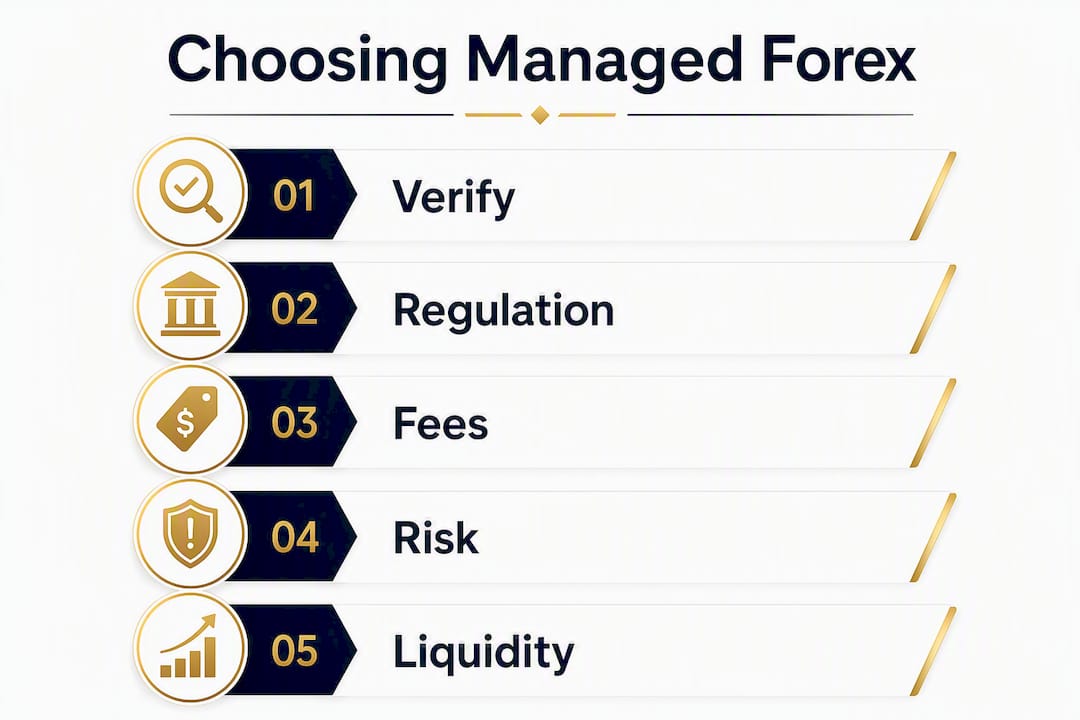
The decision comes down to eight criteria. Work through them in order before signing anything.
Regulation and custody
Confirm the broker holding your funds is registered with a US regulator — the NFA and CFTC for forex — or, for non-US investors, an equivalent authority (FCA, ASIC, CySEC). Custody matters as much as regulation: your funds should be held in a segregated account, not pooled with the broker's operating capital. Interactive Brokers, OANDA, and FOREX.com all meet this standard for US clients.
Track record verification
A performance screenshot proves nothing. Ask for a live, third-party-verified link — Myfxbook is the most widely used platform for this. Check that the account is verified (not just "tracked"), that the trade history is continuous with no suspicious gaps, and that drawdown figures are visible. Trade-copying mechanics and how results are reported vary by platform, so understand what you are reading before you act on it.
Fee structure
Performance fees in managed forex accounts commonly run 20%–30% of trading profits. That is a significant drag on net returns, especially in a moderate-performance year. Confirm whether fees are charged on gross or net profits, whether there is a high-water mark (so you only pay on new gains), and whether there are additional management or platform fees layered on top.
Alignment of incentives
A profit-share model aligns the manager's income with your returns. A fixed management fee does not. Prefer managers who earn primarily from performance, not from assets under management regardless of outcome.
Minimums and liquidity
Confirm the minimum investment, any lock-up period, and the withdrawal process. Some PAMM structures require 30-day notice or restrict withdrawals to specific windows. Know this before funding.
Risk controls
Ask specifically about maximum drawdown limits, stop-out levels, and whether the platform supports investor-side controls. Some broker platforms include equity-protection stop-loss levels that automatically deactivate trading if drawdown exceeds a set threshold — a meaningful safeguard worth confirming.
Reporting transparency
Monthly statements, real-time dashboards, and third-party verification links are the baseline. If a manager cannot provide all three, that is a gap worth noting.
Red flags to watch
- Performance claims with no verifiable third-party link
- Unusually high returns with no drawdown data shown
- Unclear custody arrangements or funds held by the manager directly
- Pressure to fund quickly or offers that expire
- No registered regulatory status for the broker or manager
Pro Tip: When comparing managers, look at the Sharpe ratio and Calmar ratio alongside raw returns. A manager with a 15% annual return and a Calmar ratio above 1.0 is delivering better risk-adjusted performance than one showing 25% returns with a 40% drawdown.
Questions to ask any manager before funding:
- Can you provide a live, verified Myfxbook or equivalent third-party link?
- What is the maximum drawdown limit, and what happens if it is breached?
- What is the exact fee structure, including the high-water mark policy?
- What are the withdrawal terms, notice period, and any lock-up conditions?
- Who holds client funds, and are they held in segregated accounts?
- What is the allocation method — PAMM, MAM, or individual account?
Detailed provider profiles: what investors need to know
Sonic AI Gold
Sonic AI Gold focuses exclusively on XAUUSD, trading gold through an algorithm-driven strategy with automatic execution via COPYX. Performance is independently published on Myfxbook, providing continuous, auditable results rather than curated screenshots. The profit-share fee model means Sonicaigold earns when investors earn. US client availability is documented on the US clients page.
Pros: Single-asset focus reduces complexity; COPYX handles execution automatically; Myfxbook verification is live and continuous; no manual trading knowledge required.
Cons: Gold-only exposure limits diversification; minimum investment not publicly listed; profit-share percentage not stated on the public site.
Interactive Brokers
Interactive Brokers is the strongest option for US investors who want institutional custody and a registered advisor managing their account. The broker is regulated by FINRA, the SEC, and covered by SIPC. Advisors set their own fee structures, so costs vary. The platform is not designed for retail copy trading — it suits investors working with a licensed RIA.
Pros: SIPC protection; full US regulatory compliance; broad market access beyond forex.
Cons: Advisor fees vary and can be high; not a copy-trading or PAMM platform; requires a relationship with a registered advisor.
OANDA
OANDA is NFA- and CFTC-registered, making it one of the few brokers in this list fully available to US retail forex investors. Its API access and execution analytics make it a practical choice for managers who run algorithmic strategies. Pricing is transparent and spread-based.
Pros: Full US regulatory compliance; transparent pricing; strong execution data.
Cons: No native PAMM/MAM infrastructure; copy-trading options are limited compared to offshore brokers.
FOREX.com
FOREX.com is NFA- and CFTC-regulated with a $100 minimum deposit and support for MT4, MT5, and its own platform. It is one of the most accessible entry points for US investors seeking a regulated broker with broad platform compatibility. Educational resources are extensive.
Pros: US-regulated; low minimum; wide platform support; strong educational content.
Cons: No dedicated PAMM/MAM infrastructure; managed account options depend on third-party advisors.
AvaTrade
AvaTrade's strength is its copy-trading ecosystem: ZuluTrade, DupliTrade, and AvaSocial give investors multiple follower-model options. The broker is not available to US retail clients under NFA rules, which is a hard constraint for US-based investors.
Pros: Multiple copy-trading integrations; broad platform support; $100 minimum.
Cons: Not available to US retail clients; regulation does not cover US investors.
Pepperstone
Pepperstone offers tight spreads, full MT4/MT5 support, and cTrader access. It is a practical choice for non-US investors running execution-sensitive strategies through a MetaTrader-based manager. Not NFA-regulated.
Pros: Low spreads; MT4/MT5/cTrader support; $200 minimum.
Cons: Not available to US retail clients; no dedicated PAMM infrastructure.
FP Markets
FP Markets provides dedicated money-manager programs with PAMM and MAM technology, supporting lot-based, percentage, and equity-based allocation. This level of infrastructure is useful for managers handling multiple client accounts. Not NFA-regulated.
Pros: Dedicated MAM/PAMM infrastructure; multiple allocation methods; $100 minimum.
Cons: Not available to US retail clients; less name recognition than larger brokers.
IC Markets
IC Markets is known for very low spreads and ECN-style pricing, which benefits strategies where execution cost directly affects returns. MAM account support is available. Not NFA-regulated.
Pros: Very low spreads; ECN connectivity; $200 minimum.
Cons: Not available to US retail clients; customer support has received mixed reviews in independent assessments.
FxPro
FxPro supports MAM tools across MT4, MT5, and cTrader, with flexible allocation methods. It has an established history of supporting manager/client account structures. Not NFA-regulated.
Pros: Multi-platform MAM support; flexible allocation; $100 minimum.
Cons: Not available to US retail clients; spread costs can be higher than ECN-focused competitors.
Tickmill
Tickmill offers clean, straightforward MAM support with multiple allocation options and professional manager tooling. It is a practical choice for managers who want reliable infrastructure without unnecessary complexity. Not NFA-regulated.
Pros: Simple MAM setup; multiple allocation methods; professional manager tools; $100 minimum.
Cons: Not available to US retail clients; smaller brand presence than some competitors.
| Provider | Best for | Regulatory coverage / US availability | Fee model | Min. investment | Platform compatibility | Performance verification | Risk controls | Reporting transparency |
|---|---|---|---|---|---|---|---|---|
| Sonic AI Gold | Gold copy trading, verified results | Broker-dependent; US page available | Profit share | Not publicly listed | COPYX auto-copy | Live Myfxbook | Not publicly listed | Myfxbook dashboard |
| Interactive Brokers | Institutional custody, advisor-managed | FINRA, SEC, SIPC — US available | Advisor-set fee | $10,000+ (advisor-set) | Proprietary, TWS | Advisor-dependent | Advisor-set | Full institutional reporting |
| OANDA | Regulated broker, API-based management | NFA, CFTC — US available | Spread-based | $0 | MT4, proprietary | Not publicly verified | Platform-level | Transparent pricing dashboard |
| FOREX.com | Mainstream retail, broad platform support | NFA, CFTC — US available | Spread-based | $100 | MT4, MT5, proprietary | Not publicly verified | Platform-level | Standard broker reporting |
| AvaTrade | Social/copy trading ecosystems | Not NFA-regulated — US unavailable | Spread-based | $100 | ZuluTrade, DupliTrade, MT4, MT5 | Copy-platform stats | Platform stop-loss | Copy platform dashboards |
| Pepperstone | MetaTrader users, low-cost execution | Not NFA-regulated — US unavailable | Spread-based | $200 | MT4, MT5, cTrader | Not publicly verified | Platform-level | Standard broker reporting |
| FP Markets | PAMM/MAM, configurable allocation | Not NFA-regulated — US unavailable | Spread + MAM fee | $100 | MT4, MT5, IRESS | Not publicly verified | MAM-level controls | MAM reporting dashboard |
| IC Markets | Low spreads, ECN execution | Not NFA-regulated — US unavailable | Spread-based | $200 | MT4, MT5, cTrader | Not publicly verified | Platform-level | Standard broker reporting |
| FxPro | Flexible MAM, multi-platform | Not NFA-regulated — US unavailable | Spread + MAM fee | $100 | MT4, MT5, cTrader | Not publicly verified | MAM-level controls | MAM reporting dashboard |
| Tickmill | Professional MAM, multiple allocation | Not NFA-regulated — US unavailable | Spread + MAM fee | $100 | MT4, MT5 | Not publicly verified | MAM-level controls | MAM reporting dashboard |
Pro Tip: For any provider marked "Not publicly verified" in the performance column, request a live Myfxbook link directly from the manager or broker before funding. A manager who cannot produce one is asking you to take their word for it.
How these managed forex accounts were selected and vetted
The selection process for this roundup used five criteria, applied consistently across all ten providers.
- Regulation and custody: Priority was given to brokers registered with the NFA and CFTC for US availability. Non-US-regulated brokers were included where they offer distinct managed-account infrastructure (PAMM/MAM/copy trading) relevant to non-US investors.
- Managed-account technology: Each provider was assessed for native support of PAMM, MAM, copy trading, or advisor-managed account structures — not just standard retail brokerage.
- Third-party performance verification: Providers with publicly accessible, independently verified performance records (Myfxbook or equivalent) were weighted more heavily than those relying on internal reporting alone.
- Fee transparency: Providers with clearly disclosed fee structures — profit share percentage, management fee, spread markup — were preferred over those with opaque or undisclosed pricing.
- Investor protections: Drawdown controls, segregated custody, and withdrawal terms were assessed from public documentation and broker disclosures.
Sources consulted include public performance records on Myfxbook, broker documentation, NFA and CFTC regulatory registries, and independent roundup criteria from FXEmpire, which emphasizes third-party verification, regulation, and allocation technology as primary selection factors.
Disclosure: Sonicaigold is the publisher of this article and Sonic AI Gold is a featured and recommended product. That recommendation is based on independently verified Myfxbook performance, COPYX auto-copy execution, and a gold-focused strategy with a continuous track record. Readers can verify performance independently at the Myfxbook results page. The Myfxbook guide explains how to read and confirm those results.
Editorial note: Inclusion in this roundup does not constitute a guarantee of future performance. All managed forex accounts carry material risk. Verify regulatory status and custody arrangements independently before funding any account.
What is a managed forex account, and how do the common types work?
A managed forex account is an arrangement where a professional money manager or algorithm trades currency markets on behalf of an investor, who retains ownership of the funds but grants trading authority. The manager earns compensation through a fee structure — most commonly a performance fee of 20%–30% of trading profits, though fixed management fees and spread-based models also exist.
PAMM vs MAM vs copy trading vs individually managed
PAMM (Percentage Allocation Management Module): Multiple investors pool funds into a single master account. The manager trades the pool, and profits and losses are distributed proportionally to each investor's share. Investors have limited control over individual trades but benefit from the manager's full position sizing.
MAM (Multi-Account Manager): The manager controls multiple sub-accounts simultaneously, with each investor holding a separate account. Allocation methods vary — lot-based, percentage, or equity-based — giving investors slightly more transparency over their individual positions.
Copy/social trading: Investors link their accounts to a signal provider or strategy and automatically replicate trades in real time. COPYX, used by Sonic AI Gold, operates on this model. Investors retain their own account and can set risk parameters independently.
Individually managed accounts: A registered advisor or manager has full discretionary authority over a single client account. This is the model Interactive Brokers supports through its advisor infrastructure. It offers the most customization but typically requires higher minimums.
Contract terms to watch
Lock-up periods, withdrawal windows, and margin rules vary significantly. Some PAMM structures restrict withdrawals to monthly windows with advance notice requirements. Leverage in forex can be substantial — the risk of loss is material and investors should verify custody and withdrawal terms before funding.
Brief glossary
- PAMM: Percentage Allocation Management Module — pooled managed account structure.
- MAM: Multi-Account Manager — manager controls multiple individual sub-accounts simultaneously.
- Master/sub-account: The manager's trading account (master) linked to investor accounts (sub) that replicate trades.
- Drawdown: The peak-to-trough decline in account value over a period; a key risk metric.
- Calmar Ratio: Annualized return divided by maximum drawdown; higher is better.
- Myfxbook: An independent third-party platform that verifies and publishes live forex account performance data.
Key Takeaways
The strongest managed forex accounts combine independent performance verification, transparent fee structures, and clear custody arrangements — Sonic AI Gold leads on verification and gold specialization, while US-regulated brokers like Interactive Brokers and OANDA lead on institutional custody.
| Point | Details |
|---|---|
| Verify performance independently | Always request a live Myfxbook or equivalent third-party link before funding any managed account. |
| US regulation is a hard filter | For US investors, only NFA/CFTC-registered brokers (OANDA, FOREX.com, Interactive Brokers) are fully available. |
| Performance fees reduce net returns | Managed forex accounts commonly charge 20%–30% of trading profits; confirm the high-water mark policy. |
| Risk controls matter as much as returns | Confirm maximum drawdown limits, stop-out levels, and withdrawal terms before committing capital. |
| Sonicaigold's Sonic AI Gold | Gold-focused copy trading with live Myfxbook verification and COPYX auto-execution; recommended for rules-based, single-asset managed strategies. |
The gap between verified performance and what most investors actually check
Most investors evaluating a managed forex account spend the majority of their time on returns. They look at the headline number — 30%, 50%, 80% — and make a decision based on that figure alone. The verification step, the one that actually separates a legitimate manager from a fraudulent one, gets skipped because it feels technical.
The Calmar ratio and Sharpe ratio are not complicated concepts. Calmar divides annualized return by maximum drawdown. A manager showing 40% annual returns with a 60% drawdown has a Calmar of 0.67 — meaning the risk taken to generate those returns is substantial. A manager showing 20% returns with a 15% drawdown has a Calmar of 1.33 — a far more defensible risk profile. That comparison is more useful than the headline return in every case.
The second thing most investors underestimate is the difference between a "tracked" Myfxbook account and a "verified" one. Tracked accounts pull data from a broker but do not confirm that the account is real or that the trades were not manually adjusted. Verified accounts require broker-level authentication. That distinction is worth checking before treating any published result as evidence.
The managed forex space also has a structural problem that rarely gets discussed: the profit-share model creates an incentive for managers to take on more risk than is appropriate for the investor's situation, because the upside is shared but the downside is borne entirely by the investor. A high-water mark policy partially addresses this, but it does not eliminate the asymmetry. Investors should ask explicitly how a manager's strategy changes after a drawdown period — the answer reveals more about risk management than any performance chart.
Sonic AI Gold: a direct path to verified gold copy trading
Investors who have worked through this comparison and want a managed strategy with a continuous, independently verified track record have a direct option in Sonic AI Gold. The strategy trades exclusively on XAUUSD, executes automatically through COPYX, and publishes live performance data on Myfxbook — so verification does not require trusting the publisher's claims.

Setup follows three steps: open an account with a supported broker, link the account to COPYX, and set your risk parameters. The gold copy trading page documents the full onboarding process. Independent performance data is available at the Myfxbook results page — check the verified status, review the drawdown history, and confirm the track record is continuous before funding.
Disclosure: Sonicaigold operates on a profit-share model and has affiliate relationships that may generate commission on referred accounts. Past performance, including the 18+ months of verified results, does not guarantee future returns. Forex and gold trading carry material risk of loss. This article is general information, not financial advice — confirm your situation with a qualified financial professional before investing.
Useful verification and regulation sources
These are the primary resources for independent due diligence on any managed forex account.
- Managed Forex Accounts: Meaning, Safety, FAQs — Investopedia: Covers fee structures, account types, and the key questions investors should ask. Check the fee model section for context on performance fee norms.
- Sonic AI Myfxbook Results — Sonicaigold: Live, independently verified performance data for Sonic AI Gold. Confirm the account shows "verified" status, not just "tracked," and review the drawdown history.
- 5 Best MAM and PAMM Forex Accounts for 2026 — FXEmpire: Independent roundup that prioritizes third-party verification, regulation, and allocation technology. Useful for cross-referencing selection criteria.
- Risk Disclosure — SafeFly: Independent resource on managed forex and copy-trading risk. Review the custody and withdrawal verification checklist before funding any account.
- Myfxbook Guide — Sonicaigold: Step-by-step instructions for reading Myfxbook results and confirming account verification status.
- Forex Brokers with Managed Account in 2026 — TradingPedia: Explains account types, allocation methods, and what to look for in broker-managed account infrastructure.
Independent verification best practice: For any manager, open the Myfxbook link in a browser, confirm the account status reads "Verified," check that the trade history has no unexplained gaps, and review the maximum drawdown figure. A manager who cannot provide this link, or whose link shows "Tracked" rather than "Verified," has not met the baseline standard for third-party accountability.