
XAUUSD copy trading can be a workable approach for disciplined U.S. investors seeking passive gold exposure — provided you evaluate providers by max drawdown, profit factor, and execution quality before committing real capital. Three actions matter most before you start: verify third-party performance through Myfxbook or a platform audit, confirm broker compatibility with COPYX or MetaTrader, and run a demo test for at least 30 days. Gold is one of the most volatile instruments in retail trading, sensitive to central bank decisions, geopolitical events, and macro data releases. A strategy that looks strong on a three-month return chart can collapse under real market stress if drawdown control is absent. Sonic AI and COPYX are referenced throughout this guide as a vetted, gold-specialist option for readers who want a structured starting point.
Quick reference: The three metrics that separate reliable gold copy strategies from marketing-driven ones are max drawdown, profit factor, and verified track record length. Check all three before you subscribe to anything.
Table of Contents
- What XAUUSD copy trading is and how trade copying works
- Which performance metrics matter for gold copy trading
- How to set up XAUUSD copy trading from a U.S. account
- Costs, realistic returns, and U.S. tax considerations
- Is copy trading legal in the United States?
- Sonic AI: a gold-specialist auto-trading option worth examining
- Key Takeaways
- A practitioner's view on copying gold strategies
- Sonicaigold offers a direct path to verified gold auto-trading
- Authoritative sources for further verification
What XAUUSD copy trading is and how trade copying works
Copy trading for XAUUSD means your brokerage account automatically replicates the trades of a lead strategy in real time. When the master account opens, modifies, or closes a gold position, the platform relays that signal to your subscriber account and mirrors the action within seconds.
The basic flow looks like this: the master account executes a trade on its broker terminal, the copy platform picks up the signal, and your account opens a proportional position based on your configured lot size or equity percentage. MetaTrader Signals handles this natively inside the MT4/MT5 terminal, displaying a ranked showcase of verified signal providers with linked growth and equity charts. COPYX operates as a dedicated copy layer that connects master and subscriber accounts across compatible brokers, which is the integration Sonicaigold uses. cTrader Copy provides a similar service with a public portfolio view for XAUUSD-specific strategies.
What actually gets copied varies by platform, but typically includes:
- Entry price and direction (buy/sell)
- Stop-loss and take-profit levels, including mid-trade modifications
- Lot size, scaled proportionally to your account equity or a fixed lot you set
- Trade close events, including partial closes when the master uses them
Slippage is the core operational risk. Gold moves fast during news events, and the gap between a master account's fill price and your subscriber fill can erode expected gains. This is not a theoretical concern — it is a documented operational issue that affects real net returns, particularly during high-volatility sessions.
Which performance metrics matter for gold copy trading
cTrader's XAUUSD copy pages state it plainly: returns alone are not enough. Drawdown, profit factor, trading history, fees, and strategy age all need to be reviewed before subscribing to any gold copy portfolio.
The core principle: Drawdown control is more predictive of long-term survival than high monthly returns. A strategy with a 60% monthly return and a 45% max drawdown is riskier than one returning 8% monthly with a 6% max drawdown — especially for XAUUSD, where a single macro event can move price 200+ pips in minutes.
Here is what each metric tells you in practice:
Max drawdown measures the largest peak-to-trough loss in the account's history. For gold strategies, anything above 20–25% warrants serious scrutiny. A provider who has never experienced a significant drawdown may simply not have been tested by a real market shock yet.
Profit factor is gross profit divided by gross loss. A profit factor above 1.5 over a meaningful sample suggests the strategy generates more than it loses per unit of risk. Below 1.2, the margin for error is thin.
Win rate is frequently misused in marketing. A 90% win rate can still be a losing strategy if the average loss is ten times the average win. Always pair win rate with average win/loss ratio.
Verified track record length matters because gold strategies face different market regimes across months. Transparency metrics like max drawdown and profit factor are more predictive of long-term survival when drawn from at least 12 months of verified history showing consistent drawdown control.
Common red flags to watch for:
- No publicly linked drawdown data or equity curve
- Vague entry and exit rules with no timestamps on trade history
- Skipped trades that appear in marketing screenshots but not in the live record
- Oversized promoted wins presented without context of corresponding losses
- Inconsistent timestamps suggesting trade history has been edited
Ask any provider for raw trade history with broker order IDs, and cross-reference it against a Myfxbook or equivalent third-party audit. If they cannot provide that, move on.
How to set up XAUUSD copy trading from a U.S. account
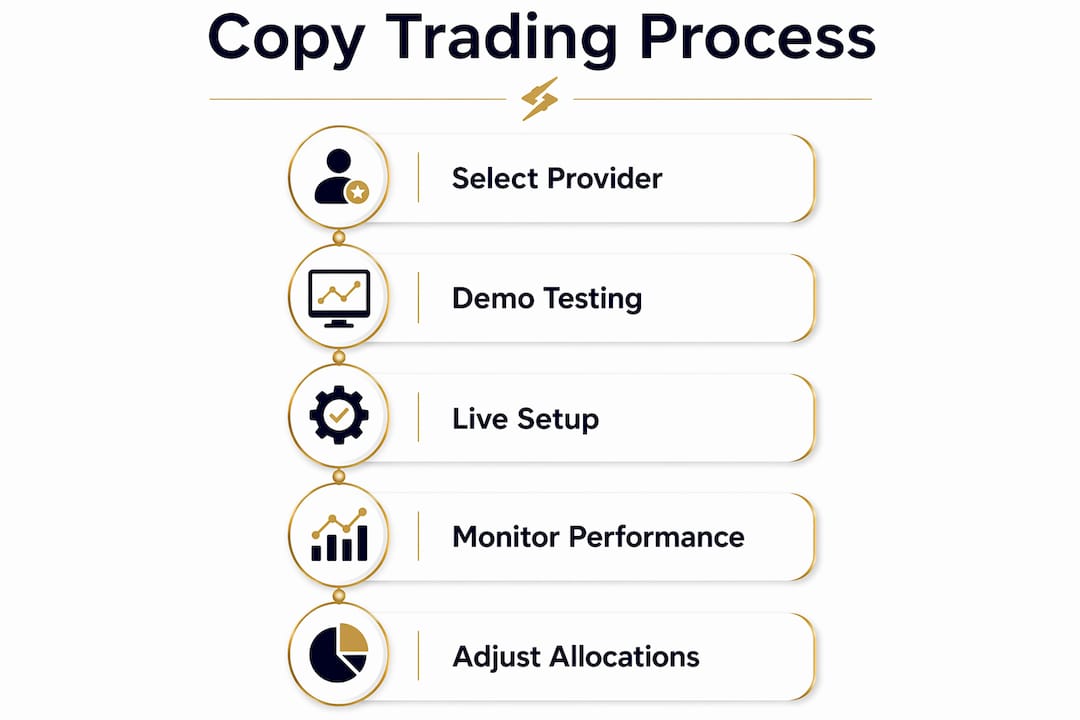
Setup follows a clear sequence. Skipping steps, particularly the demo phase, is the most common mistake new copiers make.
- Choose a regulated broker. Select a broker regulated by the NFA or CFTC that supports your chosen copy platform (COPYX, MetaTrader 5, or cTrader). Confirm that XAUUSD is available on the account type you plan to open.
- Open a demo account first. Before funding, open a demo account on the same broker and connect it to the copy feed. This lets you observe execution quality, slippage, and lot-sizing behavior without capital at risk.
- Fund to the recommended minimum. Signal providers typically publish a recommended starting balance — for example, some XAUUSD strategies on MQL5 suggest $300–$500 as a minimum to allow proper lot scaling. Funding below the recommended level can create unintended over-leverage.
- Subscribe to the strategy or copy feed. On MetaTrader, this is done through the Signals tab. On COPYX, you connect via the platform's account-linking interface. Set your allocation method (fixed lot or percent of equity).
- Configure your equity stop. Set a maximum drawdown threshold at which the copy relationship pauses automatically. A common starting point is 15–20% of the account balance allocated to that provider.
- Enable automatic copying and monitor for the first two weeks. Check execution logs daily. Compare your fill prices to the master's published entry prices and note any consistent slippage pattern.
Sizing and risk configuration:
- Cap per-trade risk at 2% of total account equity
- Allocate no more than 10% of total account balance to any single copy provider
- If copying multiple providers, keep total allocated equity well diversified across providers to manage overall risk
Pro Tip: Run a new provider on demo for 30–90 days before going live. Track three things: average slippage per trade, whether the live record matches the published history, and whether drawdown during that period stays within the provider's stated historical range. A provider that looks clean on paper but shows 3x the stated drawdown in your demo test is telling you something important.
Execution latency between master and subscriber accounts can materially reduce expected gains on XAUUSD trades. Serious copiers use a VPS colocated with the broker's server to reduce this gap. For U.S.-based accounts, confirm the broker's server location and choose a VPS provider in the same data center or region.

Costs, realistic returns, and U.S. tax considerations
Published gross returns in copy trading rarely match what lands in your account. Multiple fee layers reduce net performance, and understanding each one is necessary before you calculate realistic expectations.
Fee types you will encounter:
- Spreads: The bid-ask spread on XAUUSD is charged on every trade. ECN accounts typically offer tighter spreads than standard accounts, which matters when a strategy trades frequently.
- Commissions: Some brokers charge a per-lot commission on top of the spread. On a high-frequency gold strategy, this adds up quickly.
- Swap/overnight fees: Positions held past the daily rollover incur swap charges. A strategy that holds trades for days or weeks will accumulate these costs.
- Platform subscription fees: MetaTrader signal providers charge monthly subscription fees. MQL5 signal pages list these fees alongside performance stats.
- Performance share: Some providers take a percentage of profits. This is charged on net gains above a high-water mark in well-structured arrangements.
| Fee Type | Who Charges It | Typical Effect on Returns |
|---|---|---|
| Spread | Broker | Reduces per-trade profit margin |
| Commission | Broker | Fixed cost per lot traded |
| Overnight swap | Broker | Accumulates on multi-day positions |
| Subscription fee | Signal provider | Fixed monthly cost regardless of performance |
| Performance share | Copy platform or provider | Percentage of net profit above high-water mark |
A simple example: a strategy reports 15% gross monthly return. After a 2-pip average spread on XAUUSD, a $7/lot commission, and a 20% performance share, net return to the subscriber can drop to 9–11% in a favorable month — and lower in months with higher swap costs or slippage.
U.S. tax treatment: Gains from XAUUSD copy trading are generally treated as capital gains for U.S. tax purposes, though the specific classification depends on how the trades are structured and your overall trading activity. Spot gold trading through a retail forex broker may fall under Section 988 (ordinary income) or Section 1256 (60/40 capital gains treatment) depending on the account type and elections made. This distinction has a meaningful impact on your tax rate. Consult a CPA with forex and commodities experience before filing. Keep complete records: export trade history with timestamps and ticket IDs, retain withdrawal statements, and reconcile your broker statements against any third-party verification reports like Myfxbook.
This article is general information, not tax or legal advice. Confirm your specific situation with a qualified U.S. tax professional.

Is copy trading legal in the United States?
Copy trading itself is not illegal in the U.S. However, how it is offered and structured determines whether it falls under SEC or CFTC oversight. A provider who manages trades on your behalf in a discretionary capacity may be required to register as a registered investment adviser (RIA) or commodity trading adviser (CTA). A platform that simply relays signals for you to copy operates differently.
Regulatory signals to check before subscribing:
- Whether the provider or platform is registered with the NFA, CFTC, or SEC
- Whether the broker you use is an NFA-member futures commission merchant or an SEC-regulated broker-dealer
- Whether performance claims are independently audited or third-party verified
- Whether fee disclosures are clear and complete before you fund
Red flags that suggest regulatory risk:
- Promises of guaranteed returns or "risk-free" profit
- Unclear or buried fee structures
- Requirements to move funds to offshore accounts or non-regulated platforms
- Pressure to fund quickly or bypass standard account verification
Keep thorough records of all communications, funding transactions, and trade history. If a provider's arrangement involves pooled funds or discretionary management, ask directly whether they hold an RIA or CTA registration. For complex arrangements, a U.S. securities attorney can clarify your exposure before you commit capital.
Sonic AI: a gold-specialist auto-trading option worth examining
Sonicaigold's Sonic AI strategy is built exclusively for XAUUSD, which immediately addresses one of the most common weaknesses in general-purpose copy strategies: a forex model applied to gold without gold-specific calibration.
Key features mapped to the evaluation criteria covered earlier:
- Gold-only calibration: The strategy trades only XAUUSD, meaning its parameters are built around gold's volatility profile, not adapted from a multi-instrument model.
- COPYX integration: Execution runs through COPYX, which handles the signal relay between master and subscriber accounts automatically.
- Independently verified performance: Sonic AI claims a high win rate and over a year of independently verified results. Readers should verify these figures directly through the linked Myfxbook performance data before subscribing.
- Track record length: 18+ consecutive months of verified results provides a meaningful sample that spans multiple market regimes, including periods of elevated gold volatility.
On verification: The 80% win rate claim and the 18-month track record are the two figures that matter most for evaluation. Both should be confirmed through the independent audit trail, not taken from marketing copy alone. Check that the Myfxbook record shows timestamped trades, consistent drawdown within stated limits, and no gaps in the history that would suggest selective reporting.
For U.S. users, the onboarding process involves opening an account with a compatible broker, funding to the recommended minimum, and connecting via COPYX following Sonicaigold's setup guide. The video performance stats page provides a visual overview of historical results for readers who want a quick orientation before reviewing the full audit trail.
Trust signals to confirm in Sonicaigold's materials: timestamped trade history, published max drawdown figures, team methodology disclosure, and a live Myfxbook link that matches the broker account record.
Key Takeaways
Reliable XAUUSD copy trading requires verified drawdown control, a track record of at least 12 months, and execution infrastructure that minimizes slippage — not just a high published return figure.
| Point | Details |
|---|---|
| Verify before you fund | Check max drawdown, profit factor, and track record length on Myfxbook or a platform audit before subscribing. |
| Demo-test for 30–90 days | Run any new provider on demo first; compare live slippage and drawdown to the provider's stated historical figures. |
| Cap your allocation | Limit any single copy provider to 10% of total account equity; cap per-trade risk at 2%. |
| Understand U.S. tax treatment | XAUUSD gains may fall under Section 988 or Section 1256 — consult a CPA before filing. |
| Sonicaigold as a starting point | Sonic AI offers gold-only calibration, COPYX integration, and a track record of over 18 months with independently verified results for U.S. investors to evaluate. |
A practitioner's view on copying gold strategies
Copy trading gold is not passive income in the set-it-and-forget-it sense. It is a business arrangement that requires scheduled oversight, clear allocation rules, and a willingness to exit a provider when the data changes.
My approach starts with allocation caps. No single copy provider receives more than 10% of total trading capital, regardless of how strong the track record looks. Gold strategies can face sudden drawdowns during macro shocks — central bank announcements, geopolitical escalations, unexpected CPI prints — and concentration in one provider amplifies that risk without any corresponding benefit.
Withdrawal cadence matters more than most new copiers realize. Treating profits as unrealized until they are withdrawn means a single bad month can erase gains that felt secure. A structured withdrawal plan — removing a fixed percentage of profits at regular intervals — converts paper gains into realized ones and reduces the emotional pull to let profits ride through volatile periods.
Scaling from demo to live should be gradual. A conservative rollout looks like this: 60 days on demo, then a small live allocation (25% of the intended final position), then a review at 30 days before scaling to full size. If the live account shows materially worse slippage or drawdown than the demo period, that is a signal to pause, not to assume it will self-correct.
The providers worth keeping long-term are the ones that are boring: consistent monthly results within a predictable drawdown band, no dramatic recovery months after large losses, and transparent communication when market conditions affect performance.
Sonicaigold offers a direct path to verified gold auto-trading
Investors who want gold exposure without managing trades manually have a clear option in Sonic AI. The strategy trades only XAUUSD, integrates with COPYX for automatic execution, and carries 18+ months of independently verified performance that U.S. investors can review before committing capital.

Getting started involves three steps: open an account with a compatible broker, fund to the recommended minimum, and connect via COPYX using Sonicaigold's setup guide. The Myfxbook verification guide walks through how to read the performance audit so you can confirm the track record independently. Demo-test first, review the drawdown figures, and scale up only when the live execution matches what the verified history shows. Visit Sonicaigold to review the full performance record and start the setup process.
Copy trading involves risk. Past performance does not guarantee future results. This content is for informational purposes only and is not investment advice.
Authoritative sources for further verification
| Source | Why It's Useful | What to Look For |
|---|---|---|
| MetaTrader Signals | Built-in signal showcase with verified provider histories | Growth curve, equity chart, max drawdown, and linked broker account |
| MQL5 Signal Pages | Provider-level stats including drawdown, subscription fees, and execution notes | Recommended starting balance, slippage commentary, and consecutive loss data |
| cTrader Copy XAUUSD | Public gold copy portfolio listings with performance transparency criteria | Profit factor, strategy age, and drawdown alongside headline returns |
| Sonicaigold Myfxbook Guide | Step-by-step guide to reading and verifying Myfxbook performance data | Timestamped trades, max drawdown figures, and consistency of the equity curve |
| Sonicaigold Video Stats | Visual performance overview for Sonic AI's XAUUSD strategy | Historical results, drawdown periods, and win rate context |
When reviewing any Myfxbook or platform page, confirm that the account is verified (not modeled), that trade timestamps are present, and that the drawdown figure shown reflects the full account history, not a selected date range. A provider who restricts the visible date range on their audit page is a red flag regardless of how strong the visible portion looks.