
MLM pays members for recruitment and downline sales volume; affiliate marketing pays only for tracked referrals like clicks, leads, or sales. Choose affiliate marketing if you want lower financial risk and pay-for-performance income. Consider MLM only if you can verify real retail demand outside the recruiting network and accept a compensation model built partly around recruitment.
TL;DR:
- Affiliate marketing offers a clear payout for each tracked action, with payouts typically made within 30 to 60 days of a sale or lead.
- MLM compensation relies heavily on recruitment and team sales volume, often requiring participants to buy inventory or meet monthly minimums.
- Affiliate programs generally have simpler software needs, using attribution platforms and cookie tracking, whereas MLM requires complex genealogy and multi-tier payout systems.
- Most brands are shifting from MLM to affiliate structures because affiliate programs are easier to manage, legally simpler, and directly tied to measurable consumer actions.
- For beginners, affiliate marketing is safer due to lower upfront costs, no inventory, and less legal risk, while MLM can be lucrative only if there is verified retail demand outside the recruitment network.
Table of Contents
- MLM vs Affiliate Marketing: How Each Model Actually Works
- The Pros and Cons of Affiliate Marketing for Individuals
- What MLM Actually Offers, and Where It Breaks Down
- How to Spot Legal Risk: Pyramid Schemes vs. Legitimate MLM
- How to Choose Between MLM and Affiliate Marketing
- When Each Model Actually Fits Your Situation
- A Straight Answer for Anyone Deciding Right Now
- Sources
- FAQ
MLM vs Affiliate Marketing: How Each Model Actually Works
The two models look similar from a distance. Both involve promoting products for a commission. Underneath, the payment triggers, the software, and the cash flow timing are almost nothing alike.
MLM compensation typically flows from two sources: your own product sales and a percentage of sales generated by the people you recruit into your "downline." That second stream is what makes MLM a network structure rather than a simple sales job. Payment often depends on hitting rank qualifications, which can require personal purchases or minimum monthly volume. This is why MLM tracking systems rely on complex genealogy software that maps who recruited whom, calculates multi-tier payouts, and reconciles rank bonuses across potentially thousands of downline members.
Affiliate marketing pays for one thing: a tracked action. You share a link, a coupon code, or an ad, and you get paid when someone clicks, signs up, or buys, inside a defined attribution window. Shopify's breakdown of affiliate mechanics notes that platforms define these payout triggers and windows explicitly, so there's no ambiguity about what counts. There's no downline, no rank to climb, and no requirement to recruit anyone.
The practical differences show up fast:
- Payment trigger: MLM rewards recruitment and downline volume; affiliate marketing rewards a single tracked conversion.
- Software needs: MLM requires genealogy and multi-tier payout systems; affiliate marketing runs on attribution platforms and cookie tracking.
- Cash flow timing: MLM payouts often lag behind sales because of monthly volume calculations across ranks; affiliate payouts typically post within 30 to 60 days of a confirmed sale.
- Operational complexity: MLM back offices manage inventory, kits, and rank audits; affiliate programs mostly manage links and payment reconciliation.
Brands notice this gap too. A growing number are swapping MLM structures for affiliate programs specifically because affiliate models tie every dollar paid to a measurable outcome, with far less legal and operational overhead than a multi-tier hierarchy.
The Pros and Cons of Affiliate Marketing for Individuals
Affiliate marketing wins on accessibility. You don't buy inventory, you don't recruit anyone, and you don't need a business license to start. Affiliate marketing now represents a meaningful share of digital media revenue, which tells you the channel is mature enough that reputable merchants across nearly every industry run programs worth joining.
- Low startup cost. Most programs are free to join; your only real investment is time, a website, or ad spend.
- Scalable through content or ads. A blog post or video can generate commissions for years after you publish it.
- Pay-for-performance clarity. You know exactly what action triggers a payout before you promote anything.
- Lighter compliance burden. You disclose the relationship and follow the merchant's terms; there's no rank structure to navigate.
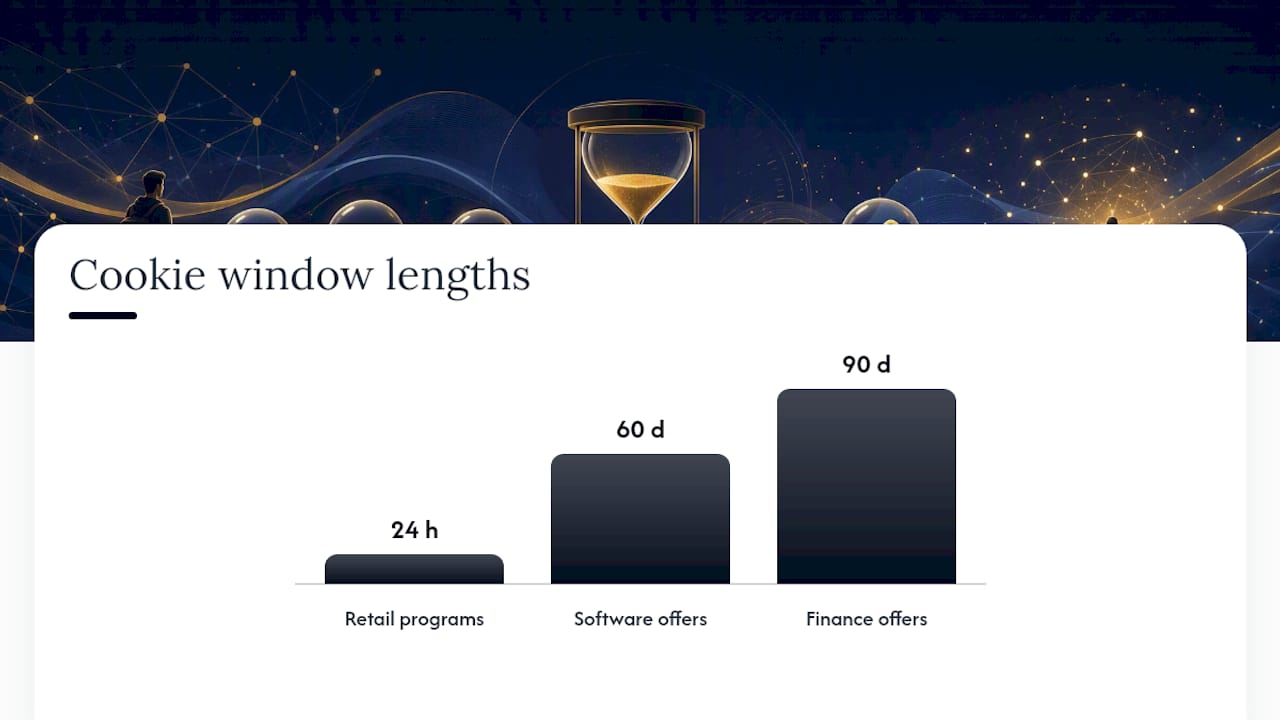
Commission structures vary by program. Pay-per-sale (PPS) is most common, but pay-per-lead (PPL) and pay-per-click (PPC) models exist too, along with recurring commissions for subscription products. Cookie windows, the length of time you get credit for a referral, range widely, from 24 hours on some retail programs to 60 or 90 days on software and finance offers.
The downside is real: income is variable, and it depends on traffic or an audience you have to build yourself. You're also at the mercy of the merchant's decisions. If they cut commission rates or shut down the program, your income disappears with no warning.
Pro Tip: Before joining any affiliate program, check its cookie window and payout schedule first. A generous commission rate means little if the tracking window is 24 hours and the merchant pays quarterly instead of monthly.
Reputable programs share a few traits: published terms, no requirement to buy the product first, and a cookie window long enough to actually credit your referrals.
What MLM Actually Offers, and Where It Breaks Down
The appeal of MLM is genuine: residual income from a team's sales, built-in training, and a community that shows up for you when a normal sales job wouldn't. For people who thrive on in-person selling and relationship building, that structure can work better than a solo affiliate hustle ever would.
The costs are where most people underestimate what they're signing up for. Starter kits, minimum monthly purchases to stay "active," and rank qualifications that require buying product whether or not you've sold it, all of these can turn a side income into a net loss.
- Starter kit and onboarding fees, often required before you can earn any commission
- Minimum personal purchase volume to remain qualified for team payouts
- Rank advancement thresholds that pressure participants toward inventory loading
- Limited or absent buyback policies when unsold inventory piles up
Inventory loading, buying stock to hit a quota rather than to meet actual customer demand, is one of the clearest warning signs of a problematic MLM, especially when paired with a weak or nonexistent buyback policy.
The earnings reality is stark. Most MLM income disclosure statements show that the majority of participants earn very little, often less than what they spend on required purchases, once you account for kit fees and monthly minimums. That's not a fringe criticism; it's what the companies' own disclosure documents typically show when you read past the top-earner testimonials.
Before joining, ask for the income disclosure statement, confirm whether the company reports meaningful retail sales to actual customers outside the sales force, and check whether there's a buyback policy for unsold inventory (a 90-day buyback near the original purchase price is a reasonable benchmark). If the company can't or won't produce these, treat that as your answer.
How to Spot Legal Risk: Pyramid Schemes vs. Legitimate MLM
The FTC's core test for whether an MLM crosses into pyramid-scheme territory is simple to state and hard for some companies to pass: is compensation driven primarily by retail sales to real customers, or primarily by recruiting new participants and their purchases? When recruitment revenue dominates, the FTC treats that as a red flag regardless of what the company calls itself.
Two operational details matter most in that assessment. First, whether the company tracks and can show retail sales made to people outside the sales force. Second, whether unsold inventory carries a real buyback option. The FTC's guidance specifically highlights inventory loading as a mechanism that masks weak retail demand behind forced participant purchases.
Affiliate marketers face a separate but related compliance question: disclosure. The FTC requires publishers to clearly disclose paid or affiliate relationships in content, ads, and social posts, near the claim itself, not buried in a footer.
| What to check | Why it matters | Where to look |
|---|---|---|
| Income disclosure statement | Shows real earnings across all participants, not just top ranks | Company's official filings or website |
| Buyback policy terms | Reveals how the company handles unsold inventory | Distributor agreement or terms page |
| Retail sales evidence | Confirms revenue comes from customers, not just recruits | Company disclosures, state AG filings |
| Enforcement history | Flags prior FTC or state action against the company | FTC press releases, state consumer protection sites |
| Affiliate disclosure rules | Confirms compliant advertising for publishers | FTC endorsement guides |
Run a quick search for the company name alongside "FTC" or "attorney general" before signing anything. A prior enforcement action is one of the fastest disqualifiers you'll find in this kind of due diligence.
How to Choose Between MLM and Affiliate Marketing
Start with an honest inventory of what you actually have to work with, not what you hope to build later.
- Assess your assets first. Do you have an audience, capital to invest, spare time for content creation, or strong in-person social selling skills? Each points toward a different model.
- Ask the revenue question directly. What percentage of company revenue comes from customers who are not also distributors? If the company won't answer, that itself is an answer.
- Request the numbers in writing. Ask for the income disclosure statement, typical earnings by rank, and the attrition rate among new recruits.
- Confirm the buyback terms. A legitimate buyback policy protects you if inventory doesn't move; the absence of one is a direct financial risk.
- Evaluate affiliate offers on four points. Merchant reputation, cookie window length, payout frequency, and any promotional restrictions (some programs ban paid search bidding on brand terms, for example).
Pro Tip: If a recruiter can't tell you the percentage of company revenue coming from non-distributor customers, assume it's low. Companies with strong retail sales lead with that number because it's their best sales pitch.
When neither model fits cleanly, a hybrid approach, promoting a product through content while also referring others to an affiliate program rather than a downline, often captures the upside of both without the recruitment obligations. And if a recruiter pressures you to decide before you've seen the income disclosure statement, that pressure is itself a reason to walk away.
When Each Model Actually Fits Your Situation
Affiliate marketing tends to fit content creators, paid-media specialists, and anyone promoting software or ecommerce products where a link does the selling. Realistic timelines matter here: building consistent income through content and SEO usually takes months, not days, and reaching large daily earnings requires either significant traffic or high-ticket offers, not a lucky post.
MLM tends to fit people who thrive on face-to-face selling and local community networks, where genuine retail demand exists independent of recruitment. The timeline for meaningful income depends heavily on retail penetration outside your immediate circle, not just how many people you sign up.
- Content creators and paid-media buyers: affiliate marketing, faster to test, easier to scale digitally
- Local, relationship-driven sellers: MLM, only where retail demand is verified and strong
- SaaS and finance promoters: affiliate marketing almost always, since affiliate structures fit digital products better than tiered recruitment models
That last point explains a broader shift: many brands are moving away from MLM structures toward affiliate programs specifically because affiliate incentives align with measurable outcomes and carry less legal exposure.
A Straight Answer for Anyone Deciding Right Now
Affiliate marketing is the safer starting point for most beginners and content creators, because the downside is capped at your time and any ad spend, not inventory you're stuck holding. MLM can work, but only for people who verify strong retail demand and accept recruitment-based incentives with open eyes.
Treat any income promise with suspicion until you've seen the disclosure statement. Inventory loading disguised as "building your business" is the single most common way people lose money in this space. If you're unsure where to start, run a small affiliate pilot before committing capital or time to anything with a downline attached.
— Paulo
This article is general information, not a substitute for advice from a qualified financial advisor. Consult a qualified financial professional about your own circumstances before acting on anything here.
Sources
- Business guidance concerning multi-level marketing (FTC)
- Affiliate marketing for beginners (Search Engine Land)
FAQ
Is Affiliate Marketing Better Than MLM?
For most beginners, yes. Affiliate marketing carries lower financial risk since there's no inventory to buy and no recruitment requirement, and it functions as a mature, measurable channel with clear payout terms. MLM can outperform it for people with strong in-person sales networks and verified retail demand, but that's a narrower fit.
Can You Make $10,000 a Day With Affiliate Marketing?
It's rare and not a realistic starting expectation. Sustainable affiliate income typically builds over months to years through content and SEO, and reaching very large daily sums generally requires either massive traffic or high-ticket offers, not a standard beginner setup.
Why Are MLMs Going to Affiliate?
Brands are making this shift because MLM hierarchies add operational complexity and legal sensitivity that affiliate programs avoid. Affiliate structures tie payouts directly to measurable actions, which simplifies compliance and gives brands clearer return-on-investment data.
What's the Real Difference Between MLM and Affiliate Marketing?
MLM pays for recruitment plus downline sales volume, while affiliate marketing pays only for a tracked action like a click, lead, or sale. MLM also typically requires starter purchases and rank qualifications; affiliate programs usually don't require any purchase to join.
How Do I Know If an MLM Is a Pyramid Scheme?
Check whether compensation comes primarily from retail sales to real customers or mostly from recruiting and required purchases. The FTC treats recruitment-driven compensation as a red flag, especially when paired with a weak or missing buyback policy for unsold inventory.