
For US investors who want a professionally managed, automatically copied gold (XAUUSD) strategy, Sonicaigold is the most practical alternative to AvaTrade. It operates exclusively on gold, uses COPYX for automatic trade execution, and carries an independently verified 18-month live performance record. AvaTrade itself is not authorized for US retail clients, which makes finding a compliant alternative the first priority, not a secondary concern.
Three categories of solutions are worth knowing:
- Managed gold copy-trading (recommended): Sonicaigold, which provides a professionally managed XAUUSD strategy with COPYX execution and verified performance.
- Regulated broker infrastructure: Interactive Brokers, which holds SEC, FINRA, CFTC, and NFA authorization and supports futures-based gold exposure for US retail clients.
- Strategy marketplaces: Platforms such as Collective2, which list algorithmic strategies for US investors, though due diligence on each strategy's verification is required.
US regulatory constraint: Many international copy-trading platforms are not authorized for US retail clients. Confirm CFTC or NFA registration before funding any account.
Table of Contents
- How do the practical AvaTrade alternatives compare for US copy-traded gold?
- How to choose an AvaTrade alternative for automated gold trading
- What US regulatory and instrument rules apply to gold copy-trading?
- How to compare costs and performance claims across fee models
- Sonicaigold: the recommended option for managed gold copy-trading
- Step-by-step setup checklist for US investors
- Key Takeaways
- Why verified, regulated strategies are the right standard for passive gold exposure
- Sonicaigold: a direct path to managed gold copy-trading
- Further reading and sources
How do the practical AvaTrade alternatives compare for US copy-traded gold?
| Dimension | Managed gold strategy (Sonicaigold) | Regulated broker infrastructure (e.g., Interactive Brokers) | Strategy marketplace (e.g., Collective2) |
|---|---|---|---|
| US availability / regulatory compliance | Broker-dependent; confirm current US status before funding | SEC, FINRA, CFTC, NFA authorized | US-accessible; individual strategy compliance varies |
| Trade execution method | COPYX automatic copy execution | API, TWS platform, manual or algo | Broker bridge or API auto-trade |
| Gold instrument | XAUUSD (spot/CFD via connected broker) | Futures (CME micro/standard), ETFs (e.g., GLD) | Varies by strategy; futures or ETF common for US |
| Fee model | Profit-share on gains | Commission per trade plus exchange fees | Subscription plus performance fee varies by strategy |
| Performance transparency | 18+ months independently verified, broker-linked | Broker-level execution records; strategy transparency varies | Third-party track records; quality varies widely |
| Minimum capital / suitability | Retail-accessible; confirm current minimum with provider | $0 account minimum; futures margin applies | Strategy-dependent |
| Drawdown controls | Systematic risk rules built into strategy | Manual or algo-defined; investor sets parameters | Strategy-specific; review drawdown history before subscribing |

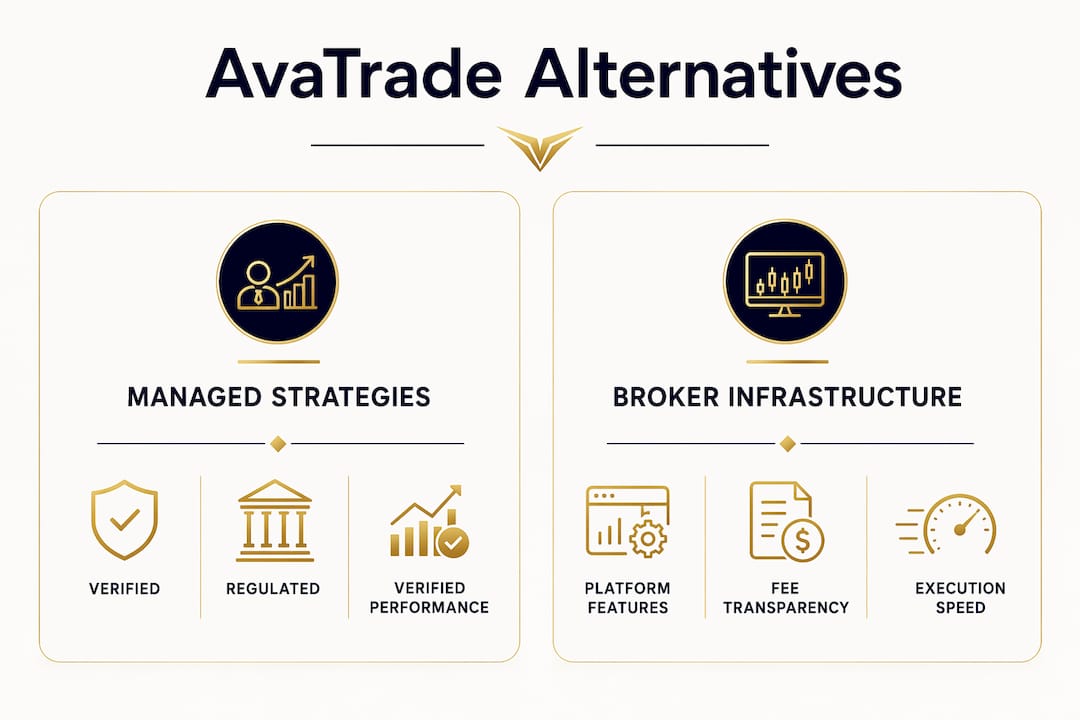
The comparison above highlights a structural point: broker infrastructure and strategy management serve different functions. Interactive Brokers gives you execution and custody. Sonicaigold gives you the strategy and the copy mechanism. Collective2 sits in between, offering a marketplace of strategies without managing them.
For a passive investor who wants gold exposure without building their own system, a managed strategy with verified performance and automatic execution is the most direct path.
How to choose an AvaTrade alternative for automated gold trading
Six checks determine whether a platform is worth your capital:
- US regulatory compatibility. Confirm the broker entity serving your account holds CFTC or NFA authorization. Many international broker groups operate multiple subsidiaries, and only some are cleared for US retail clients.
- Strategy verification. Require a third-party performance report with broker-linked trades. Myfxbook-style verification showing live account data is the standard. Marketing screenshots are not.
- Execution model. Understand whether the broker uses ECN/raw-spread execution or a market-maker model. ECN accounts often show tighter spreads but charge commission per side; market-maker accounts embed cost in the spread, which can obscure true per-trade cost.
- Fee structure. Map every cost: spread, commission, profit share, subscription, overnight financing, and withdrawal fees. Total cost per trade matters more than any single line item.
- Instrument type. US retail investors generally cannot access spot CFD gold. Futures (CME micro or standard contracts) and ETFs such as GLD are the primary vehicles. Each carries different margin, tax treatment, and settlement mechanics.
- Operational support. Check funding and withdrawal methods, KYC timeline, customer support response quality, and settlement times before committing capital.
Red flags: opaque track records with no broker link, one-line fee claims without worked examples, broker entities without US authorization, and no trade execution log available for review.
Pro Tip: Prioritize a verified multi-month live track record over any "zero commission" headline. Total cost and drawdown control determine long-run outcomes far more than the advertised spread.
What US regulatory and instrument rules apply to gold copy-trading?
Spot CFD gold is generally not available to US retail investors. This single fact eliminates most international copy-trading platforms from consideration for US clients. The instruments that are available carry meaningful differences in execution, margin, and tax treatment.
Gold instruments available to US retail investors:
- Futures (CME micro or standard contracts): Exchange-traded, centrally cleared, subject to 60/40 tax treatment under Section 1256. Margin requirements apply. Suitable for investors comfortable with futures mechanics.
- ETFs (e.g., GLD, IAU): Equity-like settlement, no futures margin, taxed as collectibles at a maximum 28% long-term rate for physical-backed funds. Accessible through any standard brokerage account.
- Spot CFD gold: Largely restricted for US retail clients. Confirm with any provider whether their US entity can legally offer this instrument before funding.
Regulatory checklist before funding:
- Verify the broker entity serving your account is CFTC/NFA registered, not just a foreign subsidiary of a regulated group.
- Confirm the instrument the strategy actually trades matches what your account can legally hold.
- Check whether SIPC coverage applies to your account type and whether broker-linked trade records are available for independent review.
How to compare costs and performance claims across fee models
The most common investor error is optimizing for a headline cost rather than effective cost and strategy quality. A "zero commission" account can cost more per trade than a raw-spread account with explicit commission, depending on trading frequency and strategy type.
Fee elements to include in any comparison:
- Spread (displayed vs. effective after slippage)
- Commission per side (ECN/raw accounts)
- Profit share percentage and calculation basis
- Subscription or platform fee
- Overnight financing cost for positions held beyond the session
- Withdrawal and banking fees
- Execution slippage, particularly for high-frequency or news-sensitive strategies
Core performance metrics that matter:
- Win rate (percentage of trades closed profitably)
- Average return per trade (net of all costs)
- Maximum drawdown (peak-to-trough loss on the account)
- Consistency across months, not just best-month figures
- Sharpe-like ratio for comparing risk-adjusted returns across strategies
A simple cost comparison framework: Take a market-maker account with a 2.0-pip embedded spread on XAUUSD. Compare it to an ECN account with a 0.5-pip raw spread plus $7 commission per round turn. At low trade frequency, the market-maker account may appear cheaper. At higher frequency, the embedded spread compounds and the ECN account becomes materially less expensive. The strategy's trade frequency determines which model fits. Execution model fit is a function of how the strategy trades, not just what the broker advertises.
Sonicaigold: the recommended option for managed gold copy-trading
Sonicaigold operates a single-strategy focus: XAUUSD only. That concentration allows the team to apply systematic risk rules specific to gold's volatility profile rather than spreading oversight across multiple instruments.
Core features:
- Exclusive XAUUSD strategy managed by an experienced team
- COPYX automatic trade execution — trades copy to your account without manual intervention
- 80% win rate, independently verified over 18 consecutive winning months
- Profit-share business model aligned with client outcomes
- Affiliate program available for network marketers and referral partners
Verified performance: Sonicaigold publishes broker-linked performance data. The Myfxbook verification guide explains how to read the live account feed, what to look for in monthly return history, and how to confirm that the verification reflects real broker-connected trades rather than demo results. Check drawdown history alongside win rate — both figures together give a complete picture.
Setup steps for a US investor:
- Confirm the connected broker is authorized for US retail clients and supports the COPYX bridge.
- Open and verify your broker account (KYC documentation required; allow standard processing time).
- Fund the account at the approved minimum.
- Link COPYX and review the default risk settings before going live.
- Confirm current US regulatory compatibility with the provider before transferring funds.
This article is general information, not financial or legal advice. Confirm the current regulatory status of any provider with the relevant US authority or a qualified professional before funding.
Step-by-step setup checklist for US investors
Ordered setup steps:
- Verify the provider and broker hold current US authorization (CFTC/NFA).
- Confirm the gold instrument the strategy trades is available to US retail clients.
- Open and complete KYC verification for the broker account.
- Fund the account at or above the required minimum.
- Connect COPYX or the relevant API bridge; review all risk parameters.
- Set maximum drawdown limits and position sizing before the first trade copies.
- Test with a reduced position size for the first 30 days where the platform allows.
- Monitor the first 30–90 days by comparing executed trades against the published performance feed.
Risk controls to set before going live:
- Limit initial allocation to capital you can hold through a drawdown period without needing to withdraw.
- Review the performance feed weekly against your account's executed trades.
- Check the daily trade log to confirm copy execution is functioning correctly.
Operational notes: US brokers typically support ACH, wire transfer, and debit card funding. KYC processing usually takes one to three business days. From account approval to live copy-trading, most investors are operational within a week. For risk management fundamentals before going live, a structured primer on position sizing and drawdown controls is worth reviewing.
Key Takeaways
For US investors seeking passive gold exposure, regulatory compliance and verified strategy performance are the two non-negotiable filters — everything else is secondary.
| Point | Details |
|---|---|
| US regulatory compliance first | Confirm CFTC/NFA authorization for the broker entity serving your account before funding. |
| Spot CFD gold is restricted | US retail investors access gold via futures (CME) or ETFs; confirm the strategy's instrument matches your account. |
| Verified track record over headline fees | Prioritize 18+ months of broker-linked performance data and drawdown history over "zero commission" claims. |
| Total cost includes more than spread | Factor in profit share, overnight financing, slippage, and withdrawal fees for an accurate cost comparison. |
| Sonicaigold as the managed option | Sonicaigold offers XAUUSD-only strategy, COPYX execution, and independently verified performance for passive investors. |
Why verified, regulated strategies are the right standard for passive gold exposure
The conventional framing of "AvaTrade alternatives" focuses on broker features: spreads, platforms, asset counts. That framing is wrong for passive gold investors. The broker is infrastructure. The strategy is the product. Separating those two layers reduces conflict of interest and makes accountability clear: the broker handles execution and custody; the strategy provider is responsible for performance.
Retail copy-trading platforms that mirror individual traders inherit human inconsistency. Professionally managed algorithmic strategies use systematic rules to control drawdown differently. That distinction changes the risk profile of what you are copying. Sonicaigold's single-instrument focus and profit-share model align the provider's incentive with the investor's outcome. Managed strategies still carry drawdown risk, and monitoring the live performance feed remains the investor's responsibility. Verification is not a guarantee; it is evidence of consistency that you can track going forward.
Sonicaigold: a direct path to managed gold copy-trading
Investors who have worked through the regulatory and cost analysis above often find that the practical shortlist is short. A managed, single-instrument strategy with verified performance and automatic execution covers the core requirement without requiring the investor to build or monitor a system manually.

Sonicaigold provides exactly that: an XAUUSD-only strategy, COPYX automatic execution, 18+ months of independently verified performance, and a profit-share model that aligns provider and investor outcomes. The video performance summary gives a quick visual overview of the strategy's track record before you commit to deeper research. Confirm current US regulatory compatibility with the connected broker before funding, then follow the setup checklist above to go live. Visit the Myfxbook verification guide to review the broker-linked performance data and start the account opening process.
General information only. Confirm regulatory status and suitability with a qualified professional before investing.
Further reading and sources
Regulatory and broker verification:
- CFTC.gov — confirm broker registration status for US retail clients
- NFA BASIC database — search NFA membership and disciplinary history
- AvaTrade vs Plus500 vs XTB comparison — regulatory status comparison across brokers
Performance verification:
- Sonicaigold Myfxbook guide — how to read broker-linked verification and interpret the live performance feed
- Publish and verify a trading strategy — understanding what independent verification workflows look like and what to check
Broker and platform analysis:
- AvaTrade alternatives comparison — cost and execution model analysis across broker categories
- AvaTrade vs top alternatives — trust signals, SIPC coverage, and broker-linked trade record guidance
How to verify third-party performance claims: Check that the verification source links to a live broker account, not a demo. Confirm timestamps cover multiple months and that drawdown figures are visible alongside return data. Independent audits or Myfxbook-style verification with a broker-connected account are the minimum standard for any managed strategy.