
Most investors evaluating AI gold trading should choose managed copy-trading over building or running a self-serve bot. The reasoning is simple: managed strategies concentrate independent verification, explainable outputs, and tested risk controls into one accountable system, instead of asking you to build and monitor that infrastructure yourself.
- Check for independent, multi-month performance verification before funding any account.
- Confirm the platform discloses fees, drawdown, and win rate together, not in isolation.
- Start with a demo or small live allocation before scaling capital.
Key Takeaways
Managed, independently verified gold-only auto-trading gives most investors stronger risk controls and transparency than building a self-serve AI bot from scratch.
| Point | Details |
|---|---|
| Choose managed for passivity | Copy-trading suits investors who want verified results without daily monitoring or coding. |
| Demand verification | Ask for independent audits, sample size, drawdown, and Sharpe ratio before funding any account. |
| Test before scaling | Run a two to four week demo and check execution logs before committing full capital. |
| Watch for regime filtering | Credible systems trade selectively; constant activity is a warning sign, not a strength. |
| Sonicaigold as the verified option | Sonicaigold offers gold-only, COPYX-based copy-trading with an 18-month independently verified track record. |
Table of Contents
- How Does AI Gold Trading Actually Work?
- What Features Should a Credible AI Gold Platform Have?
- What Should You Check Before Trading Live?
- How Do You Verify AI Gold Trading Performance?
- Sonic AI's Approach to Managed Gold Auto-Trading
- Managed Copy-Trading or a Self-Serve Bot: Which Fits You?
- Getting Started: Timeline, Steps, and Costs
- Ready to Trade Gold With a Verified AI Strategy?
- Frequently Asked Questions
- Sources
How Does AI Gold Trading Actually Work?
An AI gold trading system takes market data as input, runs it through a model, and outputs a trade signal that gets executed automatically. For XAUUSD, that input layer usually includes multi-timeframe price action, macro indicators like the dollar index and Treasury yields, liquidity and volume patterns, and sometimes news or sentiment feeds.
The model layer varies widely. Some systems use rules-based filters (simple if-this-then-that logic). Others run machine learning classifiers trained on historical patterns. More advanced setups use ensemble models or deep reinforcement learning, one open-source project trains autonomous XAUUSD policies on 140-plus market features across multiple timeframes and macro inputs using architectures like PPO and Dreamer.
Regime filtering decides when the system trades at all. Gold moves differently during Asian session consolidation than during a Federal Reserve announcement, and a well-built system recognizes that difference and stays flat when conditions do not favor its edge. Execution then happens through broker copy-trading, direct API orders, or MT5 integration.
- Signals come from price, macro data, and liquidity, not gut instinct.
- Regime filters stop the system from trading low-quality setups.
- Execution can run through copy-trading or direct API connections.
Pro Tip: Ask any AI gold platform how often it actually stays out of the market. A system that trades constantly is usually chasing noise, not edge.
What Features Should a Credible AI Gold Platform Have?
Look for these categories before trusting any platform with capital:
- Signal explainability — some form of feature attribution (SHAP-style breakdowns) showing why a trade fired.
- Regime filtering — selective activation instead of constant trading.
- Risk controls — position sizing rules, circuit breakers, and daily loss caps.
- Backtesting with walk-forward testing — not just a single in-sample curve.
- Data sources and latency — clean feeds matter more in gold given its volatility around macro releases.
- Connectivity — support for COPYX, broker APIs, or MT5.
- Paper trading or demo mode — a way to test before funding.
- Live monitoring and alerts — visibility into open positions and system status.
Each feature matters more for gold than for most assets because XAUUSD reacts sharply to interest rate expectations, currency moves, and geopolitical headlines. A second-generation gold AI system uses ensemble models with SHAP-based explainability so every signal comes with a stated reason, not a black box. That kind of transparency is becoming the baseline for anyone serious about choosing a signal provider.
What Should You Check Before Trading Live?
The single most important step is running a funded demo or paper trade with a full audit trail before committing real capital. If a platform cannot show you an order log from that test period, do not fund it.
- Confirm the exact API permission scope (read-only vs trade execution).
- Set a minimum test allocation, not your full intended position.
- Test slippage and spread behavior during high-volume sessions.
- Review execution audit logs for every trade, not just summaries.
- Verify timeout and fail-safe rules exist if connectivity drops.
- Confirm max-drawdown and daily-loss limits are enforced automatically.
- Keep strategy capital segregated from your core account.
Pro Tip: Size your paper trade like it's real money. Testing with an unrealistic position size hides how the system behaves under actual risk pressure.
How Do You Verify AI Gold Trading Performance?
Independent verification and out-of-sample testing are the strongest signals that an AI gold strategy actually works, not just a curve that looks good in hindsight. Ask for net returns after fees, maximum drawdown, Sharpe ratio, and the number of trades in the sample. A strategy with 40 trades tells you far less than one with 400.
Common pitfalls undermine most backtests you'll encounter:
- Overfitting — a model tuned so precisely to past data that it fails on new data.
- Lookahead bias — accidentally using future information in historical tests.
- Survivorship bias — showing only strategies that survived, hiding the ones that failed.
- Unrealistic execution assumptions — ignoring slippage, spread widening, or fill delays.
A system that shows confidence scores or a stated win rate should also show the drawdown and sample size supporting it. A high win rate with a small sample or no drawdown disclosure is a red flag, not a selling point. Practitioners building selective systems note that the most common mistake is forcing a bot to trade every move instead of waiting for genuine confluence across multiple conditions.
Sonic AI's Approach to Managed Gold Auto-Trading
Sonicaigold is built for investors who want a verified, passive gold strategy without managing the technical layer themselves. The approach is gold-only by design: a regime-aware algorithm trades XAUUSD exclusively, using COPYX to mirror trades directly into a linked account.
Sonicaigold's strategy has produced independently verified results across 18 consecutive winning months, with a managed win rate that the platform states is high, overseen by an experienced trading team rather than an unattended black box.
That combination matters because gold rewards selectivity over constant activity. The platform pairs its win rate claim with transparent reporting on net performance and drawdown, and it offers setup guidance for XAUUSD copy trading so investors without a trading background can connect an account correctly the first time.
Key trust signals worth checking directly:
- Independently verified track record spanning 18+ months.
- Transparent metrics reported alongside the win rate, not instead of it.
- Step-by-step onboarding guides for account setup.
- Demo-friendly setup process before scaling capital.
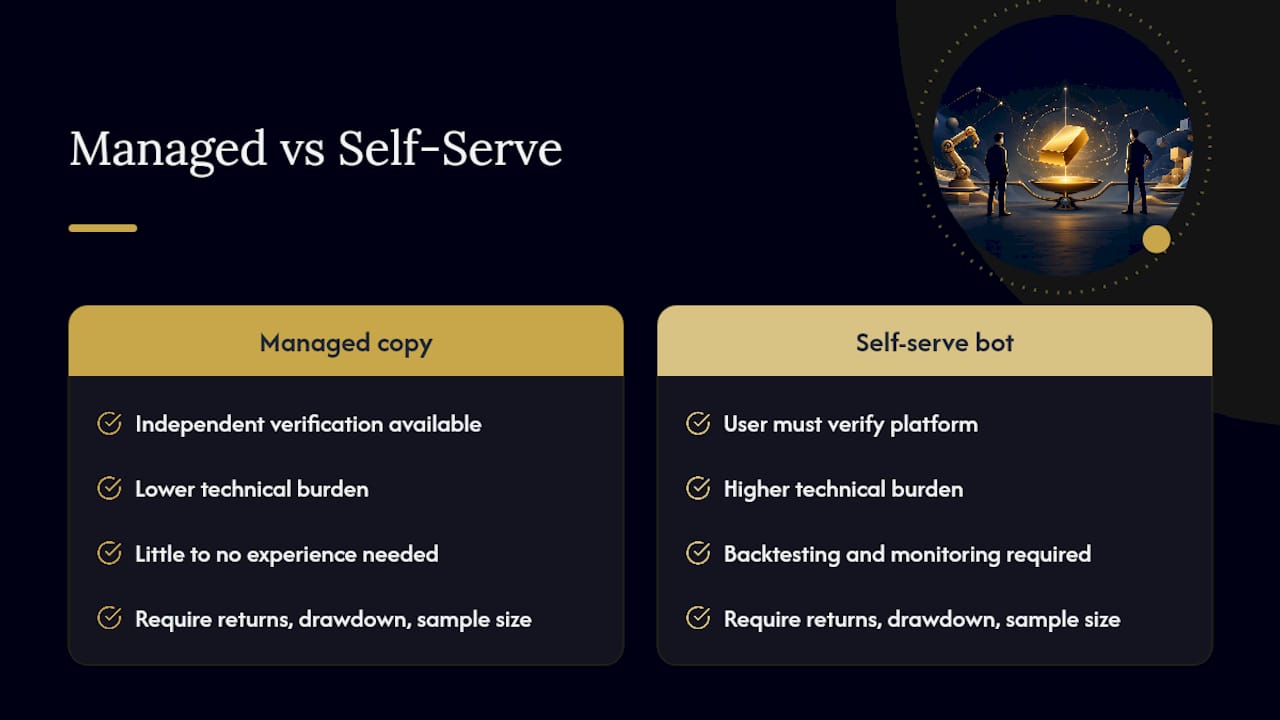
Managed Copy-Trading or a Self-Serve Bot: Which Fits You?
If you want a passive, verified strategy without ongoing technical maintenance, managed copy-trading fits better. If you have coding skills, time to monitor positions daily, and want full control over model logic, a self-serve bot may suit you.
| Factor | Managed copy-trading | Self-serve bot |
|---|---|---|
| Setup skill required | Low | Moderate to high |
| Fee structure | Profit share or subscription | Often free/open-source plus broker commissions |
| Oversight burden | Minimal, provider monitors system | Ongoing, you monitor and retrain |
| Verification | Should be independently audited | You must backtest and validate yourself |
Red flags to watch for: opaque performance claims with no audit trail on the managed side, and overfitted backtests with unrealistic execution assumptions on the self-serve side.
Before committing to either route, ask any vendor:
- Can you show independently verified results, not just a self-reported curve?
- What happens to my capital if the system disconnects or fails?
- What's the actual sample size behind your stated win rate?
Getting Started: Timeline, Steps, and Costs
The safest path to live trading runs through three stages: paper trade first, fund a small live allocation, then ramp toward your target capital over several weeks.
- Open an account with your chosen platform or broker.
- Connect COPYX or your API for automated execution.
- Run a demo period of two to four weeks before funding.
- Verify order logs match expected signal behavior.
- Start live with a defined risk percentage, often 1 to 2% per trade.
- Schedule periodic audits of drawdown and performance against your original expectations.
Expect setup itself to take under an hour, with fee structures typically built around profit-sharing, subscriptions, or standard broker spreads and commissions. A detailed deposit and funding guide walks through account activation step by step.
Why a Managed, Gold-Focused Approach Makes Sense
Most investors don't need to become gold market experts. They need a verified system that trades selectively and reports honestly. That's the standard worth holding any AI gold strategy to. For more on methodology and results, see the Sonic AI blog.

Ready to Trade Gold With a Verified AI Strategy?
Building and monitoring your own gold trading bot means backtesting, retraining, and watching execution logs every week, on top of your actual job or portfolio. Sonicaigold removes that workload by pairing a gold-only algorithm with independently verified results across 18 consecutive winning months.

The platform connects through COPYX, so trades mirror into your account automatically once you're set up, no manual entry, no constant screen time. Setup guides walk you through account activation, and a demo period lets you see the system's behavior before committing full capital. If you're ready to see how a verified gold-only strategy fits your portfolio, activate XAUUSD copy trading and start with your own risk-sized allocation.
Frequently Asked Questions
Is AI gold trading reliable for beginner investors? It can be, if the platform offers independent verification, transparent metrics, and a demo period before live funding. Managed copy-trading generally reduces the technical burden compared to running your own bot.
What win rate should I expect from an AI gold trading strategy? Win rate alone tells you little without drawdown and sample size attached. A stated win rate should always come with net returns, maximum drawdown, and the number of trades behind it.
Do I need trading experience to use AI gold trading tools? Not for managed copy-trading, since the strategy and execution are handled for you. Self-serve bots require more hands-on monitoring, backtesting knowledge, and comfort with API connections.
How much capital do I need to start with AI gold trading? Most platforms let you start with a small test allocation before scaling. The exact minimum depends on the broker and platform, so check funding requirements directly before committing your target capital.
This article is general information, not a substitute for advice from a qualified financial advisor. Consult a qualified financial professional about your own circumstances before acting on anything here.
Sources
- zero-was-here/tradingbot